Physics · Ch 5 — Work, Energy and Power
Work
Work
The Physics Definition of Work
In everyday language, "work" means any physical or mental effort. In physics, the meaning is far more precise and narrow. Work is done only when a force actually causes a displacement. If nothing moves, no work is done in the physics sense, even if you feel exhausted.
Consider a constant force acting on an object of mass . The object undergoes a displacement in the positive x-direction. The work done by the force is defined as the product of the component of the force in the direction of the displacement and the magnitude of that displacement.
If is the angle between the force vector and the displacement vector , then the component of along is . The work is therefore:
This is the scalar product (also called the dot product) of the force and displacement vectors:
This single equation contains the entire definition. The angle is the key. It determines not only how much work is done, but whether that work is positive, negative, or zero.
When is Work Zero?
The definition makes it clear that work can be zero in three distinct situations.
1. Zero Displacement ()
If there is no displacement, no work is done, regardless of how large the force is. Pushing hard against a rigid brick wall does no work on the wall because the wall does not move. Your muscles are contracting and relaxing, internal energy is being used, and you get tired — but in the physics sense, you have done zero work on the wall. A weightlifter holding a 150 kg mass steadily on his shoulders for 30 seconds does no work on the load during that time, because the load's displacement is zero.
2. Zero Force ()
If no force acts on an object, no work is done. A block moving on a perfectly smooth horizontal table experiences no horizontal force (assuming no friction). It may slide a large distance, but no work is done on it by any horizontal force.
3. Force Perpendicular to Displacement (, )
When the force is perpendicular to the displacement, the component of force along the displacement is zero, and so the work done is zero. For the block on the smooth horizontal table, the gravitational force acts vertically downward, while the displacement is horizontal. Since , gravity does no work on the block.
A more striking example is the Moon's orbit around the Earth. If we assume the orbit is perfectly circular, the Earth's gravitational force on the Moon is always directed radially inward (towards the Earth's centre). The Moon's instantaneous displacement is always tangential to its circular path. The force and displacement are therefore perpendicular at every instant, so the Earth's gravitational force does no work on the Moon.
A common mistake is to think that if you are tired, you must have done work. Fatigue is a biological phenomenon involving internal energy consumption in your muscles. It is not a measure of the physics work done on an external object.
Positive and Negative Work
Work is a scalar quantity, but it can be positive or negative. The sign is determined entirely by the angle between the force and the displacement.
-
Positive work (): When is between and , is positive. The force has a component in the same direction as the displacement. The force is helping the motion. For example, when you pull a box forward, the force you apply does positive work.
-
Negative work (): When is between and , is negative. The force has a component opposite to the direction of the displacement. The force is opposing the motion. The most common example is friction. When a block slides across a rough surface, the frictional force acts opposite to the displacement, so and . The work done by friction is negative.
-
Zero work (): As discussed above, the force is perpendicular to the displacement.
Units and Dimensions of Work
From the equation , the dimensions of work are the same as the dimensions of force multiplied by displacement.
Work and energy have the same dimensions. The SI unit of work (and energy) is the joule (J), named after the British physicist James Prescott Joule. One joule is the work done when a force of one newton displaces an object by one metre in the direction of the force: .
Since work and energy are such fundamental concepts, many alternative units exist. The table below lists some of them and their equivalent values in joules.
| Unit | Symbol | Equivalent in Joules (J) |
|---|---|---|
| erg | erg | J |
| electron volt | eV | J |
| calorie | cal | J |
| kilowatt-hour | kWh | J |
Work and Newton's Third Law: A Key Lesson
Consider a cyclist who skids to a stop in a distance of 10 m. During the skid, the road exerts a stopping (frictional) force of 200 N on the cycle, directly opposite to the direction of motion.
(a) Work done by the road on the cycle: …
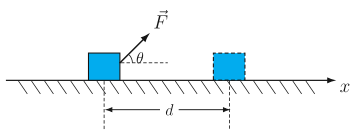
Drawn by us to help you understand the concept clearly, and verified to make sure it's accurate. For exams, practice from your textbook's own diagram.
Fig. 5.2 is the textbook’s first concrete picture of work done by a force. It shows a blue block resting on a hatched horizontal surface — the hatching tells you the surface is present but not the focus; the block is the system we care about. A force is drawn as an arrow pointing up and to the right, making an angle with the horizontal. A dashed outline of the block further to the right marks where the block ends up after it has been displaced. A dimension line with the label runs from the centre of the original block to the centre of the dashed outline, showing the magnitude of the displacement.
The physical idea is simple but precise: when a force acts on an object and the object moves, only the part of the force that acts along the direction of motion actually contributes to what we call work. The force here has two components — one horizontal (parallel to ) and one vertical (perpendicular to ). The vertical component does not help the block slide across the surface; it only tries to lift it. The horizontal component, , is the effective force that pushes the block through the displacement.
The textbook uses this figure to define work as the product of the displacement and the component of the force in the direction of that displacement:
Here is the magnitude of the applied force (in newtons), is the magnitude of the displacement (in metres), and is the angle between the force vector and the displacement vector. The result is the work done by the force on the object, measured in joules ().
A common mistake is to plug in the full force without accounting for the angle. If the force is perpendicular to the displacement (), and the work is zero — no matter how large the force is. Pushing vertically down on a car that moves horizontally does no work on the car. …