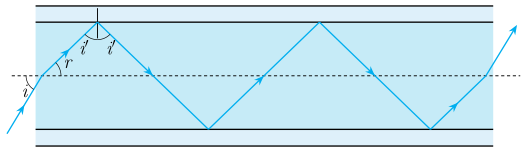
Total Internal Reflection: When Light Decides to Stay Home
Imagine you're running on a beach toward the water. On sand, you run fast. The moment you hit the water, your speed drops — the water "resists" more. If you run at a shallow angle toward the waterline, your legs will suddenly slow down, and your body will twist. That twist is refraction — light bending when it changes speed between two media.
Now imagine the reverse: you're swimming in the water, heading toward the shore. You're moving slower in water, and you want to get out onto the fast sand. If you approach the shore at a very shallow angle — almost parallel to the beach — you might never make it out. The sudden speed-up as you hit the sand could "reflect" you back into the water. That's the intuition for total internal reflection.
The Core Idea
Light normally passes from one transparent medium to another (say, from water to air) and bends away from the normal — because it speeds up. But if the angle of incidence in the slower medium is large enough, the light can't escape. It gets completely reflected back inside the first medium. No light transmits. That's total internal reflection.
Total internal reflection (TIR) occurs only when light travels from a denser (slower) medium to a rarer (faster) medium, and the angle of incidence exceeds a critical value.
The Two Conditions (Memorise These)
For TIR to happen, both must be true:
-
Light must go from a denser medium to a rarer medium (e.g., glass → air, water → air, diamond → air).
Denser means higher refractive index (n). Light slows down in a denser medium.
-
Angle of incidence (i) must be greater than the critical angle (C).
The critical angle is the angle of incidence in the denser medium for which the angle of refraction in the rarer medium is exactly 90∘.
The Critical Angle — The Tipping Point
Look at the diagram in your mind: a ray in water heading toward the surface. As you increase the angle of incidence, the refracted ray in air bends more and more away from the normal. At some specific angle C, the refracted ray skims exactly along the surface — angle of refraction =90∘.
sinC=ndensernrarer
For water (n=1.33) to air (n=1.00):
sinC=1.331.00≈0.75⇒C≈48.6∘
So if you shine a light from water into air at an angle greater than about 49∘ from the normal, the light will not leave the water at all. It reflects back down — perfectly.
What Actually Happens at the Boundary?
- i<C: Most light refracts out; a little reflects (normal partial reflection).
- i=C: Refracted ray grazes the surface; transmitted intensity is nearly zero.
- i>C: No transmitted ray. All the light energy reflects back into the denser medium. The reflection is 100% — no absorption, no transmission.
TIR is not the same as ordinary reflection from a mirror. In TIR, there is no silvering or coating. The reflection happens because the wave cannot exist in the rarer medium — it's forced back. This gives perfect reflection with zero energy loss, unlike a metal mirror which absorbs some light.
--- …