Q.Give the schematic representation of Hatch and Slack Pathway. What is its Significance ? OR Where does glycolysis occur in a cell ? Give schematic representation of various steps of Glycolysis.
You're viewing a preview — the full solution, concept, methods & PYQ mapping are locked.
Start your 14-day free trial to unlock the full solution →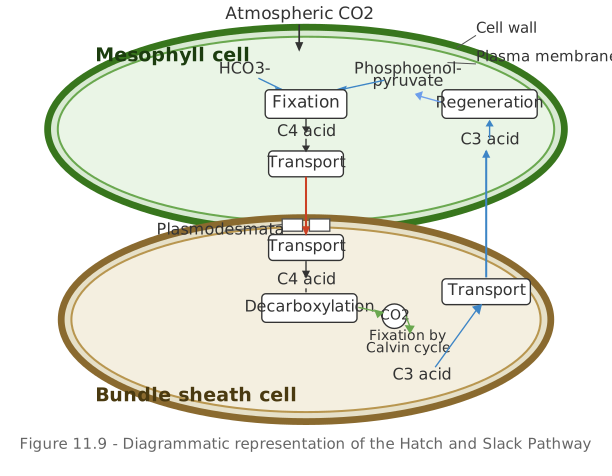
The Hatch and Slack (C4) Pathway is a two-cell-type CO2-fixation mechanism (mesophyll → bundle sheath) that concentrates CO2 around RuBisCO, suppressing photorespiration and making C4 plants highly efficient photosynthesisers in hot, dry, high-light habitats.
Schematic representation of the Hatch and Slack (C4) Pathway:
C4 plants have a characteristic leaf anatomy called Kranz anatomy, where vascular bundles are surrounded by large bundle sheath cells, which in turn are surrounded by mesophyll cells. The pathway operates across these two cell types:
-
In mesophyll cells: atmospheric CO2 (as HCO3-) is first accepted by a 3-carbon compound, phosphoenolpyruvate (PEP), in a reaction catalysed by the enzyme PEP carboxylase (PEPcase). This produces the 4-carbon compound oxaloacetic acid (OAA) — hence the name "C4 pathway".
CO2 + PEP --(PEPcase)--> OAA (4C)
-
OAA is then converted into another 4-carbon acid, either malate or aspartate.
-
Transport: this 4-carbon acid (malate/aspartate) is transported from the mesophyll cell into the adjoining bundle sheath cell.
-
In bundle sheath cells: the 4-carbon acid is broken down (decarboxylated) to release CO2 and a 3-carbon compound (pyruvate).
Malate/Aspartate --> CO2 + Pyruvate (3C)
-
The released CO2 now enters the standard Calvin cycle (C3 pathway) inside the bundle sheath chloroplasts, where it is fixed by RuBisCO onto RuBP, exactly as in a normal C3 plant.
-
The 3-carbon pyruvate is transported back to the mesophyll cell, where it is converted back to PEP (using ATP), regenerating the CO2 acceptor and completing the cycle.
Significance of the C4/Hatch-Slack pathway:
- It acts as a "CO2-pump", concentrating CO2 to a high level specifically around RuBisCO in the bundle sheath cells. …
Unlock everything free for 14 days
- Full step-by-step solutions
- Concept-first explanations
- Methods, shortcuts & mistakes
- PYQ mapping + timed mock tests
Full access for 14 days. No credit card required.