Question of 16
Q.Draw a labelled diagrammatic sketch of Male Reproductive System of a Frog.
Jammu Kashmir JkboseJammu and Kashmir Board of School Education (Class 11) 2025Subjective· 2mImportance★★★★★
0% · 0/16 Questions
You're viewing a preview — the full solution, concept, methods & PYQ mapping are locked.
Start your 14-day free trial to unlock the full solution →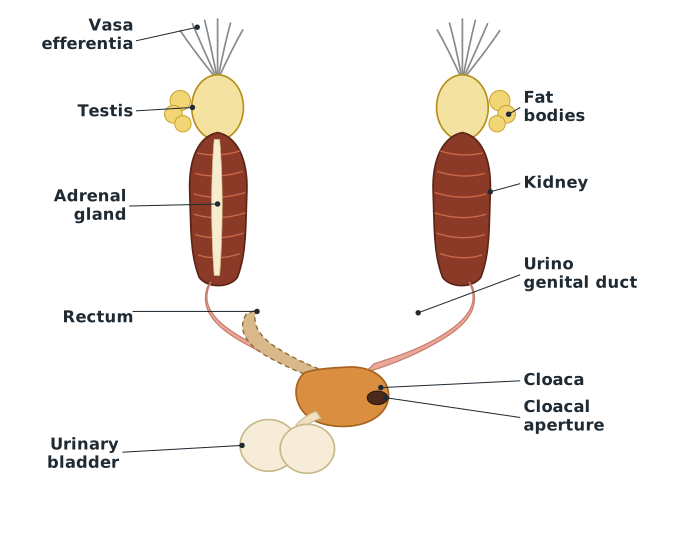
The frog's male reproductive system consists of a pair of testes, vasa efferentia, kidneys (with Bidder's canal), the ureter acting as a urinogenital duct, and a cloaca — described here part by part since an actual sketch cannot be rendered in text.
Since this is a 'draw and label' question, the description below lists every structure a correct labelled sketch should include, in the order they would be labelled from anterior to posterior:
- Testes — a pair of small, oval, yellowish-white bodies lying on the ventral surface of the kidneys, suspended by a fold of peritoneum called the mesorchium. They produce sperm.
- Vasa efferentia — a number of fine, thread-like ducts that arise from each testis and pass into the adjacent kidney.
- Bidder's canal — a longitudinal canal running along the outer border of each kidney, into which the vasa efferentia open; it collects sperm and passes them into the kidney's uriniferous tubules.
- Ureter (urinogenital duct) — in the male frog, the ureter carries both urine (from the kidney) and sperm (from Bidder's canal) — it therefore functions as a common urinogenital duct, and opens into the cloaca.
- Urinary bladder — a thin-walled, bilobed sac that opens ventrally into the cloaca and temporarily stores urine (and, indirectly, receives no sperm — sperm bypass it via the ureter). …
Unlock everything free for 14 days
- Full step-by-step solutions
- Concept-first explanations
- Methods, shortcuts & mistakes
- PYQ mapping + timed mock tests
Full access for 14 days. No credit card required.