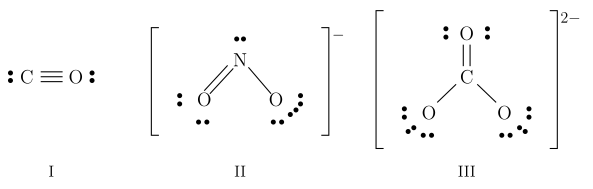
Why do we need Lewis dot structures?
Atoms are held together in molecules by chemical bonds — but what exactly is a bond? In the early 20th century, Gilbert N. Lewis realised that the key lies in the valence electrons (the outermost electrons). He noticed that atoms of noble gases (like Ne, Ar) are extremely stable and unreactive, and they all have 8 electrons in their outermost shell (except helium, which has 2). This led to the octet rule: atoms tend to gain, lose, or share electrons to achieve a full outer shell of 8 electrons (or 2 for hydrogen).
Lewis dot structures are simply a shorthand picture of this idea. They show:
- Which atoms are connected to which
- How many valence electrons each atom contributes
- How those electrons are arranged as bonding pairs (shared) or lone pairs (unshared)
The precise statement
A Lewis dot structure (or electron dot structure) represents the valence electrons of an atom or molecule using dots placed around the element's symbol. Each dot stands for one valence electron. Shared pairs (bonds) are shown as lines, and unshared pairs as pairs of dots.
For a single atom, you write the element symbol and place dots on its four sides (top, bottom, left, right) — up to 8 dots. The order of filling doesn't matter for the final picture, but conventionally you place one dot on each side first, then pair them up.
For example:
- Carbon (group 14, 4 valence electrons): ⋅C⋅ (four single dots)
- Oxygen (group 16, 6 valence electrons): ⋅O¨⋅ (two single dots and two pairs)
How to draw a Lewis structure for a molecule
Here's the step-by-step method you'll use in exams:
-
Count total valence electrons — add up valence electrons from all atoms. For ions, add 1 electron for each negative charge, subtract 1 for each positive charge.
-
Identify the central atom — usually the least electronegative element (not hydrogen or fluorine). Place it in the centre.
-
Connect atoms with single bonds — each bond uses 2 electrons. Subtract these from your total.
-
Complete octets of outer atoms — place remaining electrons as lone pairs on terminal atoms (except hydrogen, which only needs 2).
-
Place leftover electrons on the central atom — if any remain.
-
If the central atom has fewer than 8 electrons, form multiple bonds — move lone pairs from outer atoms to create double or triple bonds until the central atom has an octet.
A common mistake: forgetting that hydrogen only needs 2 electrons (a duet), not 8. Never put more than 2 electrons around H.
A concrete example: water (H₂O)
- Total valence electrons: O has 6, each H has 1 → 6+1+1=8 electrons.
- Central atom: oxygen (least electronegative after H).
- Connect: O—H bonds (2 bonds × 2 electrons = 4 electrons used).
- Remaining: 8−4=4 electrons → place as two lone pairs on oxygen.
- Check: O has 2 bonds (4 electrons) + 2 lone pairs (4 electrons) = 8. Each H has 1 bond (2 electrons) = 2. Done.
The structure: H−O¨−H
What the structure tells you
Once drawn, a Lewis structure reveals:
- Bond order (single, double, triple)
- Lone pairs (which affect molecular shape and reactivity)
- Formal charge (a bookkeeping tool to check which structure is most stable) …