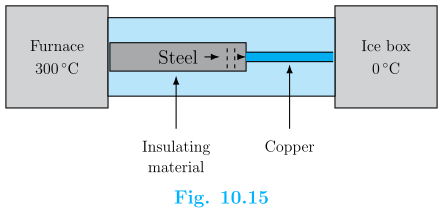
Thermal Conduction Through Bars
Imagine holding a metal rod with one end in a fire. Within seconds, the other end gets hot — even though it never touched the flame. Something travelled through the rod. That something is heat, and the process is thermal conduction.
The Intuition: What's Actually Happening?
At the microscopic level, atoms in the hot end vibrate violently. These vibrations bump into neighbouring atoms, passing energy along like a line of dominoes. In metals, free electrons also carry energy quickly — that's why a metal spoon feels cold at first (it steals heat from your hand fast) and heats up fast at the other end.
The key idea: heat flows from the hotter region to the colder region, and the rate of flow depends on three things:
- How big the temperature difference is
- How thick the bar is (cross-sectional area)
- What the bar is made of (its thermal conductivity)
The Precise Statement: Fourier's Law of Heat Conduction
For a bar of uniform cross-section, the rate of heat transfer Q/t (in joules per second, or watts) is given by:
tQ=kALT1−T2
Where:
- Q/t = rate of heat flow (W)
- k = thermal conductivity of the material (W/m·K) — a property like "how good is this at conducting heat"
- A = cross-sectional area of the bar (m²)
- T1−T2 = temperature difference between the hot end and cold end (K or °C)
- L = length of the bar (m)
The formula assumes steady state — temperatures at each end are constant, and heat flows at a constant rate. No heat is lost from the sides of the bar (perfect insulation).
Why It Makes Sense
Think of the bar as a pipe for heat. A wider pipe (larger A) lets more heat through. A longer pipe (larger L) makes it harder for heat to travel — like walking a longer corridor. A bigger temperature difference (T1−T2) is like a steeper hill — heat flows faster downhill.
The material constant k is the "conductivity" of the bar. Copper has k≈400 W/m·K, wood has k≈0.1 W/m·K. That's why a copper rod feels cold to touch (it pulls heat from your hand) while wood at the same temperature feels neutral.
A Worked Example
A copper rod (k=400 W/m·K) is 0.5 m long with cross-sectional area 2×10⁻⁴ m². One end is at 100°C, the other at 20°C. Find the heat flow.
tQ=400×(2×10−4)×0.5100−20
=400×2×10−4×160
=400×0.032=12.8 W
So 12.8 joules of heat flow through the rod every second. …