Q.What would be the number of chromosome in the spermatids?
Concept understanding — Hormonal Regulation Spermatogenesis
Let’s begin with an everyday picture. Think of a factory that produces a specific product — say, a car factory. The factory doesn’t just run on its own; it needs a central command centre that sends signals to start production, keep it steady, and stop it when enough cars are made. In the male body, the “factory” is the testes, and the “product” is sperm. The command centre is the brain — specifically two tiny glands: the hypothalamus and the pituitary gland. The signals they send are hormones (chemical messengers that travel through the blood).
Hormonal regulation of spermatogenesis means that the entire process of sperm production is controlled by a chain of hormones, each one triggering or suppressing the next. This ensures that sperm are made at the right time, in the right quantity, and that the body doesn’t overproduce them.
The Hormonal Chain (Step by Step)
-
Hypothalamus releases GnRH
The hypothalamus, a region at the base of the brain, secretes Gonadotropin-Releasing Hormone (GnRH). This is the “start” signal. GnRH travels a short distance to the pituitary gland, telling it to get ready.
-
Pituitary releases two key hormones
In response to GnRH, the anterior pituitary releases two hormones into the bloodstream:
- LH (Luteinizing Hormone) — targets the Leydig cells in the testes.
- FSH (Follicle-Stimulating Hormone) — targets the Sertoli cells in the seminiferous tubules (the actual “assembly line” where sperm are made).
-
LH stimulates testosterone production
Leydig cells, when activated by LH, produce testosterone. Testosterone is the main male sex hormone and is absolutely essential for spermatogenesis. It acts directly on the seminiferous tubules to drive sperm production.
-
FSH supports the Sertoli cells
Sertoli cells are like the “nourishers” and “quality controllers” inside the tubules. FSH makes them produce nutrients and other factors that help developing sperm cells survive and mature. Sertoli cells also convert some testosterone into a more active form.
Both LH and FSH are needed for normal sperm production. LH provides the fuel (testosterone), and FSH ensures the assembly line runs smoothly. If either is missing, spermatogenesis slows down or stops.
The Feedback Loop (Why It Doesn’t Go Wild)
The body hates waste. If too much testosterone is produced, it sends a message back to the brain to slow down. This is called negative feedback.
- High testosterone in the blood signals the hypothalamus to reduce GnRH release, and the pituitary to reduce LH and FSH release.
- Low testosterone does the opposite — the brain increases GnRH, LH, and FSH to boost production.
This keeps testosterone levels within a narrow, healthy range. Sertoli cells also produce a hormone called inhibin, which specifically suppresses FSH when sperm production is adequate.
Think of it like a thermostat: when the room gets warm enough, the heater turns off. When it cools, the heater turns back on. The hypothalamus and pituitary are the thermostat; testosterone is the heat.
Why This Matters (Even for a Commerce/Humanities Student)
- Fertility: If any link in this hormonal chain breaks — say, the pituitary fails to produce LH or FSH — a man may become infertile. This is why some fertility treatments involve giving synthetic FSH or LH.
- Medical context: Drugs that block GnRH (like those used in prostate cancer treatment) intentionally stop testosterone production, which also halts spermatogenesis.
- Real-world example: Anabolic steroid abuse (taking synthetic testosterone) shuts down the body’s own GnRH and LH production, leading to shrunken testes and temporary infertility.
Summary in One Line
Hypothalamus → GnRH → Pituitary → LH (→ Leydig cells → testosterone) + FSH (→ Sertoli cells) → Spermatogenesis
(with negative feedback from testosterone and inhibin to keep everything balanced)
No formulas, no numbers — just a chain of chemical commands that turns a factory on, keeps it running, and knows when to stop.
Many learners look this topic up as "Hormonal Regulation Spermatogenesis: Definition, Diagram & Examples", "Hormonal Regulation Spermatogenesis notes class 12 biology", or "NCERT biology syllabus hormonal regulation spermatogenesis". This concept is directly part of the Human Reproduction chapter in the NCERT/CBSE Class 12 Biology syllabus, and it is also an important topic for NEET and state medical/CET entrance exams, making it worth mastering for both board and competitive-exam preparation.
23 chromosomes. A spermatid is haploid, exactly like the secondary spermatocyte it comes from — the second meiotic division (which produces spermatids from secondary spermatocytes) is an EQUATIONAL division, not a reductional one, so it does not halve the chromosome number again.
A spermatid has 23 chromosomes (haploid, n) — the same haploid number as the secondary spermatocyte, since the second meiotic division does not reduce the chromosome number further.
Spermatids have 23 chromosomes — the haploid number — because meiosis II (which produces them) is an equational division, not a further reduction.
Section 2.3 traces the full lineage: a spermatogonium (46 chromosomes, diploid) undergoes mitotic multiplication, and some become primary spermatocytes (still 46). The first meiotic division (meiosis I) is the REDUCTION division — it halves the chromosome number, producing two secondary spermatocytes, each with 23 chromosomes (haploid).
The secondary spermatocytes then undergo the second meiotic division (meiosis II) to form spermatids. Meiosis II is an EQUATIONAL division — like an ordinary mitosis, it separates sister chromatids but does not halve the chromosome number again. So each of the four spermatids produced from one primary spermatocyte retains the same haploid chromosome number as the secondary spermatocyte: 23 chromosomes.
This is exactly what Figure 2.8(a)'s own chromosome-number column shows: 46 (spermatogonia/primary spermatocyte) -> 23 (secondary spermatocyte) -> 23 (spermatids) -> 23 (spermatozoa, after spermiogenesis just repackages the same haploid nucleus).
Each spermatid has 23 chromosomes — the haploid number, unchanged from the secondary spermatocyte, since meiosis II does not reduce the chromosome number further.
- JKBOSE Class 12 Annual Regular Examination 2021Set ZOOLOGY_B5 marksQ.Define Asexual reproduction, mention various methods of Asexual reproduction. Describe any three of them. OR Define Gametogenesis. Explain the steps involved in the process of spermatogenesis.
›Reveal solutionSolution
Asexual reproduction produces clonal offspring from a single parent (e.g., fission, budding, fragmentation); alternatively, spermatogenesis is the meiotic, hormone-regulated formation of sperm from spermatogonia in the seminiferous tubules.
A note on scope: the 'Asexual Reproduction' half of this question belongs to the topic 'Reproduction in Organisms', a chapter that has been dropped from the current rationalised NCERT syllabus (it is retained here as basic biology background, since it is a standard OR alternative in this paper). The Gametogenesis/spermatogenesis half is fully within the current Human Reproduction chapter.
Option 1 — Asexual Reproduction:
Asexual reproduction is a mode of reproduction involving a single parent, in which offspring are produced without the fusion of gametes, and are genetically identical to the parent (clones).
Methods of asexual reproduction include: fission (binary and multiple), budding, fragmentation, spore formation, and vegetative propagation. Any three, described:
- Fission: The parent organism divides into two (binary fission, e.g., Amoeba, Paramecium — divides into two equal daughter cells) or many (multiple fission, e.g., Plasmodium — the parent divides simultaneously into many daughter individuals under favourable conditions).
- Budding: A small outgrowth called a bud develops on the parent body (e.g., Hydra), grows by repeated mitotic divisions, and eventually detaches to form a new independent individual; in yeast, small buds are produced that separate from the parent cell.
- Fragmentation: The parent body breaks into two or more fragments (e.g., Spirogyra, a filamentous alga), and each fragment grows into a new, complete individual.
Option 2 — Gametogenesis & Spermatogenesis:
Gametogenesis is the biological process by which diploid (2n) germ cells undergo meiosis to form haploid (n) gametes (sperm in males, ova in females).
Spermatogenesis (its male form) occurs in the seminiferous tubules of the testis, beginning at puberty, and proceeds as follows:
- Spermatogonia (2n), present along the inner wall of the seminiferous tubule, multiply by mitosis to increase in number.
- Some spermatogonia periodically enlarge to become primary spermatocytes (2n).
- Each primary spermatocyte undergoes the first meiotic division (meiosis I, reductional) to form two secondary spermatocytes (n, haploid).
- The secondary spermatocytes undergo the second meiotic division (meiosis II, equational) to produce four haploid spermatids.
- Spermatids are transformed into mature, motile spermatozoa through the process of spermiogenesis (development of the acrosome, condensation of the nucleus, formation of a flagellar tail, and loss of most cytoplasm).
- Finally, sperm heads become embedded in the Sertoli cells and are later released into the lumen of the seminiferous tubule — a process called spermiation.
This entire process is regulated hormonally: the hypothalamus secretes GnRH, which stimulates the pituitary to release LH (acts on Leydig cells → testosterone secretion) and FSH (acts on Sertoli cells → stimulates spermiogenesis); testosterone in turn stimulates the process of spermatogenesis.
✓Final answerAsexual reproduction (single parent, no gamete fusion) occurs by fission, budding, and fragmentation, described above. (OR: Spermatogenesis converts diploid spermatogonia into haploid spermatozoa via meiosis I & II followed by spermiogenesis, regulated by GnRH–LH–FSH–testosterone.)
- JKBOSE Class 12 Annual Regular Examination 2019Set ZOOLOGY5 marksQ.Define Gametogenesis. Explain in brief with diagrammatic representation the stages of Spermatogenesis. OR With the help of neat and labelled diagram describe in brief human male reproductive system.
›Reveal solutionSolution
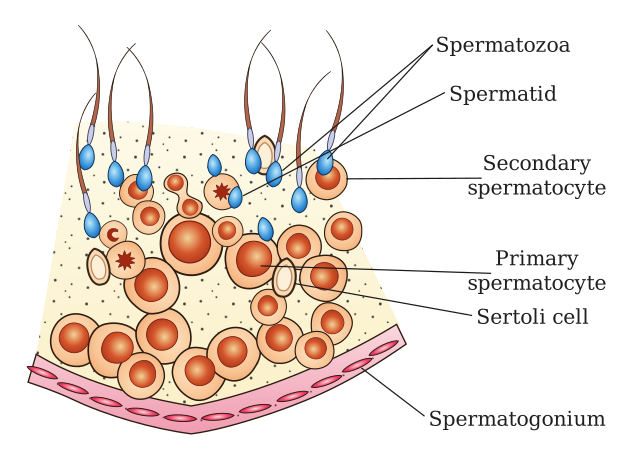
Figure — The primary alternative asks for a diagrammatic representation of the stages of spermatogenesis, and the answe Gametogenesis forms haploid gametes by meiosis; spermatogenesis converts diploid spermatogonia into four haploid spermatozoa via mitotic multiplication, growth, meiotic maturation and spermiogenesis. The alternative answer describes the structure of the human male reproductive system.
Gametogenesis
Gametogenesis is the biological process by which the diploid germ cells of the gonads (testis in males, ovary in females) undergo meiosis to produce haploid gametes — spermatozoa in the male and ova in the female. Because it involves meiosis (a reductional division), the chromosome number is halved, so that fertilisation of two gametes restores the diploid number in the offspring.
Spermatogenesis — stages
Spermatogenesis occurs in the seminiferous tubules of the testis and passes through the following phases:
- Multiplication phase: The undifferentiated germ cells, spermatogonia (2n), located at the periphery (basal membrane) of the seminiferous tubule, divide repeatedly by mitosis to increase in number.
- Growth phase: Some spermatogonia periodically stop dividing and increase in size to become primary spermatocytes (2n).
- Maturation phase: Each primary spermatocyte undergoes meiosis-I (reductional division) to form two haploid secondary spermatocytes (n). Each secondary spermatocyte then undergoes meiosis-II (equational division) to produce two spermatids — so one primary spermatocyte yields four haploid spermatids.
- Spermiogenesis: The rounded, non-motile spermatids are transformed into elongated, motile spermatozoa — the acrosome (from the Golgi body) caps the nucleus, the nucleus condenses, mitochondria arrange in the middle piece, a flagellum (tail) develops, and most cytoplasm is shed.
- Spermiation: The mature spermatozoa are finally released from the Sertoli cells into the lumen of the seminiferous tubule.
Diagrammatic representation (described): In a cross-section of a seminiferous tubule, cells are arranged from the outer basal membrane towards the central lumen in the order — spermatogonia (basal layer) → primary spermatocytes → secondary spermatocytes → spermatids → spermatozoa (nearest the lumen). Large, columnar Sertoli (nurse) cells span the full thickness of the tubule, nourishing the developing germ cells and secreting factors that support spermatogenesis; interstitial Leydig cells lie in the connective tissue between the tubules and secrete testosterone. (No image was supplied with this question, so the diagram is described in words above rather than drawn.)
OR — Human male reproductive system
The male reproductive system consists of:
-
A pair of testes, located outside the abdominal cavity in a pouch called the scrotum, which maintains a temperature about 2–2.5°C lower than body temperature — necessary for normal spermatogenesis. Each testis has about 250 compartments called testicular lobules, each containing one to three highly coiled seminiferous tubules where sperm are produced. The tubules are lined by germ cells and Sertoli cells; the interstitial spaces between tubules contain small Leydig cells that synthesise testosterone.
-
Accessory ducts: rete testis → vasa efferentia → epididymis (stores and matures sperm) → vas deferens (ascends and opens into the urethra along with the duct of the seminal vesicle as the ejaculatory duct) → urethra (common passage for both sperm and urine, opening through the penis).
-
Accessory glands: a pair of seminal vesicles and the prostate gland, plus a pair of bulbourethral (Cowper's) glands, whose secretions constitute the seminal plasma — rich in fructose, calcium and enzymes — that nourishes and provides a medium for sperm transport, and lubricates the passage.
-
External genitalia: the penis, a copulatory organ made of erectile tissue, whose enlarged end (glans penis) is covered by a fold of skin called the foreskin/prepuce.
✓Final answerGametogenesis = formation of haploid gametes by meiosis; spermatogenesis = spermatogonium (2n) → primary spermatocyte → 2 secondary spermatocytes (meiosis-I) → 4 spermatids (meiosis-II) → 4 spermatozoa (spermiogenesis). (OR: male reproductive system = testes + rete testis/vasa efferentia/epididymis/vas deferens + seminal vesicles/prostate/bulbourethral glands + penis.)
🎓Unlock everything free for 14 days
- ✓Full step-by-step solutions
- ✓Concept-first explanations
- ✓Methods, shortcuts & mistakes
- ✓PYQ mapping + timed mock tests
Full access for 14 days. No credit card required.