Chemistry · Ch 10 — Hydrocarbons
Properties
Properties
Physical Properties
Aromatic hydrocarbons are non-polar molecules. This non-polar nature governs nearly all their physical behaviour. They are usually colourless liquids or solids at room temperature, and they carry a characteristic aroma — the word "aromatic" itself comes from this property.
You are already familiar with naphthalene balls, which are used in toilets and for preserving clothes. Naphthalene has a strong, unique smell and acts as a moth repellent. This is a practical everyday example of an aromatic hydrocarbon in use.
Because they are non-polar, aromatic hydrocarbons are immiscible with water (like oil and water). However, they dissolve readily in organic solvents such as ether, benzene itself, or carbon tetrachloride. When burned, they produce a sooty flame due to their high carbon content — the carbon atoms do not get fully oxidised and appear as black soot.
Chemical Properties
The chemistry of arenes (another name for aromatic hydrocarbons) is dominated by one type of reaction: electrophilic substitution. The benzene ring is rich in electrons, making it attractive to electron-seeking species (electrophiles). Under normal conditions, this is the characteristic reaction.
However, under special, more vigorous conditions, arenes can also undergo two other types of reactions:
- Addition reactions — where the ring's double bonds are broken and atoms add across them.
- Oxidation reactions — where the ring is burned or otherwise oxidised.
Electrophilic Substitution Reactions
The common electrophilic substitution reactions of arenes are nitration, halogenation, sulphonation, Friedel-Crafts alkylation, and Friedel-Crafts acylation. In every case, the attacking reagent is an electrophile, denoted as .
The general pattern
In all these reactions, a hydrogen atom on the benzene ring is replaced by the electrophile. The overall reaction is:
(i) Nitration
A nitro group () is introduced into the benzene ring. This is done by heating benzene with a mixture of concentrated nitric acid () and concentrated sulphuric acid (). This mixture is called the nitrating mixture.
Nitrobenzene
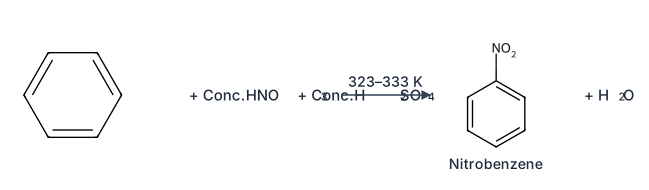
Equation 9.72 — nitration: benzene heated with the nitrating mixture (concentrated + concentrated ) at 323–333 K gives nitrobenzene and water. The attacking electrophile …
(ii) Halogenation
Arenes react with halogens (like or ) in the presence of a Lewis acid catalyst, such as anhydrous , , or , to yield haloarenes.
Chlorobenzene
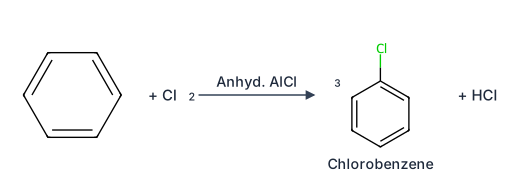
Equation 9.73 — halogenation: chlorine in the presence of anhydrous (a Lewis acid) substitutes one ring hydrogen, givin …
(iii) Sulphonation
The replacement of a hydrogen atom by a sulphonic acid group () is called sulphonation. It is carried out by heating benzene with fuming sulphuric acid (oleum), which is sulphuric acid containing dissolved sulphur trioxide ().
Benzenesulphonic acid
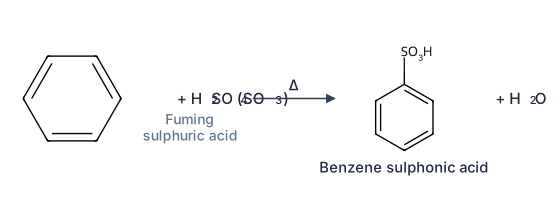
Equation 9.74 — sulphonation: heating benzene with fuming sulphuric acid ( containing ) replaces a ring hydrogen with the group, …
(iv) Friedel-Crafts Alkylation Reaction
When benzene is treated with an alkyl halide (like ) in the presence of anhydrous aluminium chloride (), an alkylbenzene is formed.
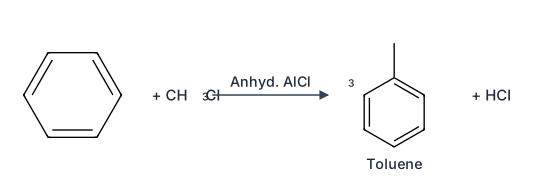
Equation 9.75 — Friedel–Crafts alkylation: benzene and methyl chloride over anhydrous give toluene and HCl. The Lewis acid generates the attacki …
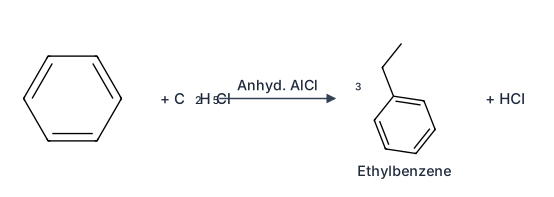
Equation 9.76 — the same Friedel–Crafts alkylation with ethyl chloride: benzene gives ethylbenzene and HCl over an …
A common exam question
Why do we get isopropyl benzene on treating benzene with 1-chloropropane instead of n-propyl benzene?
The answer lies in the mechanism. The electrophile generated is a carbocation (). The 1-chloropropane initially forms a primary carbocation (), which is unstable. It immediately rearranges to the more stable secondary carbocation () via a 1,2-hydride shift. This secondary carbocation then attacks the benzene ring, giving isopropyl benzene as the major product.
(v) Friedel-Crafts Acylation Reaction
The reaction of benzene with an acyl halide (like ) or an acid anhydride in the presence of a Lewis acid () yields an acyl benzene (a ketone).
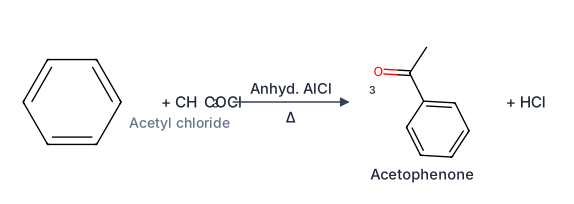
Equation 9.77 — Friedel–Crafts acylation: benzene and acetyl chloride () over anhydrous (with heating) give acetophenone (methyl phenyl ketone) and HCl; the electrophil …
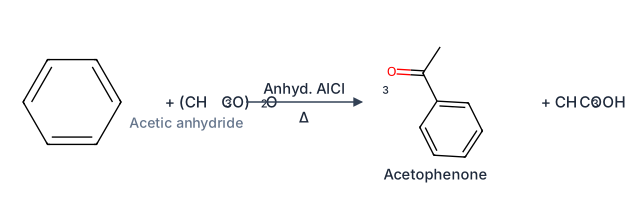
Equation 9.78 — Friedel–Crafts acylation with an acid anhydride: benzene and acetic anhydride over anhydrous give the same product, acetophenone, with ethanoic aci …
Further Substitution
If an excess of the electrophilic reagent is used, further substitution reactions can take place. Other hydrogen atoms on the benzene ring may also be successively replaced by the electrophile. For example, benzene treated with excess chlorine in the presence of anhydrous can be chlorinated all the way to hexachlorobenzene ().
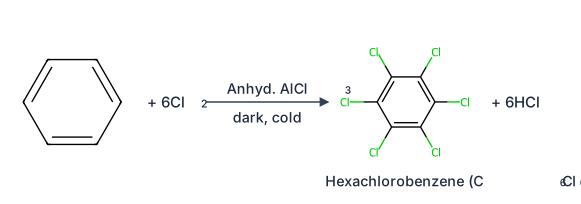
Equation 9.79 — substitution taken to completion: with excess chlorine over anhydrous in the dark and cold, all six ring hydrogens of benzene are successively replaced, giving hexachlorobenzene () and six HCl. Note the ring itself is still aromati …
Mechanism of Electrophilic Substitution Reactions
According to experimental evidence, (Substitution, Electrophilic) reactions proceed via three distinct steps:
- Generation of the electrophile ()
- Formation of a carbocation intermediate (arenium ion)
- Removal of a proton from the carbocation intermediate
›Proof
Step-by-step mechanism
Step (a): Generation of the electrophile
The Lewis acid catalyst (, ) plays a crucial role here. It combines with the attacking reagent to generate the active electrophile.
For chlorination, alkylation, and acylation: Anhydrous (a Lewis acid) accepts a lone pair from the halogen in the reagent, forming a complex that then dissociates to give the electrophile.
- Chlorination:
- Alkylation:
- Acylation: (the ion is called an acylium ion)
For nitration: The electrophile is the nitronium ion (). It is produced by a transfer of a proton from sulphuric acid to nitric acid. This is a simple acid-base equilibrium.
Step I:
Protonated nitric acid
Step II:
Nitronium ion
In this process, sulphuric acid acts as an acid (proton donor) and nitric acid acts as a base (proton acceptor).
Step (b): Formation of Carbocation (Arenium Ion)
The electrophile () attacks the electron-rich benzene ring. This results in the formation of a -complex, also called an arenium ion. In this intermediate, one of the carbon atoms (the one attacked by the electrophile) becomes hybridised.
The arenium ion is not stable, but it is stabilised by resonance. The positive charge is delocalised over three carbon atoms of the ring (the ortho and para positions relative to the point of attack).
ImportantLoss of aromaticity
The sigma complex (arenium ion) loses its aromatic character because the delocalisation of electrons is interrupted at the hybridised carbon. The ring is no longer a fully conjugated, planar system.
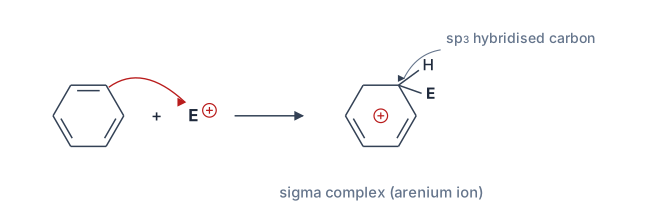
Mechanism step (b): the electrophile attacks benzene's electron-rich cloud (curved arrow), forming the sigma complex (arenium ion). The attacked carbon becomes hybridised, carrying both its hydrogen and the electrophile, while the remaining positive charge is spread over the rest of the ring — whose aro …
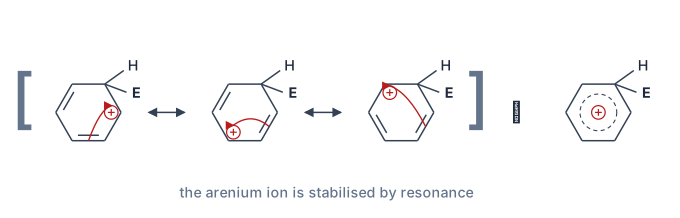
Why the unstable arenium ion survives long enough to react on: its positive charge is delocalised by resonance over the two ortho carbons and the para carbon (the three contributing structures shown, linked by curved electron-pushing arrows), equivalent to the hybrid dr …
Step (c): Removal of Proton
To restore the stable aromatic character of the ring, the -complex releases a proton () from the hybridised carbon. This proton is removed by the counter-ion present in the reaction mixture.
- In the case of halogenation, alkylation, and acylation, the proton is removed by .
- In the case of nitration, the proton is removed by .
The removal of the proton regenerates the aromatic ring and gives the final substituted product.
![Fig. removal-of-proton-mechanism-9.5.5-mechanism — Removal of proton: to restore aromaticity the sigma complex loses H+ from its sp3 hybridised carbon, taken by [AlCl4]- (halogenation, alkylation, acylation) or by [HSO4]- (nitration), leaving the substituted benzene product.](/figures/hydrocarbons/arenium-ion-proton-removal-restore-aromaticity.svg)
Mechanism step (c): to regain aromatic stability the sigma complex releases a proton from its carbon. The proton is carried off by (in halogenation, alkylation and acylation) or by (in nitration), restoring the fully de …
Addition Reactions
Under normal conditions, benzene does not undergo addition reactions because it would lose its aromatic stability. However, under vigorous conditions, addition is possible.
Hydrogenation: At high temperature and/or pressure, in the presence of a nickel catalyst, benzene adds three molecules of hydrogen to give cyclohexane.
Cyclohexane
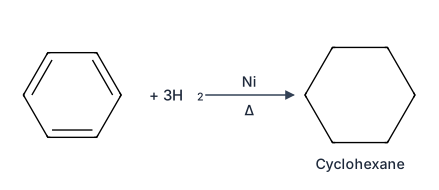
Equation 9.80 — addition forced under vigorous conditions: with a nickel catalyst and heating, benzene adds three molecules of hydrogen to give cyclohexane, a fully saturated ring. The aromatic system is destroyed, which is exac …
Halogenation (Addition): Under ultraviolet light, three molecules of chlorine add to benzene to produce benzene hexachloride (), also known as gammaxane or BHC (benzene hexachloride). This is an insecticide.
Benzene hexachloride (BHC)
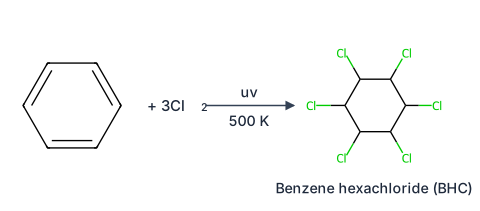
Equation 9.81 — photochemical addition: under ultraviolet light at 500 K, three chlorine molecules add across the ring to give benzene hexachloride, (BHC, gammaxane) — drawn, as in the textbook, as the saturated ring with one Cl on every carbon. This radical addition needs no L …
Combustion (Oxidation)
When heated in air (or oxygen), benzene burns with a sooty flame, producing carbon dioxide and water.
The general combustion reaction for any hydrocarbon () can be written as:
Directive Influence of a Functional Group in Monosubstituted Benzene
When a monosubstituted benzene (benzene with one group already attached) is subjected to further substitution, the three possible disubstituted products (ortho, meta, and para) are not formed in equal amounts. Two distinct types of behaviour are observed:
- The incoming group goes predominantly to the ortho and para positions.
- The incoming group goes predominantly to the meta position.
This behaviour depends entirely on the nature of the substituent already present on the ring. It does not depend on the nature of the entering group. This is known as the directive influence of substituents.
Ortho and Para Directing Groups
Groups that direct the incoming group to the ortho and para positions are called ortho and para directing groups.
›Proof
Example: The directive influence of the group (Phenol)
Phenol is a resonance hybrid of the following structures:
It is clear from these resonating structures that the electron density is more on the ortho and para positions. Therefore, substitution by an electrophile takes place mainly at these positions.
…