Q.What are Kepler's laws of planetary motion?
You're viewing a preview — the full solution, concept, methods & PYQ mapping are locked.
Start your 14-day free trial to unlock the full solution →Kepler's three empirical laws describe planetary orbits: elliptical shape, equal-area sweep rate, and .
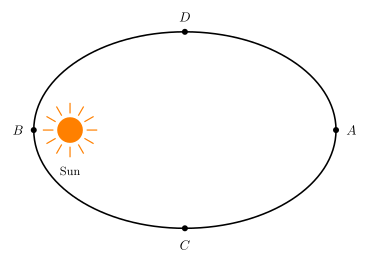
1. Law of orbits: Every planet revolves around the Sun in an elliptical orbit, with the Sun situated at one of the two foci of the ellipse (not at the centre).
2. Law of areas: The radius vector (the line joining the planet to the Sun) sweeps out equal areas in equal intervals of time — i.e. the areal velocity of a planet is constant. This is a direct consequence of the conservation of angular momentum, since the gravitational force on the planet is always directed along the radius vector (a central force), so it exerts no torque about the Sun. As a result, a planet moves fastest when it is closest to the Sun (perihelion) and slowest when farthest (aphelion).
…
Unlock everything free for 14 days
- Full step-by-step solutions
- Concept-first explanations
- Methods, shortcuts & mistakes
- PYQ mapping + timed mock tests
Full access for 14 days. No credit card required.