Q.With the help of a ray diagram, describe the construction, working of a compound microscope when the final image is formed at the least distance of distinct vision (D = 25 cm). Derive an expression for the magnifying power. (3+2)
You're viewing a preview — the full solution, concept, methods & PYQ mapping are locked.
Start your 14-day free trial to unlock the full solution →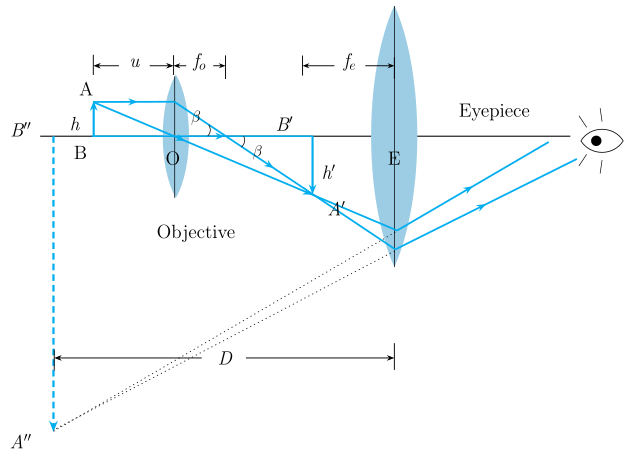
A compound microscope magnifies in two stages - a real image from the objective, then a magnified virtual image of that from the eyepiece - giving a combined magnifying power m = (L/fo)(1 + D/fe) when the final image is at the near point.
Construction: A compound microscope has two convex lenses of short focal length: the objective (very short focal length , facing the object) and the eyepiece (short focal length , close to the eye), mounted at the two ends of a tube, separated by a distance called the tube length L.
Working: The object AB is placed just beyond the focus of the objective (), so the objective forms a real, inverted, and magnified image (this is the first stage of magnification). This intermediate image then acts as the object for the eyepiece. The eyepiece is positioned so that falls within its focal length, so the eyepiece acts as a simple magnifying glass, forming a further magnified, virtual, inverted (relative to the original object) final image . For the case asked here, the eyepiece is adjusted so this final image forms at the near point (least distance of distinct vision, D = 25 cm), giving maximum magnification for that configuration (called 'normal adjustment when at D').
(Ray diagram, described): Rays from the object pass through the objective lens converging to form a real inverted image beyond region within the tube; these diverging rays from that image then strike the eyepiece and, since the image lies inside the eyepiece's focal length, emerge as a divergent bundle that appears to come from a large virtual image at distance D from the eye.
Derivation of magnifying power:
Magnifying power is the ratio of the angle subtended at the eye by the final image to the angle subtended by the object when placed at the near point (viewed directly), and it works out to be the product of the objective's linear magnification and the eyepiece's angular magnification:
…
Unlock everything free for 14 days
- Full step-by-step solutions
- Concept-first explanations
- Methods, shortcuts & mistakes
- PYQ mapping + timed mock tests
Full access for 14 days. No credit card required.