Business Studies · Ch 5 — Emerging Modes of Business
Scope of e-Business
Scope of e-Business
The scope of e-business is very wide. Almost every business function — production, finance, marketing and personnel administration — as well as managerial activities like planning, organising and controlling can be carried out over computer networks.
Another way to look at the scope is in terms of the parties involved in electronic transactions. From this angle, a firm's electronic transactions and networks extend in three directions:
- B2B — a firm's interactions with other businesses,
- B2C — a firm's interactions with its customers, and
- intra-B — a firm's internal processes.
(i) B2B Commerce (Business-to-Business)
Here both parties are business firms. Creating utilities and delivering value requires a firm to deal with many other firms — suppliers or vendors of inputs, or channel members through whom it distributes its products.
- Example: manufacturing an automobile requires the assembly of a large number of components made elsewhere, sometimes overseas. To avoid dependence on a single supplier, the automobile factory cultivates more than one vendor for each component. A network of computers is used for placing orders, monitoring production and delivery, and making payments.
- A firm can also strengthen its distribution system by exercising real-time control over stock-in-transit and stock held with middlemen at different locations — monitoring each consignment and triggering replenishment as needed. A customer's specifications can be routed through dealers to the factory and fed into the manufacturing system for customised production.
- e-commerce speeds up the movement of information, documents and, of late, money transfers. Historically, e-commerce originally meant the facilitation of B2B transactions using Electronic Data Interchange (EDI) to send and receive commercial documents such as purchase orders and invoices.
(ii) B2C Commerce (Business-to-Customers)
Here business firms are at one end and customers at the other. Online shopping comes to mind first, but 'selling' is only the outcome of the wider marketing process, which begins before a product is offered for sale and continues after it is sold. B2C therefore covers a whole range of marketing activities — identifying customers, promotion and sometimes even delivery of products (e.g., music or films delivered online) — at much lower cost but higher speed. It also lets a firm stay in touch with customers round the clock and run online surveys to learn who is buying what and how satisfied they are.
Benefits of e-Commerce
To the business organisation:
- Expands the marketplace to national and international markets
- Gradual decline in the cost of operations
- Facilitates 'pull'-type supply chain management
- Competitive advantage over rivals
- Proper time management and support to business processes
- Small firms can co-exist with big firms (a win-win)
To consumers and society:
- Flexibility
- Competitive prices, discounts and waive-offs
- More options, choices and customised products
- Quick and timely delivery (especially of digitised products)
- Employment potential
- Facilitates e-Auctions and e-Tenders
- Interaction with consumers
- Wider outreach
ATM speeds up withdrawal of money. Withdrawing one's own money from a bank used to be a tedious process full of formalities. With ATMs, the customer withdraws the money first and the back-end processes take place later — a good illustration of how e-commerce speeds up the whole B2C process.
(iii) Intra-B Commerce (within a firm)
Here the parties are within the same business firm. This marks a key difference between e-commerce and e-business: e-commerce is a firm's interaction with its suppliers/distributors (B2B) and customers (B2C) over the internet, whereas e-business is wider and also includes the use of the intranet to manage dealings among departments and persons inside the firm.
- Intra-B commerce makes flexible manufacturing possible — the marketing department can interact constantly with production to get customised products made to individual customer requirements.
- Closer computer-based interaction among departments improves inventory and cash management, plant and machinery utilisation, order handling and human resource management.
- Just as an intercom carried voice within an office, the intranet carries multimedia and even 3-D graphic communication among units, allowing better coordination, faster decisions and speedier workflows.
- B2E (Business-to-Employees): recruitment, interviewing, selection, training, development and education conducted electronically (captured in the phrase 'e-learning'). Employees use electronic catalogues and order forms, access inventory data, and send field reports by e-mail on a real-time basis. With Virtual Private Network (VPN) technology the office effectively 'goes to' the employee — people can work from wherever they are, at their own speed and convenience, and meetings are held online via tele/video conferencing.
- C2B (Consumer-to-Business), the corollary of B2C, gives consumers the freedom of 'shopping at will'. Customers can use company call centres to make toll-free queries and lodge complaints round the clock at no extra cost — and such call centres need not be set up in-house; they can be outsourced (discussed later under BPO).
(iv) C2C Commerce (Consumer-to-Consumer)
Here the business originates from a consumer and ends with consumers. It suits goods for which there is no established market mechanism — for example, selling used books or clothes for cash or by barter. The internet lets a person search globally for potential buyers, and e-commerce technology provides market-system security that would otherwise be missing in anonymous one-to-one dealings.
- eBay is a classic example, where consumers sell goods and services to other consumers. To make such trade secure and robust, technologies have emerged:
- Mutual rating — buyers and sellers rate one another, so a prospective buyer can see that one seller has sold to over 2,000 customers all rating it excellent, while another has sold only four times with all four rating it poorly.
- Payment intermediary — for example PayPal: instead of paying an unknown, untrusted seller directly, the buyer sends money to PayPal, which holds it and notifies the seller, releasing it only after the goods are shipped and accepted.
- C2C also enables consumer forums and pressure groups (such as Yahoo groups). Just as a driver stuck in a jam can warn others over FM radio, an aggrieved customer can share a bad experience with a product, service or vendor and warn the whole group — and the resulting group pressure may force a solution.
e-Business versus Traditional Business
e-enabling has radically transformed how business is done. A point-by-point comparison of traditional business and e-business is given in Table 5.1 (presented under 'Ethical fallouts'), and it points to the distinct benefits and limitations of e-business discussed in the following sections.
Flexible manufacturing and mass customisation
Customised products were traditionally made to order by craftsmen — expensive and slow to deliver. The Industrial Revolution enabled mass production of homogeneous goods at low cost through economies of scale. Thanks to e-commerce, firms can now offer customised products and services at low cost — combining the best of both worlds. Illustrative examples:
- 401(k) Forum (US) — customises educational content and investment advice from individual interviews. …
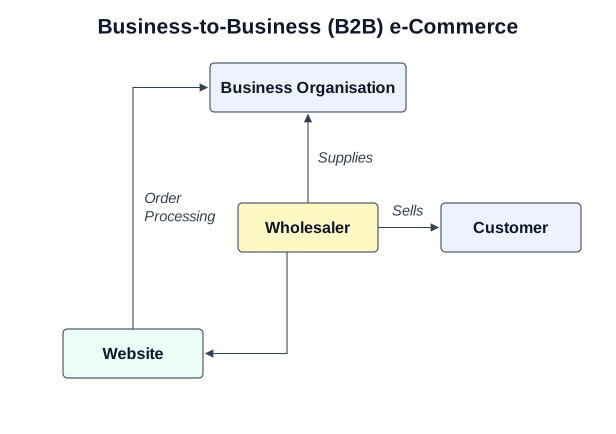
Drawn by us to help you understand the concept clearly, and verified to make sure it's accurate. For exams, practice from your textbook's own diagram.
What the Figure Shows
Our own schematic of a business-to-business (B2B) e-commerce flow — how a business organisation, a wholesaler, its website and the customer connect, with the suppl …
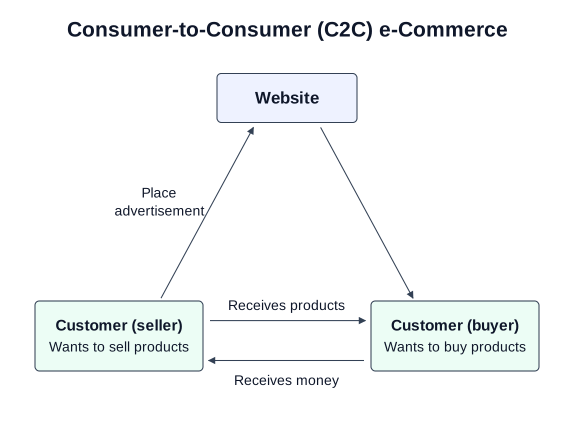
Drawn by us to help you understand the concept clearly, and verified to make sure it's accurate. For exams, practice from your textbook's own diagram.
What the Figure Shows
Our own schematic of a consumer-to-consumer (C2C) e-commerce flow — a customer who wants to sell advertises on a website, another customer buys, and prod …