Biology · Ch 2 — Biological Classification
Kingdom Monera
Kingdom Monera
Bacteria are the sole members of the Kingdom Monera. They are the most abundant micro-organisms on the planet and occur almost everywhere. Hundreds of bacteria are present in just a handful of soil, and they also thrive in extreme habitats such as hot springs, deserts, snow and deep oceans where very few other life forms can survive. Many live in or on other organisms as parasites.
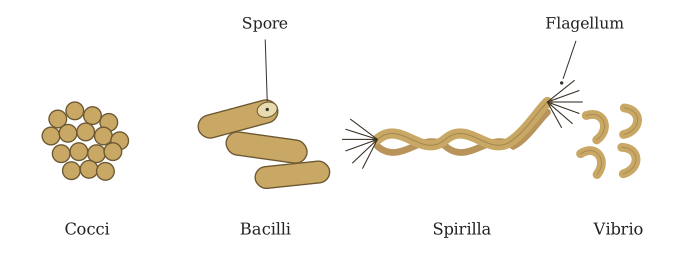
Bacteria are grouped under four categories on the basis of their shape:
- the spherical Coccus (plural: cocci)
- the rod-shaped Bacillus (plural: bacilli)
- the comma-shaped Vibrium (plural: vibrio)
- the spiral Spirillum (plural: spirilla)
Though the bacterial structure is very simple, bacteria are very complex in behaviour. Compared to many other organisms, bacteria as a group show the most extensive metabolic diversity. Some bacteria are autotrophic — they synthesise their own food from inorganic substrates, and may be either photosynthetic autotrophic or chemosynthetic autotrophic. The vast majority of bacteria, however, are heterotrophs: they depend on other organisms or on dead organic matter for their food.
Bacteria reproduce mainly by fission. Sometimes, under unfavourable conditions, they produce spores. They can also reproduce by a primitive kind of sexual reproduction, in which DNA is transferred from one bacterium to another. …
Drawn by us to help you understand the concept clearly, and verified to make sure it's accurate. For exams, practice from your textbook's own diagram.
Bacteria are grouped into four categories on the basis of their shape, and this figure shows all four side by side. The cocci are spherical and are seen clustered as small round cells. The bacilli are rod-shaped; the illustration also marks a spore, an internal resistant body formed under unfavourable conditions, and some cells carry a flagellum, the thread-like structure used for movement. The spirilla are spiral or coiled forms, drawn as long twisted filaments bearing flagella. The vibrio are comma-shaped, curved cells. Together these shapes — coccus, bacillus, spirillum and vibrium — represent the basic external …