Biology · Ch 9 — Biomolecules
How to Analyse Chemical Composition?
How to Analyse Chemical Composition?
Every living organism is built from carbon compounds, and the way biologists find out exactly which compounds are present is by doing a chemical analysis of the tissue.
Extracting the compounds
Take any living tissue — a vegetable, a piece of liver, a leaf — and grind it in trichloroacetic acid (written as Cl3CCOOH) with a mortar and pestle. This produces a thick slurry. If that slurry is strained through cheesecloth or cotton, it separates into two parts:
- The filtrate, technically called the acid-soluble pool.
- The retentate, or the acid-insoluble fraction.
When scientists have examined the acid-soluble pool, they have found thousands of different organic compounds in it. In higher classes you learn the details, but the basic idea is simple: you extract the compounds, then apply various separation techniques until one compound is separated from all the others — in other words, you isolate and purify it. Once a compound is pure, analytical techniques reveal its molecular formula and its likely structure. Any carbon compound obtained from living tissue in this way can be called a biomolecule.
Finding the inorganic part
Living organisms also contain inorganic elements and compounds, and a different, destructive experiment shows this. First weigh a small amount of fresh tissue (its wet weight) and dry it so that all the water evaporates; what is left is the dry weight. Now burn the dried tissue completely. All the carbon compounds are oxidised into gases (carbon dioxide and water vapour) and escape. What remains is the ash, which contains inorganic elements such as calcium and magnesium. Inorganic compounds such as sulphate and phosphate also turn up in the acid-soluble fraction.
So two kinds of study are done together. Elemental analysis tells you which elements are present — hydrogen, carbon, oxygen, nitrogen, chlorine and so on. Analysis for compounds tells you which organic and inorganic constituents are present.
| Element | % Weight of Earth's crust | % Weight of Human body |
|---|---|---|
| Hydrogen (H) | 0.14 | 9.5 |
| Carbon (C) | 0.03 | 18.5 |
| Oxygen (O) | 46.6 | 65.0 |
| Nitrogen (N) | very little | 3.3 |
| Sulphur (S) | 0.03 | 0.3 |
| Sodium (Na) | 2.8 | 0.2 |
| Calcium (Ca) | 3.6 | 1.5 |
| Magnesium (Mg) | 2.1 | 0.1 |
| Silicon (Si) | 27.7 | negligible |
(A comparison of elements present in non-living matter — Earth's crust — versus living matter — the human body. Adapted from C.N.R. Rao, Understanding Chemistry, Universities Press, Hyderabad.)
A representative list of the inorganic constituents found in living tissues:
| Component | Formula |
|---|---|
| Sodium | Na+ |
| Potassium | K+ |
| Calcium | Ca++ |
| Magnesium | Mg++ |
| Water | H2O |
| Compounds | NaCl, CaCO3, PO4(3-), SO4(2-) |
It is worth noting that the elemental make-up of living matter differs sharply from non-living matter. In the Earth's crust, oxygen and silicon dominate (silicon is very abundant in the crust but negligible in the body), whereas in the human body carbon, hydrogen, oxygen and nitrogen are far more prominent — reflecting the carbon-based chemistry of life. Representative inorganic constituents of living tissue include sodium, potassium, calcium and magnesium as ions, water itself, and compounds such as sodium chloride and calcium carbonate.
Two ways to classify the organic compounds
From a pure chemistry point of view, one can label the biomolecules by their functional groups — aldehydes, ketones, aromatic compounds, and so on. But from a biological point of view it is more useful to sort them into classes such as amino acids, nucleotide bases, fatty acids and sugars.
Amino acids
Amino acids are organic compounds that carry both an amino group and an acidic (carboxyl) group as substituents on the same carbon — the alpha-carbon — which is why they are called alpha-amino acids. Think of them as substituted methanes: the central carbon has four valency positions, occupied by a hydrogen, a carboxyl group (COOH), an amino group (NH2), and a variable side chain called the R group.
The nature of the R group is what makes one amino acid differ from another, so there are many possible amino acids. Only twenty of them, however, occur in proteins. In these proteinaceous amino acids the R group might be a hydrogen (giving glycine), a methyl group (alanine), a hydroxy-methyl group (serine), and so on. The chemical and physical behaviour of an amino acid comes essentially from its amino, carboxyl and R groups. Based on how many amino and carboxyl groups they carry, amino acids can be:
- Acidic — for example glutamic acid.
- Basic — for example lysine.
- Neutral — for example valine.
There are also aromatic amino acids such as tyrosine, phenylalanine and tryptophan. A special feature of amino acids is that both the NH2 and COOH groups can ionize. Because of this, the structure of an amino acid changes depending on the pH of the solution; one such charged form, carrying both a positive and a negative charge at once, is called the zwitterionic form.
(A) H₃N⁺-CHR-COOH ⇌ (B) H₃N⁺-CHR-COO⁻ ⇌ (C) H₂N-CHR-COO⁻
B is called the zwitterionic form.
Lipids and fatty acids
Lipids are generally insoluble in water. The simplest lipids are fatty acids, each of which has a carboxyl group attached to an R group. That R group can be a methyl group (CH3), an ethyl group (C2H5), or a longer chain of CH2 groups (ranging from one carbon up to nineteen carbons). For example, palmitic acid has sixteen carbons including the carboxyl carbon, and arachidonic acid has twenty carbons including the carboxyl carbon. Fatty acids may be saturated (no double bonds) or unsaturated (one or more C=C double bonds). …
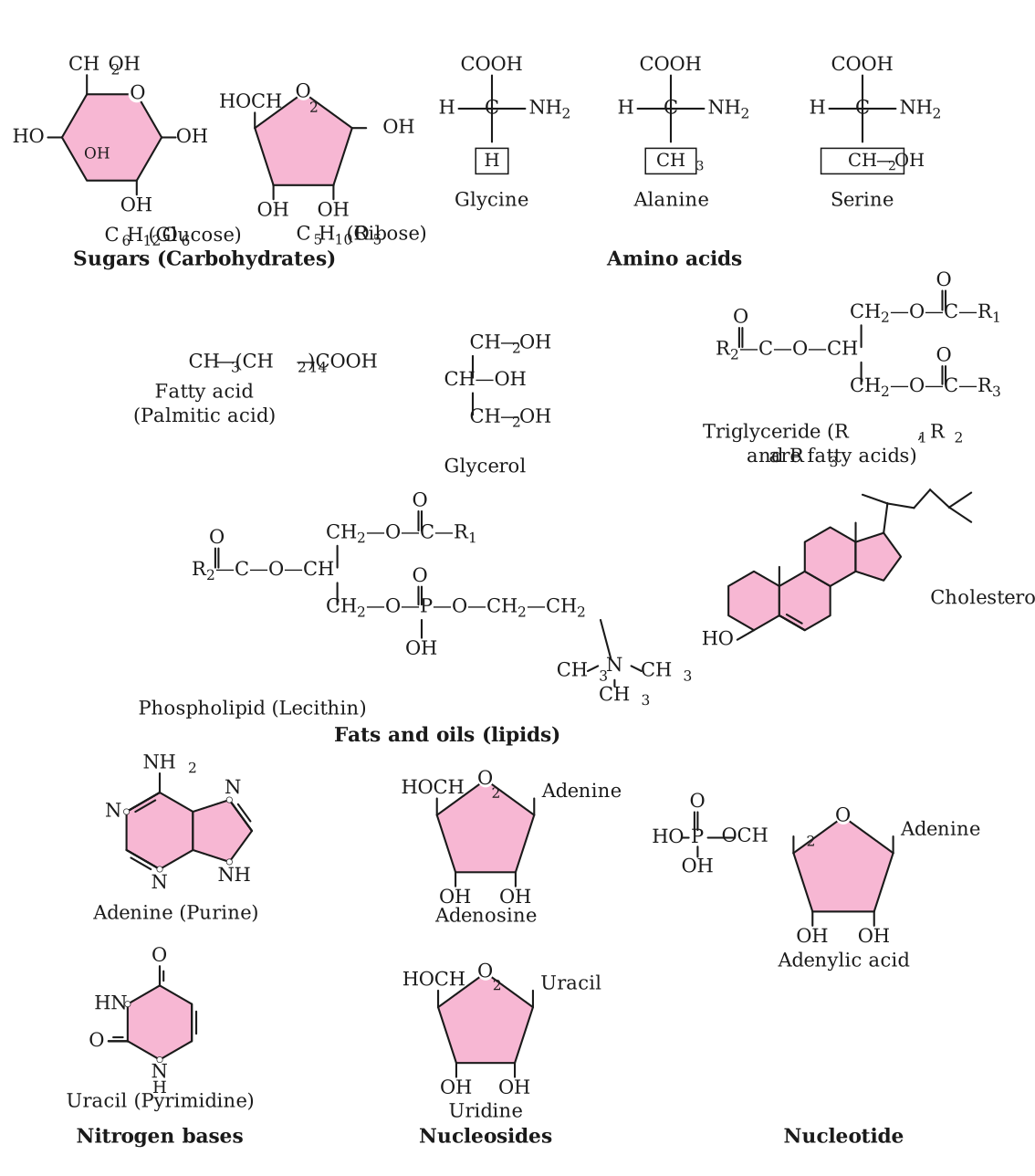
Drawn by us to help you understand the concept clearly, and verified to make sure it's accurate. For exams, practice from your textbook's own diagram.
This plate collects the structural formulae of the main kinds of small organic building-block molecules found in living tissue — the acid-soluble pool of the cell. It shows representative sugars (a monosaccharide such as glucose, drawn as a six-membered ring, and ribose as a five-membered ring); amino acids (glycine, alanine and serine, each with a central carbon carrying an amino group, a carboxyl group, a hydrogen and a variable R group); fats and lipids (a fatty acid as a long hydrocarbon chain ending in a carboxyl group, glycerol, a triglyceride, a phospholipid, and the ring-shaped steroid cholesterol); and the components of nucleic acids (nitrogen bases such as the purine adenine and the pyrimidine uracil, nucleosides such as adenosine, and a nucleotide such as adenylic acid, in which a base is joine …