Biology · Ch 15 — Body Fluids and Circulation
Formed Elements
Formed Elements
The cellular part of blood is made up of three components — erythrocytes, leucocytes and platelets — which together are called the formed elements. They constitute close to 45 per cent of the blood by volume.
Erythrocytes (red blood cells)
Red blood cells, or RBCs, are the most numerous of all the cells in blood. In a healthy adult man there are on average about 5 to 5.5 million RBCs in every cubic millimetre of blood. In adults they are produced in the red bone marrow.
Their structure is unusual and well suited to their role:
- In most mammals, mature RBCs have no nucleus.
- They are biconcave in shape.
- They contain haemoglobin, a red-coloured, iron-containing complex protein — this is what gives the cells both their colour and their name. A healthy person has about 12 to 16 grams of haemoglobin in every 100 millilitres of blood.
Haemoglobin is central to the transport of respiratory gases. Each RBC lives for an average of about 120 days, after which it is destroyed in the spleen — for this reason the spleen is described as the graveyard of RBCs.
Leucocytes (white blood cells)
Leucocytes, or WBCs, are colourless because they lack haemoglobin. They are nucleated and are far fewer than RBCs, averaging about 6000 to 8000 per cubic millimetre of blood, and they are generally short-lived.
WBCs fall into two broad categories:
- Granulocytes — neutrophils, eosinophils and basophils.
- Agranulocytes — lymphocytes and monocytes.
Their proportions and functions differ:
- Neutrophils are the most abundant WBCs, making up about 60 to 65 per cent of the total. Along with monocytes (about 6 to 8 per cent), they are phagocytic — they engulf and destroy foreign organisms that enter the body.
- Basophils are the least common (about 0.5 to 1 per cent). They secrete substances such as histamine, serotonin and heparin, and take part in inflammatory reactions.
- Eosinophils (about 2 to 3 per cent) resist infections and are also linked to allergic reactions.
- Lymphocytes (about 20 to 25 per cent) come in two major forms, B and T. Both types are responsible for the body's immune responses.
Platelets (thrombocytes) …
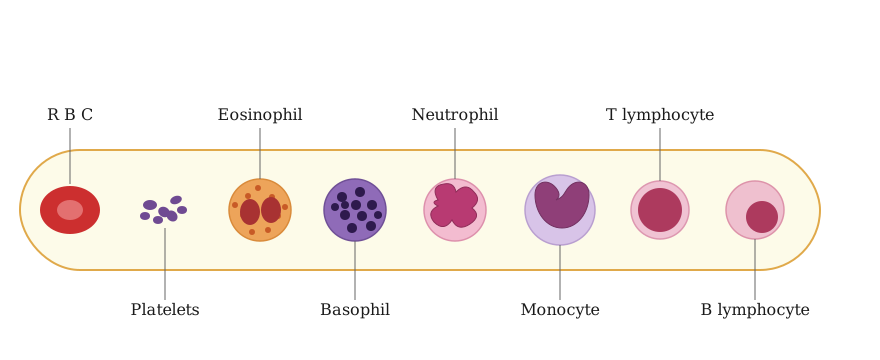
Drawn by us to help you understand the concept clearly, and verified to make sure it's accurate. For exams, practice from your textbook's own diagram.
This figure shows the formed elements of blood — the cells and cell fragments that make up close to forty-five per cent of blood by volume. Look first at the erythrocytes, or red blood cells: they are drawn as biconcave discs, dimpled on both faces and lacking a nucleus, a shape that gives them a large surface area for carrying the respiratory gases through their iron-containing pigment, haemoglobin. Next, compare them with the leucocytes, or white blood cells, which are larger, colourless and always contain a distinct nucleus. The figure lets you tell the two families of white cells apart: the granulocytes (neutrophils, eosinophils and basophils) carry granules in their cytoplasm and often lobed nuclei, while the agranulocytes (lymphocytes and monocytes) have smooth cytoplasm. Finally, notice the platelets, shown as tiny cell fragments far smaller than the other cells. From this figure …