Biology · Ch 10 — Cell Cycle and Cell Division
Cytokinesis
Cytokinesis
Mitosis does more than just share out the duplicated chromosomes into two nuclei — that part is karyokinesis. To truly finish cell division, the cell body itself must also split so that each new nucleus ends up inside its own separate cell. This dividing of the cytoplasm is called cytokinesis, and only when it is complete is cell division genuinely over.
The way cytokinesis is carried out differs between animal cells and plant cells, largely because of the presence or absence of a rigid cell wall.
In animal cells, division is achieved by a pinching-in of the cell surface. A furrow (an indentation) appears in the plasma membrane, usually around the middle of the cell. This furrow steadily deepens, cutting inward from the outside, until it reaches the centre and the two sides meet. When they join, the cytoplasm is separated into two, giving two distinct daughter cells.
In plant cells, this pinching approach is not possible, because a plant cell is surrounded by a fairly rigid, inextensible cell wall that cannot simply be squeezed inward. Plant cells therefore build a new dividing wall from the inside out. Wall formation begins in the centre of the cell and grows outward until it reaches and fuses with the existing side (lateral) walls. This new wall starts as a simple precursor structure called the cell-plate, which corresponds to the middle lamella that will lie between the walls of the two adjacent daughter cells.
During this cytoplasmic division, the cell's organelles — such as the mitochondria and plastids — get shared out and distributed between the two daughter cells, so each new cell is equipped to function on its own. …
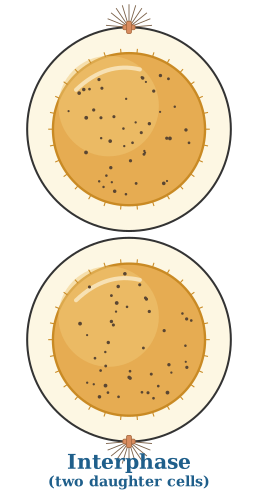
Drawn by us to help you understand the concept clearly, and verified to make sure it's accurate. For exams, practice from your textbook's own diagram.
After karyokinesis, cytokinesis divides the cytoplasm so that each daughter nucleus ends up inside its own cell (Figure 10.2 e) — completing cell division. The result is two genetically identical daughter cells, each shown here back in interphase: a single nucleus bounded by a reformed nuclear envelope, with the chrom …