Chemistry · Ch 6 — Chemical Bonding and Molecular Structure
Other Examples of sp3, sp2 and sp Hybridisation
Other Examples of sp3, sp2 and sp Hybridisation
sp³ Hybridisation in Ethane (C₂H₆)
In the ethane molecule, each carbon atom is surrounded by four other atoms — one carbon and three hydrogens. To accommodate this tetrahedral geometry, both carbon atoms undergo sp³ hybridisation. Each carbon uses its four sp³ hybrid orbitals in the following way:
- One sp³ hybrid orbital from each carbon overlaps axially (end‑to‑end) with the corresponding sp³ orbital of the other carbon. This forms a C–C σ bond (sp³–sp³ overlap).
- The remaining three sp³ hybrid orbitals on each carbon overlap axially with the 1s orbitals of three hydrogen atoms, forming C–H σ bonds (sp³–s overlap).
The result is a molecule with all bond angles close to 109.5°. Experimentally, the C–C bond length is 154 pm and each C–H bond length is 109 pm. These values are consistent with the single‑bond character of both bonds.
The C–C bond in ethane is a pure σ bond — there are no π bonds. This is the hallmark of an sp³–sp³ single bond.
sp² Hybridisation in Ethene (C₂H₄)
Ethene (ethylene) has a planar structure with a double bond between the two carbons. Each carbon is bonded to two hydrogens and the other carbon — three σ bonds in total. This requires sp² hybridisation.
σ‑bond framework:
- One sp² hybrid orbital of each carbon overlaps axially with an sp² hybrid orbital of the other carbon → C–C σ bond (sp²–sp²).
- The other two sp² hybrid orbitals on each carbon overlap axially with the 1s orbitals of two hydrogen atoms → C–H σ bonds (sp²–s).
π‑bond formation:
Each carbon also has one unhybridised p orbital (either 2pₓ or 2pᵧ, depending on the axis convention). These two p orbitals are perpendicular to the plane of the molecule. They overlap sidewise (laterally) to form a π bond. This π bond consists of two equal electron clouds — one above and one below the molecular plane.
Thus, the carbon‑carbon bond in ethene is composed of:
- one sp²–sp² σ bond, and
- one π bond (from the unhybridised p orbitals).
Bond lengths and angles:
- C=C bond length: 134 pm (shorter than the C–C single bond in ethane, as expected for a double bond).
- C–H bond length: 108 pm.
- H–C–H bond angle: 117.6°.
- H–C–C bond angle: 121°.
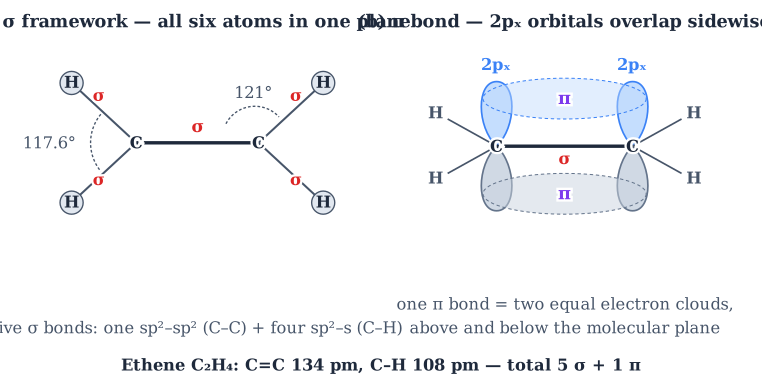
Drawn by us to help you understand the concept clearly, and verified to make sure it's accurate. For exams, practice from your textbook's own diagram.
Fig. 4.15 is a schematic diagram — not a graph with axes — that shows the orbital-level structure of ethene (C₂H₄). The figure has two main parts: a top view of the molecule in the plane of the page, and a side-on view that reveals the π bond.
In the top view, you see the two carbon atoms at the centre, each with three sp² hybrid orbitals lying in a flat plane. Two of these sp² orbitals on each carbon point toward hydrogen atoms (forming C–H σ bonds), and the third sp² orbital on each carbon points toward the other carbon (forming the C–C σ bond). All six atoms — two carbons and four hydrogens — lie in the same plane. The bond angles are marked: H–C–H is 117.6°, and H–C–C is 121°. These angles are not the ideal 120° of pure sp² hybridisation because the π bond slightly distorts the geometry.
The side-on view is the key insight of the figure. Above and below the plane of the molecule, you see two lobes — one from each carbon’s unhybridised 2p orbital. These p orbitals are perpendicular to the molecular plane. The figure shows them overlapping sideways (lateral overlap), forming a π bond that consists of two electron clouds: one above the plane and one below. This π bond is weaker than the σ bond, but together they make the C=C double bond.
The carbon-carbon double bond in ethene is one σ bond (from sp²–sp² axial overlap) plus one π bond (from sidewise overlap of unhybridised p orbitals). The π bond locks the molecule into a planar geometry because rotation around the C=C bond would break the π overlap.
The figure supports the idea that bond length and bond strength depend on the type of overlap. For ethene, the C=C bond length is 134 pm — shorter than the 154 pm C–C single bond in ethane — because the π bond adds extra electron density between the nuclei, pulling them closer. The C–H bond length is 108 pm, slightly shorter than in ethane (109 pm) due to the greater s-character of sp² hybrids (33% s) compared to sp³ (25% s).
The central formula that emerges from this figure is the relationship between hybridisation, bond order, and bond length. For a carbon-carbon bond:
Between two atoms, the bond order equals the number of shared pairs joining them: ethane C–C = 1 (σ only), ethene C=C = 2 (one σ + one π), ethyne C≡C = 3 (one σ + two π).
The figure also teaches a physical principle: σ bonds are formed by end-on (axial) overlap and are cylindrically symmetric about the internuclear axis, while π bonds are formed by sidewise overlap and have electron density concentrated above and below that axis. This asymmetry is why π bonds are weaker and more reactive — they are more exposed to attacking reagents. …
The H–C–H angle (117.6°) is slightly less than the ideal 120° of pure sp² hybridisation, while the H–C–C angle (121°) is slightly more. This small distortion arises because the π‑electron cloud repels the C–H bonds unequally.
To visualise the π bond: imagine the two carbon atoms lying in the plane of the paper. The unhybridised p orbitals stick out perpendicular to that plane — one lobe above, one below. Their sidewise overlap creates the π bond, which locks the molecule into a planar geometry and prevents free rotation about the C=C bond.
sp Hybridisation in Ethyne (C₂H₂)
Ethyne (acetylene) contains a triple bond between the two carbon atoms. Each carbon is bonded to only one hydrogen and the other carbon — two σ bonds in total. This linear geometry demands sp hybridisation.
σ‑bond framework:
- One sp hybrid orbital of each carbon overlaps axially with an sp hybrid orbital of the other carbon → C–C σ bond (sp–sp).
- The other sp hybrid orbital on each carbon overlaps axially with the 1s orbital of a hydrogen atom → C–H σ bonds (sp–s).
π‑bond formation:
Each carbon has two unhybridised p orbitals — 2pᵧ and 2pₓ (assuming the molecular axis is the z‑axis). These are perpendicular to each other and to the internuclear axis. They overlap sidewise in two independent planes:
- One pair of p orbitals (say, the 2pᵧ orbitals) overlaps to form one π bond.
- The other pair (2pₓ orbitals) overlaps to form a second π bond.
These two π bonds are perpendicular to each other and to the σ bond. Together, they form a cylindrical electron cloud around the C–C axis. …
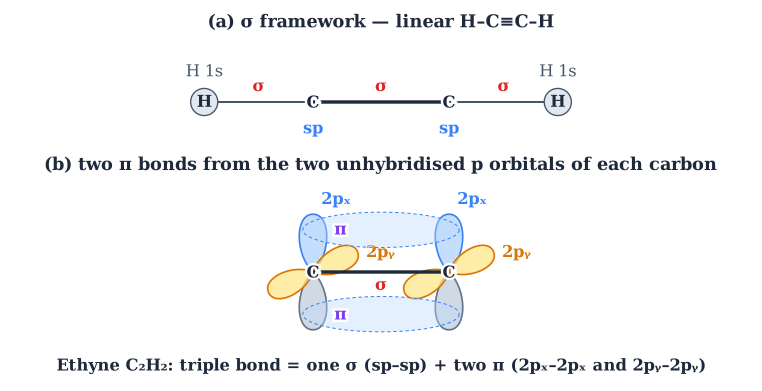
Drawn by us to help you understand the concept clearly, and verified to make sure it's accurate. For exams, practice from your textbook's own diagram.
Fig. 4.16 is a schematic orbital diagram that shows how the two carbon atoms in ethyne (C₂H₂) form a triple bond. The figure does not plot data on axes; instead, it uses three-dimensional orbital shapes to illustrate the spatial arrangement of bonds.
The diagram centres on the two carbon nuclei, each labelled C. Around each carbon, two sp hybrid orbitals are drawn as large, elongated lobes pointing in opposite directions — this is the linear geometry of sp hybridisation. One sp orbital from the left carbon overlaps end‑to‑end (axially) with one sp orbital from the right carbon, forming the C–C sigma (σ) bond. The other sp orbital on each carbon overlaps axially with the 1s orbital of a hydrogen atom, forming the two C–H σ bonds. These three σ bonds lie along a straight line, giving the molecule its linear shape.
Perpendicular to this line, the figure shows the two unhybridised p orbitals on each carbon — one labelled 2p and the other 2p. These p orbitals are drawn as dumbbell‑shaped lobes. The 2p orbital of the left carbon overlaps sideways (laterally) with the 2p orbital of the right carbon, forming one π bond. Similarly, the 2p orbitals overlap sideways to form a second π bond. The two π bonds are perpendicular to each other and to the σ‑bond axis, creating a cylindrical electron cloud around the C–C line.
The physical idea the figure teaches is that a triple bond is not three identical bonds. It consists of one strong σ bond (from head‑on overlap of hybrid orbitals) and two weaker π bonds (from sideways overlap of unhybridised p orbitals). The σ bond holds the nuclei together along the internuclear axis, while the π bonds restrict rotation and add rigidity.
The textbook develops no new formula from this figure alone, but it reinforces the general principle of bond formation: the number of σ bonds equals the number of hybrid orbitals used, and the remaining unhybridised p orbitals form π bonds. For ethyne, each carbon uses two sp hybrid orbitals for σ bonds (one C–C and one C–H), leaving two p orbitals per carbon for π bonding. …