Chemistry · Ch 6 — Chemical Bonding and Molecular Structure
Overlapping of Atomic Orbitals
Overlapping of Atomic Orbitals
The Concept of Orbital Overlap
A covalent bond forms when atomic orbitals from two atoms come sufficiently close to each other. The key idea is that the bond's strength and direction depend on how these orbitals overlap in space. The wave functions of atomic orbitals have a sign (or phase), shown as positive (+) or negative (−) in boundary surface diagrams. This sign is not related to electric charge; it is a mathematical property of the wave function.
For a bond to form, the overlapping orbitals must have the same sign (phase) in the region of overlap. This is called positive overlap. If the signs are opposite, the overlap is negative and leads to repulsion (no bond). If the overlap is exactly zero (e.g., because of orientation), no bond forms either.
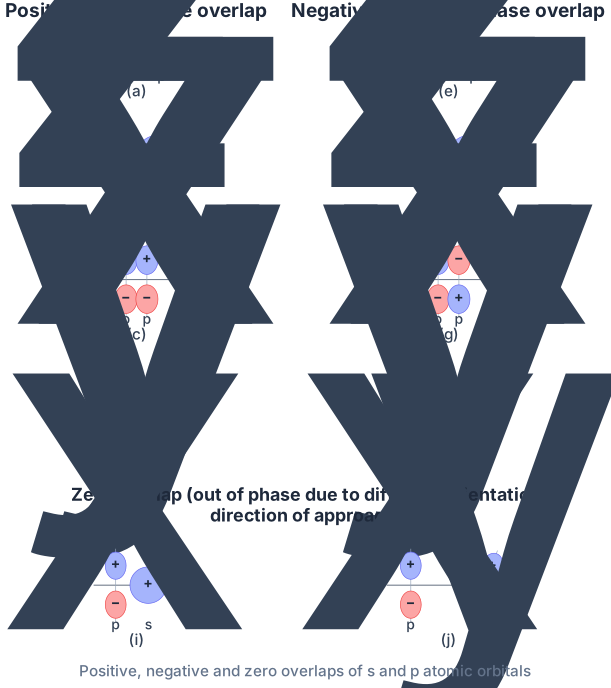
Drawn by us to help you understand the concept clearly, and verified to make sure it's accurate. For exams, practice from your textbook's own diagram.
The figure is a visual summary of the single most important rule in valence bond theory: only overlap between lobes of the same sign leads to a bond. It shows three rows of orbital pairs, each row illustrating a different type of overlap.
The top row shows positive overlap. Here, the two overlapping lobes have the same algebraic sign (both positive or both negative). The wave functions reinforce each other, increasing electron density between the nuclei. This is the only situation that produces a stable covalent bond. The figure includes the simplest cases: an s orbital overlapping with another s orbital (as in H₂), an s orbital overlapping end‑on with a pₓ orbital, and two pₓ orbitals overlapping end‑on.
The middle row shows negative overlap. The overlapping lobes have opposite signs. The wave functions cancel, creating a node (zero electron density) between the nuclei. This is antibonding — it raises the energy of the system and does not form a bond.
The bottom row shows zero overlap. The orbitals are oriented so that their lobes do not point toward each other at all. The classic example is an s orbital approaching a p orbital from the side (s–p_y). Because the p orbital has a nodal plane through the nucleus, the positive and negative contributions from the s orbital cancel exactly — the net overlap integral is zero. No bond forms.
A common mistake is to think that any overlap between orbitals is bonding. The figure makes clear that only same‑sign overlap counts. Opposite‑sign overlap is actually repulsive, and orthogonal overlap does nothing.
The physical idea is that a covalent bond is not just a matter of orbitals “touching.” The sign of the wave function matters because the bond arises from constructive interference of the electron waves. The strength of the bond depends on the extent of positive overlap, which is quantified by the overlap integral, .
…
The + and − signs on orbital diagrams represent the phase of the wave function, not positive or negative charge. Confusing these is a common mistake.
The criterion of overlap applies uniformly to all covalent molecules — homonuclear diatomic (like H₂, N₂), heteronuclear diatomic (like HF), and polyatomic molecules (like CH₄, NH₃, H₂O).
Why Simple Orbital Overlap Fails for CH₄, NH₃, and H₂O
Let us test the simple overlap idea on methane (CH₄). The ground-state electronic configuration of carbon is:
This shows only two unpaired electrons (in the 2p orbitals), which would suggest carbon can form only two bonds. But we know carbon forms four bonds in CH₄. To explain this, we consider an excited state of carbon:
The energy required to promote one electron from the 2s to the 2p orbital is compensated by the energy released when four bonds form.
Now, if we try to form four C–H bonds using these four atomic orbitals (one 2s and three 2p), we run into a problem. The three 2p orbitals are mutually perpendicular (at 90° to each other). So three C–H bonds would be at 90° angles. The 2s orbital is spherically symmetric, so the fourth bond could point in any direction. This would give H–C–H angles of 90° for three bonds and an undefined direction for the fourth — not the observed tetrahedral angle of 109.5°. …