Q.Explain why BeH2 molecule has a zero dipole moment although the Be–H bonds are polar.
🔒You're viewing a preview — the full solution, concept, methods & PYQ mapping are locked.
🔒 Start your 14-day free trial to unlock the full solution →Concept understanding — Dipole Moment Applications
Dipole Moment Applications: From Intuition to Precision
Imagine you have a magnet. One end pulls, the other pushes. Now imagine a molecule that behaves like a tiny magnet — not because of iron, but because of how its electrons are distributed. That's the idea behind a dipole moment.
A dipole moment arises when there's a separation of charge inside a molecule. One end becomes slightly negative (δ−), the other slightly positive (δ+). This imbalance creates a tiny electric "arrow" pointing from positive to negative. The arrow has both a size (how much charge is separated) and a direction (which way the molecule is polar).
The dipole moment is a vector quantity. Its magnitude is given by μ=q×d, where q is the magnitude of separated charge and d is the distance between the charge centers. The unit is the Debye (D).
Now, why does this matter? Because this tiny electric arrow determines how a molecule behaves around other molecules, around electric fields, and even how it interacts with light. Let's see the key applications.
1. Predicting Molecular Shape (Symmetry Check)
This is the most common exam application. If a molecule has polar bonds (like C–Cl or O–H), does it have a net dipole moment? The answer depends on symmetry.
Consider carbon dioxide, CO₂. Each C=O bond is polar (oxygen pulls electrons). But the molecule is linear: O=C=O. The two dipole arrows point in opposite directions and cancel out. Net dipole moment = zero. The molecule is nonpolar.
Now consider water, H₂O. Each O–H bond is polar. But water is bent (104.5°). The two arrows do not cancel — they add up to a net dipole pointing upward through the oxygen. Net dipole moment = 1.85 D. Water is polar.
Symmetry kills polarity. If a molecule has a center of symmetry or identical polar bonds arranged symmetrically, the net dipole moment is zero. This is how you distinguish between linear CO₂ (nonpolar) and bent SO₂ (polar, 1.63 D).
Exam tip: For molecules like CH₄ (tetrahedral, zero dipole) vs. CH₃Cl (tetrahedral but one C–Cl bond, dipole = 1.87 D), the key is whether the polar bonds are arranged so their vectors cancel.
2. Determining Bond Character (Ionic vs. Covalent)
The dipole moment tells you how "unequal" the sharing of electrons is in a bond. A pure covalent bond (like H–H) has zero dipole. A pure ionic bond (like Na⁺Cl⁻) would have a huge dipole — but in reality, ions are separate.
For a bond like H–Cl, the measured dipole moment is 1.08 D. If the bond were 100% ionic (one full electron transferred), the dipole would be much larger (about 6.1 D for the same bond length). The ratio gives you the percent ionic character:
% ionic character=μcalculated for 100% ionicμobserved×100
For HCl: 6.11.08×100≈17.7%. So the H–Cl bond is about 18% ionic, 82% covalent.
This is a standard numerical problem. Remember: μionic=e×d, where e=4.8×10⁻¹⁰ esu (or 1.6×10⁻¹⁹ C in SI). Convert bond length to cm or m accordingly.
3. Intermolecular Forces and Physical Properties
Polar molecules (with a nonzero dipole) experience dipole-dipole interactions — the positive end of one molecule attracts the negative end of another. This is stronger than the London dispersion forces in nonpolar molecules of similar size.
Consequences:
- Boiling points: Polar molecules have higher boiling points than nonpolar ones of similar molar mass. Example: HCl (polar, bp −85°C) vs. F₂ (nonpolar, bp −188°C). Both have about 38 g/mol, but HCl's dipole adds extra attraction.
- Solubility: "Like dissolves like." Polar solutes dissolve in polar solvents (water, ethanol). Nonpolar solutes dissolve in nonpolar solvents (hexane, CCl₄). The dipole moment explains why NaCl dissolves in water but not in oil.
- Dielectric constant: Polar liquids have high dielectric constants (water = 80), meaning they can weaken the electric field between charges. This is why water is such a good solvent for ionic compounds.
Don't confuse dipole moment with boiling point directly. A molecule can have a large dipole but low boiling point if it's very small (like HF, bp 19.5°C, dipole 1.91 D). Hydrogen bonding (a special case of dipole interaction) is even stronger.
4. Reactivity and Orientation in Electric Fields
In an external electric field, polar molecules align themselves with the field. This is the principle behind microwave heating — water molecules in food rotate to align with the alternating microwave field, generating heat through friction.
In organic chemistry, the dipole moment helps predict reaction sites. The negative end of a dipole (where electrons are concentrated) is where electrophiles attack. The positive end (electron-deficient) is where nucleophiles attack. …
The key idea is that the dipole moment depends on both bond polarity and molecular geometry. Even if individual bonds are polar, the vector sum of their dipole moments can cancel out.
Reasoning:
- BeH2 has a linear geometry (H–Be–H, bond angle 180°), with Be at the centre.
- Each Be–H bond is polar because Be (1.57) and H (2.20) differ in electronegativity, so each bond has a dipole moment pointing from Be to H. …
The key idea is that molecular dipole moment depends on both bond polarity and molecular geometry. Although Be–H bonds are polar (Be is less electronegative than H), BeH2 is linear with symmetric bond dipoles that cancel exactly, giving a net zero dipole moment.
Why This Approach Works
The dipole moment of a molecule is a vector sum of all individual bond dipole moments. A common mistake is to assume that polar bonds always produce a polar molecule — but that’s only true if the bond dipoles do not cancel. The geometry of the molecule determines whether the vectors add or cancel. For BeH2, the linear shape means the two Be–H bond dipoles point in exactly opposite directions, so their vector sum is zero.
Never judge molecular polarity by bond polarity alone. Even molecules with highly polar bonds (like CO2 or BeH2) can be nonpolar if their shape is symmetric.
Step-by-Step Reasoning
-
Understand bond polarity in Be–H
Electronegativity values: Be ≈ 1.57, H ≈ 2.20. The difference is about 0.63, which is significant enough to make the Be–H bond polar. The electron density is pulled toward hydrogen, so each bond has a dipole moment pointing from Be (positive end) toward H (negative end).
-
Determine the molecular geometry of BeH2
Beryllium has only two valence electrons and forms two sigma bonds with hydrogen. There are no lone pairs on Be. According to VSEPR theory, the electron pairs repel to maximize separation, giving a linear geometry with a bond angle of 180∘.
-
Represent bond dipoles as vectors
Each Be–H bond dipole is a vector of equal magnitude (since both bonds are identical) pointing from Be to H. In a linear molecule, these two vectors lie along the same line but point in opposite directions.
-
Add the vectors
Vector addition: …
- COMEDK 2026Set 2026-M1 markMCQQ.The highest dipole moment is for: (A) CH4 (B) CHCl3 (C) CCl4 (D) CH2Cl2
›Reveal solutionSolution
Dipole moment depends on both bond polarity and molecular symmetry. Among CH4, CHCl3, CCl4, and CH2Cl2, the highest dipole moment belongs to CH2Cl2 (~1.60 D) — option (D).
Concept & Intuition
A molecule's dipole moment is the vector sum of its bond dipoles. Perfect symmetry can cancel even strong bond dipoles entirely, so both the number of polar bonds and the geometry matter.
Step-by-step reasoning
-
CH4 — tetrahedral, C–H bonds are only weakly polar, and the four bond dipoles cancel by symmetry. Net dipole ≈ 0.
-
CCl4 — tetrahedral with four strongly polar C–Cl bonds, but the perfect tetrahedral symmetry still cancels them. Net dipole ≈ 0.
-
CHCl3 (chloroform) — three C–Cl bonds and one C–H bond; the three C–Cl dipoles don't fully cancel, but their arrangement (109.5° apart) still leaves a comparatively modest net moment: ~1.04 D. …
-
- COMEDK 2025Set 2025-A1 markMCQQ.From among the 4 given compounds identify the compounds which possess a net dipole moment. A. cis-1,2-Dichloroethene B. Tetrachloromethane C. o-Dichlorobenzene D. trans 2,3-Dibromobut-2-ene (A) A and D (B) D and B (C) A and C (D) B and C
›Reveal solutionSolution
The key idea is that a net dipole moment arises when bond dipoles do not cancel due to molecular symmetry. Among the given compounds, cis-1,2-dichloroethene and o-dichlorobenzene have net dipoles, so the correct option is (C).
Concept and Intuition
A molecule has a net dipole moment when the vector sum of all individual bond dipoles is nonzero. Symmetry often cancels dipoles: if a molecule has a center of inversion, a plane of symmetry that mirrors dipoles, or a high-order rotation axis that aligns dipoles oppositely, the net moment is zero. The trick is to visualize the 3D arrangement of polar bonds (like C–Cl or C–Br) and see if they point in opposite directions.
Step-by-Step Reasoning
-
Analyze cis-1,2-dichloroethene (A)
- Structure: Two chlorine atoms on the same side of the C=C double bond.
- Each C–Cl bond is polar (Cl more electronegative). In the cis isomer, both C–Cl dipoles point roughly in the same direction (downward if the double bond is horizontal).
- No symmetry element cancels them; the vector sum is nonzero.
- Result: Has a net dipole moment.
-
Analyze tetrachloromethane (CCl₄) (B)
- Tetrahedral geometry with four identical C–Cl bonds.
- The molecule is highly symmetric: all bond dipoles are equal in magnitude and point toward the corners of a tetrahedron. Their vector sum is exactly zero.
- Result: No net dipole moment.
-
Analyze o-dichlorobenzene (C)
- Two chlorine atoms on adjacent carbons of a benzene ring.
- The C–Cl bond dipoles are not opposite; they are at a 60° angle (in the plane of the ring). Their vector sum is nonzero, pointing roughly between them.
- The ring itself is symmetric, but the two chlorines break that symmetry.
- Result: Has a net dipole moment. …
-
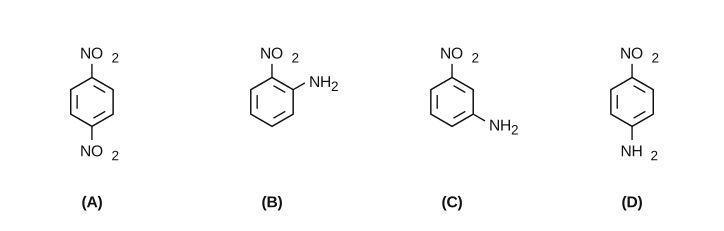
- COMEDK 2025Set 2025-E1 markMCQQ.The maximum polarity and dipole moment among the following is : (A) (B) (C) (D)
›Reveal solutionSolution
The dipole moment depends on the vector sum of bond moments; for nitroanilines, the para isomer (D) has the largest dipole because both substituents pull electron density in the same direction, while the ortho isomer (B) has partial cancellation and the meta isomer (C) has intermediate alignment. The dinitro compound (A) has two identical opposing groups, giving a small net dipole. Thus the maximum dipole moment is for the para-nitroaniline, option (D).
Concept & Intuition
Dipole moment is a vector quantity: it has both magnitude and direction. Each polar substituent on a benzene ring contributes a bond dipole (a vector pointing from the less electronegative atom toward the more electronegative one). The net dipole moment of the molecule is the vector sum of these individual dipoles.
- The nitro group (–NO₂) is strongly electron-withdrawing; its dipole points away from the ring (the nitrogen is positive relative to the oxygens, but the overall group pulls electron density from the ring, so the bond dipole vector points from the ring toward the NO₂ group).
- The amino group (–NH₂) is electron-donating; its dipole points toward the ring (the lone pair on nitrogen donates into the ring, so the bond dipole vector points from the NH₂ toward the ring).
Thus, in a nitroaniline, the two dipoles are in opposite directions relative to the ring. Their relative positions (ortho, meta, para) determine whether they reinforce or cancel each other.
Step-by-step reasoning
-
Identify the bond dipole directions
For –NO₂: the dipole vector points from the ring carbon outward toward the NO₂ group.
For –NH₂: the dipole vector points from the NH₂ group inward toward the ring carbon.
So, if we draw arrows on the ring, the NO₂ arrow points away from the ring, and the NH₂ arrow points toward the ring.
-
Analyze each isomer
- Option (A): Two NO₂ groups in para positions Both dipoles point outward, directly away from each other. They are equal in magnitude and exactly opposite in direction. Their vector sum is nearly zero (small residual due to ring polarization). So dipole moment is very small.
- Option (B): ortho-nitroaniline (1,2-) The NO₂ dipole points outward; the NH₂ dipole points inward. The angle between them is 60° (since the ring is a regular hexagon). Vector addition gives partial cancellation. The net dipole is moderate.
- Option (C): meta-nitroaniline (1,3-) The angle between the two dipoles is 120°. They partially cancel but less than in ortho; the net dipole is larger than ortho but still not maximal. …
- COMEDK 2024Set 2024-M1 markMCQQ.Identify the pair of molecules, both of which have positive values of Dipole moment. (A) NF3 & CHCl3 (B) BF3 & CHCl3 (C) NF3 & CCl4 (D) BF3 & CCl4
›Reveal solutionSolution
The key idea is that a molecule has a nonzero dipole moment only if its bond dipoles do not cancel due to symmetry. Among the given pairs, only NF₃ and CHCl₃ both have nonzero dipole moments, so the correct option is (A).
Why this approach works
Dipole moment is a vector sum of individual bond polarities. Even if bonds are polar, a symmetric shape (like trigonal planar or tetrahedral with identical substituents) can cancel the vectors to zero. So we must check both molecular geometry and bond polarity for each molecule.
Step-by-step reasoning
-
Analyze NF₃
- Nitrogen is more electronegative than fluorine, so each N–F bond is polar with the negative end toward F.
- NF₃ has a trigonal pyramidal shape (lone pair on N), so the three bond dipoles do not cancel.
- Result: NF₃ has a nonzero dipole moment (≈ 0.24 D).
-
Analyze BF₃
- Boron is less electronegative than fluorine, so B–F bonds are polar.
- BF₃ is trigonal planar (120° angles, no lone pair). The three identical bond dipoles sum to zero.
- Result: BF₃ has zero dipole moment.
-
Analyze CHCl₃ (chloroform)
- The C–H bond is nearly nonpolar; the three C–Cl bonds are strongly polar (Cl more electronegative).
- The molecule is tetrahedral, but the three Cl atoms are not symmetric with the H atom — the vector sum of the three C–Cl dipoles does not cancel with the small C–H dipole.
- Result: CHCl₃ has a nonzero dipole moment (≈ 1.04 D).
-
Analyze CCl₄ (carbon tetrachloride)
- Four identical C–Cl bonds arranged tetrahedrally.
- Perfect symmetry: all bond dipoles cancel exactly. …
-
- COMEDK 2023Set 2023-M1 markMCQQ.Pick up the correct statement. (A) Dipole moment of ammonia is due to orbital dipole and resultant diapole in same direction. (B) O2,H2 shown bond diapole due to polarisation. (C) Dipole moment is scalar quantity. (D) In BF3 bond dicopoles are zero but dipole moment is higher.
›Reveal solutionSolution
Ammonia's high dipole moment arises because the lone-pair (orbital) dipole and the resultant of the bond dipoles are oriented in the same direction and reinforce each other. Only statement (A) is correct.
Evaluating each option:
- (A) Correct. In NH3 the orbital dipole due to the nitrogen lone pair points in the same direction as the vector sum of the three N–H bond dipoles, so they add (μ≈1.47D). (In NF3 they oppose, giving a small μ.)
- (B) Wrong. O2 and H2 are homonuclear molecules; their bonds are non-polar, so no bond dipole exists.
- (C) Wrong. Dipole moment is a vector quantity (it has magnitude and direction). …
- COMEDK 2022Set 20221 markMCQQ.Which of the following molecules does not exhibit dipole moment?(i) CCl4(ii) CO2(iii) NH3(iv) CHCl3(v) H2O(vi) CH_3$$$$-O−CH3 (A) (ii), (v),(iv) (B) (i), (iii),(vi) (C) (i),(ii) (D) (iii), (iv), (vi)
›Reveal solutionSolution
Only (i) CCl4 and (ii) CO2 have zero dipole moment.
Concept: a molecule has zero net dipole moment when its bond dipoles cancel by symmetry.
- CCl4 - tetrahedral, symmetric; the four C-Cl dipoles cancel -> mu = 0.
- CO2 - linear O=C=O; the two equal C=O dipoles are opposite and cancel -> mu = 0.
- NH3 - pyramidal (lone pair); dipoles do not cancel -> mu = 1.47 D.
- CHCl3 - tetrahedral but one H replaces a Cl, so the dipoles do not cancel -> mu = 1.04 D. …
- COMEDK 2021Set 20211 markMCQQ.Find the compound which have both polar and non-polar covalent bonds. (A) HCN (B) H2O2 (C) NH4Cl (D) CH4
›Reveal solutionSolution
- HCN: H-C and C(triple)N - both polar; no bond between identical atoms. - H2O2: H-O-O-H. The two O-H bonds are POLAR (O 3.5 vs H 2.1), and the O-O bond joins two identical atoms so it is a NON-POLAR covalent bond. -> has BOTH. - NH4Cl: contains an IONIC bond (NH4+ Cl-) plus polar N-H covalent bonds; no non-polar covalent bond. - CH4: all four C-H bonds are (slightly) polar; the MOLECULE is non-polar by symmetry, but there is no non-polar BOND.
Concept: A covalent bond between two ATOMS OF THE SAME ELEMENT is non-polar (zero electronegativity difference); between different elements it is polar.
- HCN: H-C and C(triple)N - both polar; no bond between identical atoms. …
🎓Unlock everything free for 14 days
- ✓Full step-by-step solutions
- ✓Concept-first explanations
- ✓Methods, shortcuts & mistakes
- ✓PYQ mapping + timed mock tests
Full access for 14 days. No credit card required.