Q.Which of the following compounds will show cis-trans isomerism?
🔒You're viewing a preview — the full solution, concept, methods & PYQ mapping are locked.
🔒 Start your 14-day free trial to unlock the full solution →Concept understanding — Geometric Isomerism
Geometric Isomerism: The "Locked in Place" Isomers
Imagine you have two magnets. You can arrange them in two ways: north pole facing north (they repel) or north pole facing south (they attract). The magnets themselves are identical — same size, same material — but the spatial arrangement of their poles is different. That difference in arrangement, when the magnets can't rotate freely, is the core idea behind geometric isomerism.
In organic chemistry, molecules are three-dimensional. Atoms are connected by bonds, and some bonds — specifically double bonds — are rigid. They don't allow free rotation like a single bond does. This rigidity locks certain groups of atoms into fixed positions relative to each other. When you have two identical groups attached to the two ends of a double bond, they can end up on the same side or on opposite sides. These are two different molecules, with different properties, even though they have the same atoms connected in the same order.
That's geometric isomerism: same connectivity, different spatial arrangement due to restricted rotation.
The Precise Statement
Geometric isomerism (also called cis-trans isomerism) occurs when:
-
There is a rigid structural feature in the molecule that prevents free rotation. The most common cause is a carbon-carbon double bond (C=C). Other causes include cyclic structures (rings) where atoms can't rotate past each other.
-
Each of the two carbon atoms in the double bond must have two different groups attached to it. If either carbon has two identical groups, the two possible arrangements become identical — they are the same molecule.
When these conditions are met, the two isomers are named:
- cis (from Latin cis, meaning "on this side"): the two identical (or similar) groups are on the same side of the double bond.
- trans (from Latin trans, meaning "across"): the two identical (or similar) groups are on opposite sides of the double bond.
For a double bond C=C with groups A and B on one carbon, and C and D on the other:
- If A=B and C=D, geometric isomers exist.
- cis: A and C on same side (or A and D, depending on which groups you compare).
- trans: A and C on opposite sides.
A Concrete Example: 2-Butene
Consider the molecule 2-butene: CHX3−CH=CH−CHX3.
The double bond is between the second and third carbons. Each of these carbons has a hydrogen (H) and a methyl group (CHX3) attached. Since H=CHX3 on each carbon, geometric isomers exist.
| Isomer | Structure (simplified) | Key Property |
|---|---|---|
| cis-2-butene | CHX3 and CHX3 on same side of the double bond | Boiling point: ~4°C |
| trans-2-butene | CHX3 and CHX3 on opposite sides | Boiling point: ~1°C |
The two methyl groups in cis are close together, causing slight repulsion (steric strain), which makes the molecule slightly less stable and gives it a higher boiling point. In trans, the methyl groups are far apart, so the molecule is more stable and packs differently in the liquid state.
A common mistake: thinking that cis and trans are just "different orientations" of the same molecule. They are not — they are distinct compounds with different physical properties (melting point, boiling point, density) and often different chemical reactivity. You cannot rotate the double bond to convert one into the other without breaking the bond.
Why Does This Matter?
Geometric isomerism is not a textbook curiosity. It has real-world consequences:
- Vision: The molecule retinal in your eye has a cis form that, when hit by light, converts to trans. This shape change triggers a nerve signal — that's how you see.
- Fats: Natural unsaturated fats (like olive oil) are mostly cis. Artificial trans fats (from partial hydrogenation) have a different shape and are linked to heart disease. …
Concept: Geometric (cis-trans) Isomerism
A C=C double bond shows cis-trans isomerism only when each doubly-bonded carbon is attached to two different groups. If either carbon carries two identical groups, the two geometric arrangements coincide and no isomerism exists.
Test each compound:
- (i) (CH3)2C=CH−C2H5 — left carbon has two identical CH3 groups. ✗
- (ii) CH2=CBr2 — one carbon has two H, the other two Br. ✗ …
Geometric (cis-trans) isomerism needs a C=C double bond in which each doubly-bonded carbon carries two different groups. Only (iii) C6H5CH=CH−CH3 and (iv) CH3CH=CClCH3 pass this test; in (i) and (ii) one carbon bears two identical groups.
Geometric isomerism arises from the restricted rotation about a C=C double bond: the π-bond locks the two carbons in a plane, so the groups cannot swap sides. A compound shows cis-trans isomerism only if each carbon of the double bond is attached to two different groups. If either carbon carries two identical groups, the "cis" and "trans" forms are superimposable and no isomerism results.
Applying this test to each compound:
- (i) (CH3)2C=CH−C2H5 — the left carbon carries two identical CH3 groups. ✗ No cis-trans isomerism.
- (ii) CH2=CBr2 — one carbon carries two identical H atoms and the other two identical Br atoms. ✗ No cis-trans isomerism. …
Showing the 12 most recent of 17 on this concept.
- KCET 2025Set D-41 markMCQQ.The IUPAC name of the given organic compound is HC≡C−CH=CH−CH=CH2 (A) Hexa-1-yn-3,5-diene (B) Hexa-5-yn-1,3-diene (C) Hexa-1,3-dien-5-yne (D) Hexa-3,5-dien-1-yne
›Reveal solutionSolution
Both ends give the same locant set {1,3,5}, so the rule "when there is a choice, the double bond receives the lower locant" decides the numbering.
Step 1 — Identify the parent chain.
HC≡C−CH=CH−CH=CH2
Counting carbons: C≡C (2) + CH=CH (2) + CH=CH2 (2) = 6 carbons, unbranched. The parent is therefore hex-. It contains two C=C (di-ene) and one C≡C (yne), so the name will end in …dien…yne, and the root becomes hexa- (the extra 'a' is inserted before a consonant-starting suffix like di).
Step 2 — Number from the left end (the alkyne end).
HC1≡C2−CH3=CH4−CH5=CH26
Triple bond: between C1–C2 → locant 1.
Double bonds: C3–C4 and C5–C6 → locants 3, 5.
Locant set = {1,3,5}. Name would be hexa-3,5-dien-1-yne.
Step 3 — Number from the right end (the alkene end).
HC6≡C5−CH4=CH3−CH2=CH21
Double bonds: C1–C2 and C3–C4 → locants 1, 3.
Triple bond: C5–C6 → locant 5.
Locant set = {1,3,5}. Name would be hexa-1,3-dien-5-yne.
Step 4 — Break the tie.
The first rule is: give the lowest locants to the set of multiple bonds considered together. Here both directions give the identical set {1,3,5} — there is no winner, so the rule cannot decide.
The next rule then applies:
When there is a choice, lower locants are given to the double bonds (the ene endings) over the triple bonds. …
- KCET 2025Set D-41 markMCQQ.The major product formed when 1 – Bromo – 3 – Chlorocyclobutane reacts with metallic sodium in dry ether is (A)
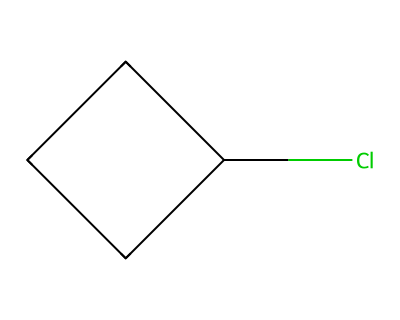 (B)
(B) 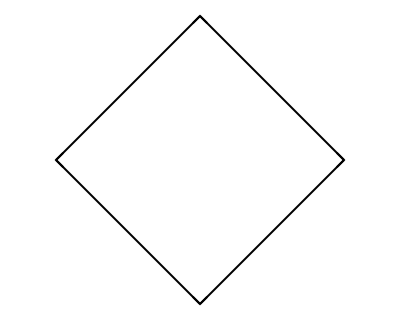 (C)
(C) ![Bicyclo[1.1.0]butane, the intramolecular Wurtz coupling product](/figures/cyclobutane-coupling/bicyclobutane-wurtz-coupling-product-fig-pyq-0f0kye-c.svg) (D)
(D) 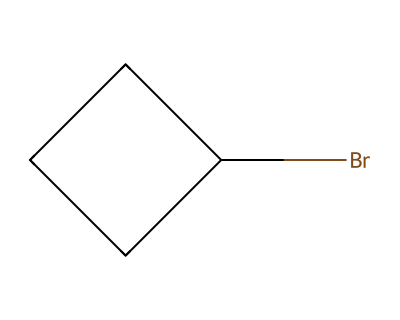
›Reveal solutionSolution
An intramolecular Wurtz reaction joins C-1 to C-3 of the ring, forming a transannular bond: bicyclo[1.1.0]butane.
Step 1 — What Na/dry ether does.
This is the Wurtz reaction. Sodium removes the halogens and couples the two carbons that carried them:
2R−X+2Nadry etherR−R+2NaX
Mechanistically Na transfers an electron to give a carbon radical / organosodium (R−Na), which then attacks the second C−X carbon in an SN2-like step. The reaction is run in dry ether because R−Na is instantly destroyed by water.
Step 2 — Notice both halogens are in the same molecule.
1-Bromo-3-chlorocyclobutane has Br on C-1 and Cl on C-3 — 1,3 across a four-membered ring, i.e. on diagonally opposite carbons. When one of them becomes the carbanion/radical, its partner electrophilic carbon is right there in the same molecule, held only two bonds away.
Step 3 — So the coupling is intramolecular.
The C-1 carbon bonds directly to C-3, forming a new transannular C–C bond straight across the square and expelling NaBr and NaCl:
1-Br-3-Cl-cyclobutane2Nadry etherbicyclo[1.1.0]butane+NaBr+NaCl …
- KCET 2024Set B-21 markMCQQ.Propanone and Propanal are : (A) Position isomers (B) Functional isomers (C) Chain isomers (D) Geometrical isomers
›Reveal solutionSolution
Same molecular formula C3H6O, different functional groups (ketone vs aldehyde) ⇒ functional isomerism.
1. Write both structures and check the formula.
- Propanone (acetone): CH3−∥CO−CH3 — a ketone; carbonyl carbon is C-2, flanked by two alkyl groups. Formula: C₃H₆O.
- Propanal: CH3−CH2−CHO — an aldehyde; carbonyl carbon is terminal (C-1), bearing an H. Formula: C₃H₆O.
They have the same molecular formula (C3H6O), so they are certainly isomers. The question is which kind.
2. The concept — classifying structural isomerism.
- Chain isomers — same functional group, different carbon skeleton (e.g. butane / isobutane).
- Position isomers — same functional group and same skeleton, group at a different position (e.g. propan-1-ol / propan-2-ol).
- Functional isomers — the atoms are rearranged so that a different functional group appears (e.g. ethanol / dimethyl ether).
- Geometrical isomers — a stereoisomerism (cis/trans), requiring restricted rotation about a C=C and two different groups on each doubly-bonded carbon.
3. Apply it. …
- KCET 2024Set B-21 markMCQQ.But-1-yne on reaction with dil. H2SO4 in presence of Hg2+ ions at 333 K gives : (A)
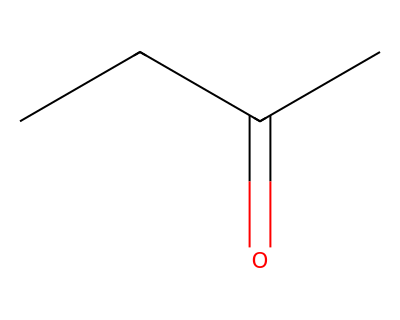 (B)
(B) 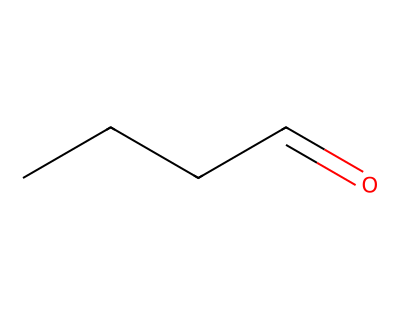 (C)
(C) 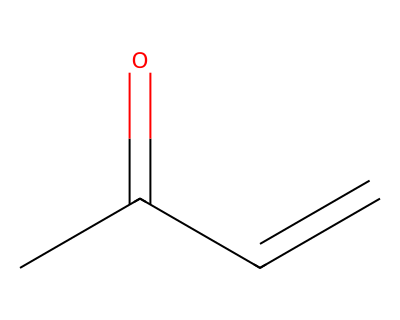 (D)
(D) 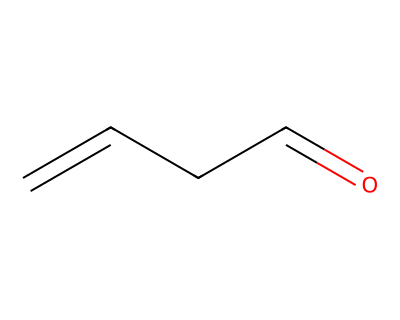
›Reveal solutionSolution
Markovnikov hydration of a terminal alkyne ⇒ enol ⇒ keto tautomer: every terminal alkyne except acetylene gives a methyl ketone.
Step 1 — The reagent and the rule.
Dilute H2SO4 with Hg2+ (mercuric sulphate) at 333 K is the classic hydration of an alkyne. Water adds across the triple bond following Markovnikov's rule: the −OH goes to the more substituted carbon (the one bearing fewer hydrogens), because that route passes through the more stable carbocation / mercurinium intermediate.
Step 2 — Add water to but-1-yne.
CH3CH2−C≡CH+H2OH2SO4/Hg2+CH3CH2−OHC=CH2
The −OH attaches to C-2 (the internal, more substituted alkyne carbon), giving the enol but-1-en-2-ol.
Step 3 — Keto–enol tautomerism.
Enols are unstable and rapidly rearrange to the far more stable keto form (the C=O bond is much stronger than C=C):
CH3CH2−C(OH)=CH2⇌CH3CH2−CO−CH3
Product=butan-2-one (ethyl methyl ketone). …
- COMEDK 2024Set 2024-A1 markMCQQ.Which of the following compounds will show geometrical isomerism? (A) 1, 2-dibromopropene (B) 2-methylbut-2-ene (C) 2-methylpropene (D) 1, 1-diphenylethylene
›Reveal solutionSolution
Geometrical isomerism requires each doubly-bonded carbon to bear two different substituents. Only 1,2-dibromopropene satisfies this; the others have a =CH2 or a C(CH3)2/C(C6H5)2 terminus with two identical groups.
Check each alkene:
- (A) 1,2-dibromopropene, CH3−CBr=CHBr: one sp2 carbon bears CH3 and Br (different), the other bears H and Br (different) → shows cis/trans isomerism.
- (B) 2-methylbut-2-ene, (CH3)2C=CHCH3: one carbon has two identical CH3 groups → no geometrical isomerism. …
- COMEDK 2024Set 2024-M1 markMCQQ.Which one of the following compounds shows Geometrical isomerism? (A) 2-Methylhex-2-ene (B) 4-Methylhex-2-ene (C) 2-Methylhex-1-ene (D) 4-Methylhex-1-ene
›Reveal solutionSolution
Geometrical isomerism requires a double bond with two different substituents on each carbon. Only 4‑Methylhex‑2‑ene satisfies this condition, so the correct option is (B).
Concept & Intuition
Geometrical (cis‑trans) isomerism arises when rotation about a bond is restricted—typically a C=C double bond—and each of the two sp² carbons bears two different groups. If either carbon has two identical substituents, swapping groups around the double bond yields the same molecule, not an isomer. So the key is to check each alkene’s double‑bond carbons for two distinct substituents.
Step‑by‑step analysis
-
Draw the structure of each compound and label the double‑bond carbons.
- (A) 2‑Methylhex‑2‑ene: The double bond is between C2 and C3. C2: attached to –CH₃, –CH₃ (from the methyl branch), and –CH₂CH₂CH₃. Two identical methyl groups on C2 → no geometrical isomerism.
- (B) 4‑Methylhex‑2‑ene: Double bond between C2 and C3. C2: attached to –H and –CH₃ (different). C3: attached to –H and –CH(CH₃)CH₂CH₃ (different). Both carbons have two different groups → geometrical isomers exist (cis/trans).
- (C) 2‑Methylhex‑1‑ene: Double bond at terminal C1. C1: attached to two –H atoms (identical). Terminal alkene → no geometrical isomerism.
- (D) 4‑Methylhex‑1‑ene: Again a terminal double bond (C1). C1: two –H atoms. Same as (C) → no geometrical isomerism.
-
Confirm the condition
For (B), the two possible arrangements are: …
-
- KCET 2023Set D-21 markMCQQ.The correct order of match between column X and column Y is : X I. Vitamin A II. Vitamin D III. Vitamin E IV. Vitamin K Y i. Muscular weakness ii. Increased blood clotting time iii. Night-blindness iv. Osteomalacia (A) I - iv, II - iii, III - ii, IV - i (B) I - ii, II - i, III - iii, IV - iv (C) I - iii, II - ii, III - iv, IV - i (D) I - iii, II - iv, III - i, IV - ii
›Reveal solutionSolution
Match each fat-soluble vitamin to its classic deficiency symptom, then read off the option.
Step 1 — The concept
All four vitamins here (A, D, E, K) are the fat-soluble vitamins. Each has one signature deficiency disease, which is exactly what the question tests.
Step 2 — Pair them one at a time
I. Vitamin A (retinol) → (iii) Night-blindness.
Retinal, an oxidation product of retinol, combines with opsin to form rhodopsin, the pigment of the rod cells that gives vision in dim light. Without vitamin A the rods cannot regenerate rhodopsin → nyctalopia (night-blindness); severe deficiency gives xerophthalmia.
II. Vitamin D (calciferol) → (iv) Osteomalacia.
Vitamin D drives intestinal absorption of Ca2+ and phosphate. Deficiency leaves the bone matrix under-mineralised → rickets in children and osteomalacia (soft bones) in adults.
III. Vitamin E (tocopherol) → (i) Muscular weakness.
Vitamin E is the membrane antioxidant that protects polyunsaturated lipids from peroxidation. Deficiency damages muscle and nerve membranes → muscular weakness / muscular dystrophy and sterility.
IV. Vitamin K (phylloquinone) → (ii) Increased blood-clotting time. …
- KCET 2023Set D-21 markMCQQ.Aqueous solution of raw sugar when passed over beds of animal charcoal, it becomes colourless. Pick the correct set of terminologies that can be used for the above example. (A) Solution of Sugar, Animal Charcoal, Sorption (B) Animal Charcoal, Solution of Sugar, Absorption (C) Animal Charcoal, Colouring substance, Adsorption (D) Colouring Substance, Animal Charcoal, Adsorption
›Reveal solutionSolution
Animal charcoal is the adsorbent, the coloured impurity is the adsorbate, and its surface-only accumulation makes the process adsorption.
Step 1 — Fix the definitions.
- Adsorption: accumulation of a substance only at the surface of another, so its concentration on the surface is higher than in the bulk.
- Absorption: the substance is distributed uniformly throughout the bulk of the other.
- Sorption: the term used when adsorption and absorption occur together (e.g. dyes on cotton fibre).
- Adsorbent: the surface on which accumulation happens.
- Adsorbate: the substance that gets accumulated on the surface.
Step 2 — Identify the players in this experiment.
Raw sugar solution is passed over beds of animal charcoal. Charcoal is a highly porous solid with an enormous surface area → it is the adsorbent.
What sticks to that surface is not the sugar (the sugar stays in solution — that is the whole point of the purification) but the coloured impurity. Hence the colouring substance is the adsorbate.
Step 3 — Name the phenomenon. …
- KCET 2023Set D-21 markMCQQ.A pair of compounds having the same boiling points are (A) cis but-2-ene and trans but-2-ene (B) n-hexane and neo-hexane (C) benzene and naphthalene (D) (+) butan-2-ol and (–) butan-2-ol
›Reveal solutionSolution
Only enantiomers share identical physical constants in an achiral environment — every other pair here differs in polarity, branching or molar mass, so their boiling points differ.
Step 1 — The concept
Boiling point is fixed by the strength of intermolecular forces (and by molecular mass/shape). Two compounds boil at the same temperature only if their intermolecular interactions are identical — which, in an achiral environment, is true only for a pair of enantiomers.
Step 2 — Test each pair
(A) cis- and trans-but-2-ene — DIFFERENT.
The cis isomer has a small net dipole moment (the two methyl groups on the same side, so the bond dipoles do not cancel); the trans isomer is symmetric and has μ≈0. Extra dipole–dipole attraction makes cis boil higher (∼3.7∘C) than trans (∼0.9∘C). (Their melting points reverse, because the symmetric trans packs better in the crystal.)
(B) n-hexane and neo-hexane — DIFFERENT.
Same molecular formula C6H14, but branching reduces the surface area available for van der Waals contact. n-Hexane (linear, b.p. 69∘C) boils well above neo-hexane (2,2-dimethylbutane, b.p. 50∘C). More branching → lower boiling point.
(C) benzene and naphthalene — DIFFERENT.
Quite different molar masses (78 vs 128 g mol−1) and hence very different dispersion forces: benzene boils at 80∘C, naphthalene at 218∘C. …
- COMEDK 2023Set 2023-E1 markMCQQ.Which of the following will show geometrical isomerism? (A) 2-methylbut-2-ene (B) 2-methylpropene (C) Cyclohexene (D) 1,2-dibromopropene
›Reveal solutionSolution
Only 1,2-dibromopropene has two different groups on each C=C carbon, so it exhibits geometrical isomerism.
Geometrical (cis–trans) isomerism requires that neither carbon of the C=C bond carries two identical substituents.
- (A) 2-methylbut-2-ene (CH3)2C=CHCH3 — one carbon bears two identical CH3 groups → no.
- (B) 2-methylpropene (CH3)2C=CH2 — one carbon has two CH3, the other two H → no.
- (C) Cyclohexene — the ring constrains it to cis only → no. …
- KCET 2021Set B-21 markMCQQ.
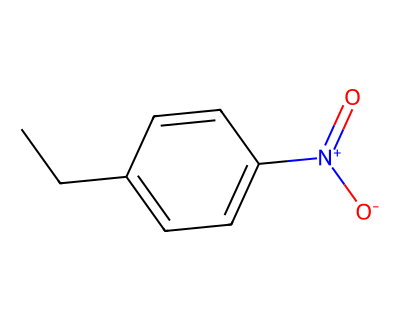 Br2UV Light A. The compound A (major product) is
(A)
Br2UV Light A. The compound A (major product) is
(A) 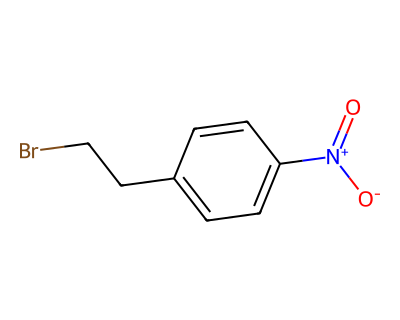 (B)
(B) 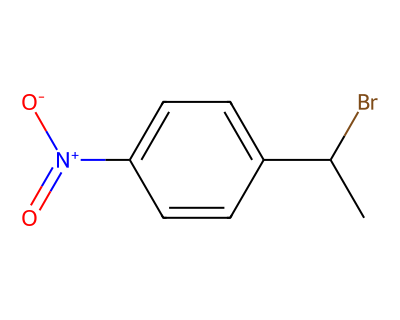 (C)
(C) 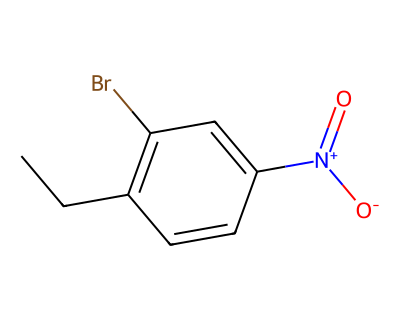 (D)
(D) 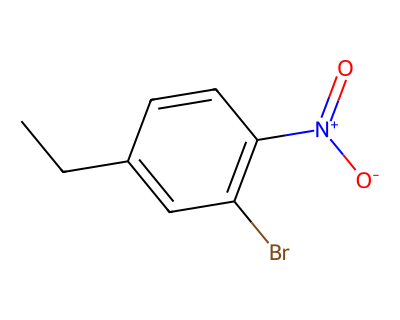
›Reveal solutionSolution
UV light + Br2 = free-radical side-chain halogenation; the most stable radical (the resonance-stabilised benzylic one) is formed, so Br lands on the carbon attached to the ring.
Step 1 — Decide ring vs side chain from the conditions.
Alkylbenzenes react with halogens by two mutually exclusive routes:
- Br2 / Lewis acid (FeBr3, AlCl3), dark → ring (electrophilic) substitution;
- Br2 / UV light or heat, NO Lewis acid → side-chain (free-radical) substitution.
Here the only condition is UV light, so this is a free-radical side-chain reaction. That immediately eliminates (C) and (D), which both leave the ethyl group intact and put Br on the ring.
Step 2 — Free-radical mechanism.
Initiation: Br2hν2Br∙.
Propagation: Br∙ abstracts a hydrogen from the side chain, forming a carbon radical, which then takes a Br from Br2.
The product is decided by which hydrogen is abstracted, and that is governed by the stability of the radical formed.
Step 3 — Which side-chain hydrogen?
The ethyl group offers two kinds of H:
- the benzylic hydrogens on −CH2− (attached directly to the ring);
- the primary hydrogens on the terminal −CH3. …
- KCET 2021Set B-21 markMCQQ.The product ‘A’ gives white precipitate when treated with bromine water. The product ‘B’ is treated with Barium hydroxide to give the product C. The compound C is heated strongly to form product D. The product D is (A) 4-Methylpent-3-en-2-one (B) But-2 enal (C) 3-Methylpent-3-en-2-one (D) 2-Methylbut-2-enal
›Reveal solutionSolution
'A' is the aldol-condensation product mesityl oxide (its C=C bond decolourises bromine water), and the sequence delivers the same α,β-unsaturated ketone as the final product D — 4-methylpent-3-en-2-one, option (A).
Identifying 'A'. A compound that decolourises bromine water and forms a white addition product contains a carbon–carbon double bond. Here it is the α,β-unsaturated methyl ketone mesityl oxide, formed by base-catalysed aldol condensation of acetone followed by dehydration:
2CH3COCH3⟶CH3COCH=C(CH3)2+H2O. …
🎓Unlock everything free for 14 days
- ✓Full step-by-step solutions
- ✓Concept-first explanations
- ✓Methods, shortcuts & mistakes
- ✓PYQ mapping + timed mock tests
Full access for 14 days. No credit card required.