Chemistry · Ch 7 — Redox Reactions
Redox Reactions and Electrode Processes
Redox Reactions and Electrode Processes
From Direct Transfer to Indirect Flow: The Daniell Cell
The reaction between zinc metal and copper(II) sulphate — zinc displacing copper — is a classic redox process. When you simply dip a zinc rod into a copper sulphate solution, electrons transfer directly from zinc atoms to copper ions at the surface of contact. Zinc oxidises to Zn²⁺, copper ions reduce to Cu metal, and the energy released appears as heat.
But what if we force those electrons to travel a longer path — through a wire — before they reach the copper ions? That is the idea behind an electrochemical cell. By separating the two half-reactions physically, we can harness the electron flow as useful electrical work.
Setting Up the Separation
Take two beakers. In one, place a copper strip immersed in copper sulphate solution. In the other, place a zinc rod immersed in zinc sulphate solution. In each beaker, at the metal–solution interface, both the oxidised and reduced forms of the same element are present:
- In the zinc beaker: Zn²⁺ (oxidised form) and Zn (reduced form)
- In the copper beaker: Cu²⁺ (oxidised form) and Cu (reduced form)
These pairs — Zn²⁺/Zn and Cu²⁺/Cu — are called redox couples. A redox couple is defined as the pair consisting of the oxidised and reduced forms of a substance involved in a half-reaction. By convention, the oxidised form is written first, separated from the reduced form by a vertical line or a slash that represents the interface between phases (solid/solution here).
Now connect the two solutions with a salt bridge — a U-tube filled with a solution of KCl or NH₄NO₃, often solidified with agar-agar to a jelly-like consistency. The salt bridge provides electrical contact between the two solutions without allowing them to mix. Connect the zinc and copper rods through a metallic wire that includes an ammeter and a switch. This complete assembly is the Daniell cell (Figure 7.3 in the textbook).
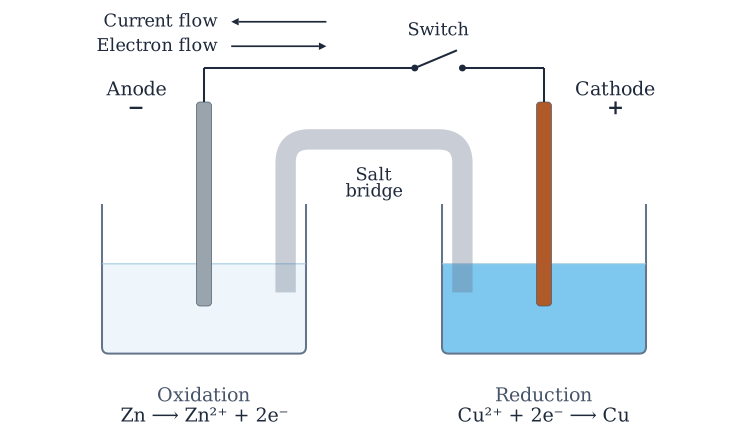
Drawn by us to help you understand the concept clearly, and verified to make sure it's accurate. For exams, practice from your textbook's own diagram.
The Daniell cell is the classic example of a redox reaction redesigned so that electron transfer happens indirectly, through an external wire, rather than by direct contact between the reactants. Figure 7.3 shows exactly this arrangement.
Two separate beakers sit side by side. One contains a zinc rod dipped in zinc sulphate solution (); the other contains a copper rod dipped in copper sulphate solution (). A U-shaped tube — the salt bridge — connects the two solutions, filled with an inert electrolyte like KCl or set in a gel. This bridge completes the electrical circuit inside the cell by allowing ions to migrate between the beakers, but it prevents the solutions from mixing.
The two metal rods are connected externally by a wire that runs through a switch and an ammeter. When the switch is off, no current flows and no net reaction occurs. When the switch is closed, the ammeter registers a current, and electrons flow through the wire from the zinc electrode to the copper electrode.
The direction of electron flow is the key physical idea. At the zinc electrode, zinc atoms lose electrons and go into solution as ions — this is oxidation. The electrons travel along the wire to the copper electrode, where ions from solution gain those electrons and deposit as copper metal — reduction. So the zinc electrode acts as the anode (negative terminal) and the copper electrode as the cathode (positive terminal). The textbook notes that the conventional current direction is opposite to the electron flow.
A common mistake is to think electrons flow through the salt bridge. They do not. The salt bridge carries only ions — positive ions move toward the cathode compartment, negative ions toward the anode compartment — to maintain electrical neutrality in both half-cells. The electrons travel exclusively through the external wire.
Each metal rod in contact with its own salt solution forms a redox couple, written as and , with the oxidised form written first. The potential difference that drives the electrons arises because each couple has a characteristic tendency to gain or lose electrons. That tendency is quantified by the electrode potential, . When all species are at unit concentration (1 M for solutions, 1 atm for gases) and the temperature is 298 K, the potential is the standard electrode potential, .
The standard potentials are tabulated in Table 7.1 of the textbook. For the Daniell cell, the relevant half-reactions and their standard reduction potentials are:
The more positive (or less negative) the reduction potential, the greater the tendency for that species to be reduced. Here, has a much stronger tendency to gain electrons than . So when the cell is connected, is reduced at the copper electrode, and is forced to be oxidised at the zinc electrode.
The overall cell reaction is obtained by reversing the zinc half-reaction (since it actually undergoes oxidation) and adding:
The cell potential, , is the difference between the reduction potentials of the two half-cells:
For the Daniell cell, using standard values:
…
What Happens When the Switch Closes
With the switch off, nothing happens — no reaction, no current. The moment the switch is turned on, two observations become clear:
-
Electrons flow through the wire. The transfer of electrons no longer happens directly from Zn to Cu²⁺. Instead, electrons travel from the zinc rod, through the metallic wire, to the copper rod. The ammeter shows a current. (Remember: conventional current direction is opposite to electron flow.)
-
Ions migrate through the salt bridge. For the circuit to be complete, charge must also move through the solutions. Ions in the salt bridge migrate — anions toward the zinc side, cations toward the copper side — maintaining electrical neutrality in both beakers as the reaction proceeds.
The salt bridge does not allow the two solutions to mix. It only permits ion migration to complete the circuit. Without it, charge would build up in one beaker and the reaction would quickly stop.
Electrode Potential: The Driving Force
Why do electrons flow at all? Because there is a potential difference between the two metal rods — now called electrodes. Each electrode, when dipped in its own salt solution, develops a characteristic potential. This is the electrode potential, a measure of the tendency of the species at that electrode to gain or lose electrons.
If the concentration of every species involved in the electrode reaction is 1 M (unity), any gas involved is at 1 atm pressure, and the temperature is 298 K, the potential is called the Standard Electrode Potential, denoted .
By international convention, the standard electrode potential of the hydrogen electrode (the H⁺/H₂ couple) is set at exactly 0.00 V. All other standard potentials are measured relative to this reference.
The standard electrode potential for a half-reaction is a quantitative measure of the tendency of the oxidised form to get reduced (or, equivalently, of the reduced form to get oxidised). A more positive means a stronger oxidising agent; a more negative means a stronger reducing agent.
What the Sign of Tells You
The textbook states two key properties based on the sign of relative to the H⁺/H₂ couple:
Property 1: A negative means the redox couple is a stronger reducing agent than the H⁺/H₂ couple.
Why? A negative for the reduction half-reaction (oxidised form + reduced form) means that the reduced form has a strong tendency to lose electrons — i.e., to be oxidised. Compared to H₂, which has V, a couple with negative is more willing to give up electrons. For example, Zn²⁺/Zn has V. Zinc metal is a stronger reducing agent than H₂ gas.
Property 2: A positive means the redox couple is a weaker reducing agent than the H⁺/H₂ couple.
Why? A positive indicates that the oxidised form has a strong tendency to gain electrons — i.e., to be reduced. The reduced form, therefore, is reluctant to lose electrons. Compared to H₂, such a couple is a weaker reducing agent. For example, Cu²⁺/Cu has V. Copper metal is a weaker reducing agent than H₂ gas.
Do not confuse the sign convention. A negative does NOT mean the reaction is "bad" or impossible. It simply means the reduced form is a stronger reducing agent than H₂. The more negative the value, the stronger the reducing agent.
The Standard Electrode Potential Table
The textbook provides Table 7.1, listing standard electrode potentials at 298 K for selected reduction half-reactions. The reactions are written as reductions (oxidised form + reduced form). Ions are aqueous unless stated; H₂O is liquid; gases and solids are marked (g) and (s).
| Reaction (Oxidised form + → Reduced form) | /V |
|---|---|
| 2.87 | |
| 1.81 | |
| 1.78 | |
| 1.51 | |
| 1.40 | |
| 1.36 | |
| 1.33 | |
| 1.23 | |
| 1.23 | |
| 1.09 | |
| 0.97 | |
| 0.92 | |
| 0.80 | |
| 0.77 | |
| 0.68 | |
| 0.54 | |
| 0.52 | |
| 0.34 | |
| 0.22 | |
| 0.10 | |
| 0.00 | |
| −0.13 | |
| −0.14 | |
| −0.25 | |
| −0.44 | |
| −0.74 | |
| −0.76 | |
| −0.83 | |
| −1.66 | |
| −2.36 | |
| −2.71 |
…