Physics · Ch 7 — Gravitation
Kepler's Laws
Kepler's Laws
7.2 Kepler's Laws
The motion of planets across the night sky had been studied for centuries before Johannes Kepler, working with the precise observations of Tycho Brahe, finally broke free from the ancient assumption that planetary paths must be perfect circles. Kepler's three laws describe not just how planets move, but reveal the geometry of the Solar System itself.
Law of Orbits (Kepler's First Law)
Every planet moves in an elliptical orbit with the Sun at one focus of the ellipse.
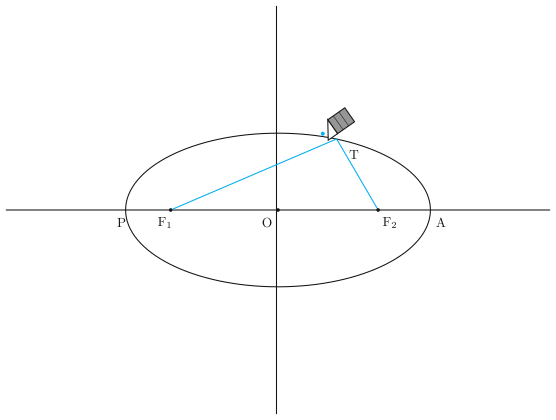
This was a radical departure from the Copernican model, which insisted on circular orbits. An ellipse is a closed curve you can draw with a simple construction: fix the ends of a string at two points and (the foci), stretch the string taut with a pencil, and move the pencil around. For any point on the ellipse, the sum of the distances from to and remains constant.
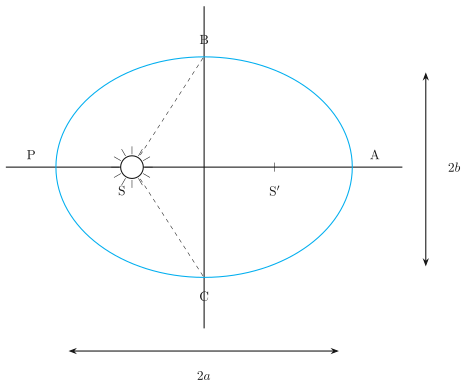
The line joining the two foci is extended to meet the ellipse at two points: the closest point (perihelion) and the farthest point (aphelion). The midpoint of is the centre of the ellipse. The distance is called the semi-major axis. For a circle, the two foci merge into one, and the semi-major axis becomes the radius.
The Sun is at one focus — not at the centre of the ellipse. This means the planet's distance from the Sun changes continuously as it orbits.
Law of Areas (Kepler's Second Law)
The line joining a planet to the Sun sweeps out equal areas in equal intervals of time.
This law follows directly from observations: planets appear to move slower when farther from the Sun and faster when nearer. The physical reason is deeper — it is a consequence of conservation of angular momentum under a central force.
Derivation from Angular Momentum
Let the Sun be at the origin. The planet of mass has position vector and momentum . In a small time interval , the area swept out by the radius vector is approximately the area of a triangle:
Dividing by :
where is the magnitude of the angular momentum.
For a central force — one always directed along the line joining the planet to the Sun — the torque about the Sun is zero, so angular momentum is constant. Therefore is constant. This is the law of areas.
Gravitation is a central force. Hence Kepler's second law is a direct consequence of the conservation of angular momentum.
Example: Perihelion and Aphelion Speeds
Let be the speed at perihelion and the Sun-planet distance there. Similarly, let and be the speed and distance at aphelion . At both points, the velocity is perpendicular to the radius vector (the planet moves tangentially at these extreme points).
Angular momentum conservation gives:
Therefore:
Since , we get — the planet moves fastest at perihelion and slowest at aphelion.
A common mistake is to think the planet takes equal time to traverse any two arcs of equal length. Kepler's second law says equal areas are swept in equal times, not equal arc lengths. The area (near aphelion) is larger than (near perihelion) for arcs of similar angular span, so the planet takes longer to traverse than .
Law of Periods (Kepler's Third Law)
The square of the time period of revolution of a planet is proportional to the cube of the semi-major axis of its elliptical orbit:
Confirmation from Data …
Drawn by us to help you understand the concept clearly, and verified to make sure it's accurate. For exams, practice from your textbook's own diagram.
The figure shows the elliptical orbit of a planet around the Sun. The ellipse is drawn with its major axis horizontal. The Sun sits at one of the two foci, labelled S; the other focus is S'. The planet moves along the blue ellipse, and its position changes with time.
The two special points on the major axis are the vertices of the ellipse. The left vertex is labelled P (perihelion) — this is the point where the planet is closest to the Sun. The right vertex is labelled A (aphelion) — the farthest point from the Sun. The straight line segment AP is the major axis of the ellipse, and the figure marks its half-length, the semimajor axis, with the label a. A horizontal double-arrow below the ellipse shows the full length .
The minor axis runs vertically through the centre of the ellipse. Its endpoints are labelled B (top) and C (bottom). A vertical double-arrow on the right side of the figure shows the full length of the minor axis as . The dashed lines from B and C to the two foci S and S' form a rhombus — this is a visual hint that the sum of the distances from any point on the ellipse to the two foci is constant and equal to .
The dashed rhombus is not an orbit; it is a geometric construction that illustrates the constant-sum property of an ellipse: for any point on the curve, . …
Drawn by us to help you understand the concept clearly, and verified to make sure it's accurate. For exams, practice from your textbook's own diagram.
The figure shows the classic gardener’s construction of an ellipse. Two fixed points, and , are marked on a horizontal line. A string of fixed length has its ends tied at and . A pencil tip at point holds the string taut, so the two straight segments from to and from to are always under tension. As the pencil moves, the string length remains constant, and the pencil traces the closed curve — an ellipse.
The horizontal axis through and is the major axis. The midpoint of is the centre of the ellipse. The points where the ellipse meets the major axis are labelled and the opposite end (not named in the description), so is the semi-major axis of length . The fixed points and are the foci (singular: focus). The distance from the centre to each focus is , so .
The physical idea is simple: the sum of the distances from any point on the ellipse to the two foci is constant. For the pencil at ,
That constant is exactly the length of the string. When the pencil is at (the farthest point on the right), both string segments lie along the major axis, and the sum equals . So the constant is :
This single relation is the definition of an ellipse. From it, the textbook derives the standard equation. If you place the centre at the origin and the major axis along the -axis, the coordinates of the foci are . For a point on the ellipse, the distance-sum condition gives
Squaring and simplifying (a standard algebraic exercise) leads to
where . The quantity is the semi-minor axis — half the length of the shorter vertical axis through .
A common mistake is to think the string is attached at the pencil. It is not — the string is fixed at the foci, and the pencil merely holds it taut. The pencil does not shorten or lengthen the string; it only keeps it stretched. …
Drawn by us to help you understand the concept clearly, and verified to make sure it's accurate. For exams, practice from your textbook's own diagram.
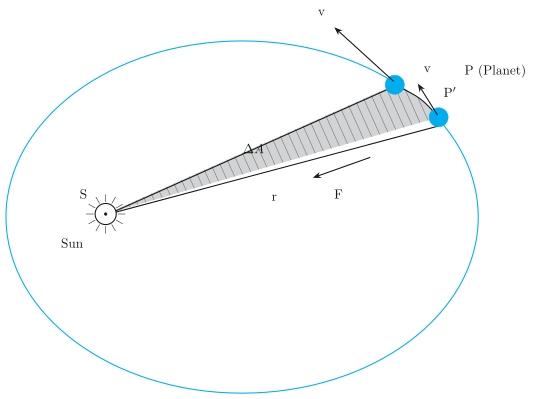
The figure shows an elliptical orbit drawn in blue, with the Sun placed at the left focus of the ellipse. The planet is shown at a point P on the right side of the orbit. A straight line from the Sun to P is labelled r — this is the radius vector, the instantaneous distance between the Sun and the planet. At P, a small arrow labelled v points tangent to the orbit, showing the planet’s instantaneous velocity. A second position P' is marked a short distance ahead along the orbit, with its own velocity vector v drawn tangent there as well. A small arrow labelled F points from P back toward the Sun, representing the gravitational force that always acts along the radius vector.
Two grey shaded sectors are shown. One is a thin wedge centred at the Sun, sweeping from the radius vector at P to the radius vector at P'. This wedge is labelled ΔA — it is the area swept out by the radius vector in a small time interval Δt. The other shaded sector is identical in shape and area, placed elsewhere on the orbit to emphasise that equal areas are swept in equal times.
The physical idea is Kepler’s second law: the radius vector from the Sun to a planet sweeps out equal areas in equal intervals of time. The figure makes this geometric. Because the force is central (always along r), the angular momentum of the planet is conserved. The area swept per unit time is directly proportional to the angular momentum per unit mass.
Here is the areal velocity (area swept per unit time), is the angular momentum of the planet about the Sun, and is the planet’s mass. Since is constant for a central force, is constant — hence equal areas in equal times.
The textbook also derives from this figure the relation for the area of an elliptical sector:
where is the small angle through which the radius vector turns in time , and is the instantaneous distance. Dividing by and taking the limit gives , with the angular speed. Equating this to and using confirms the consistency. …
| Planet | a | T | Q |
|---|---|---|---|
| Mercury | 5.79 | 0.24 | 2.95 |
| Venus | 10.8 | 0.615 | 3.00 |
| Earth | 15.0 | 1 | 2.96 |
| Mars | 22.8 | 1.88 | 2.98 |
| Jupiter | 77.8 | 11.9 | 3.01 |
| Saturn | 143 | 29.5 | 2.98 |