Physics · Ch 4 — Laws of Motion
Common Forces in Mechanics
Common Forces in Mechanics
Common Forces in Mechanics
In mechanics, we deal with several kinds of forces. The gravitational force is everywhere — every object on Earth experiences it, and it governs the motion of planets and stars. Gravity acts at a distance, requiring no intervening medium. All other forces commonly encountered in mechanics are contact forces: they arise only when one object touches another, whether solid or fluid.
When two bodies are in contact — a book on a table, a system of rods connected by hinges — there are mutual contact forces between each pair, satisfying Newton's third law. The contact force has two perpendicular components: the component normal to the surfaces in contact is called the normal reaction; the component parallel to the surfaces is called friction.
Contact forces also arise when solids interact with fluids. For a solid immersed in a fluid, there is an upward buoyant force equal to the weight of the fluid displaced. Viscous forces, air resistance, and drag are other examples of contact forces.
Two other common forces deserve special attention: tension in a string and the spring force.
The Spring Force
When a spring is compressed or stretched by an external force, a restoring force is generated. For small displacements from the unstretched (natural) length, this force is proportional to the displacement. The spring force is written as
where is the displacement from the unstretched state and is the force constant (or spring constant). The negative sign indicates that the force always opposes the displacement — it tries to restore the spring to its natural length.
The spring force is a restoring force: it always acts opposite to the direction of displacement from equilibrium. The larger the force constant , the stiffer the spring.
Tension in a String
For an inextensible string, the force constant is effectively very high — the string does not stretch appreciably under ordinary forces. The restoring force in a string is called tension. It is customary to treat the tension as constant throughout the string. This assumption holds true for a string of negligible mass.
Tension is always a pull, never a push. A string can only exert force along its length, pulling on whatever is attached at its ends. If the string is massless and inextensible, the tension is the same at every point.
The Microscopic Origin of Contact Forces
There are four fundamental forces in nature: gravitational, electromagnetic, strong nuclear, and weak nuclear. The strong and weak forces operate at subatomic scales and do not concern us in mechanics. Only gravitational and electrical forces are relevant here. …
Drawn by us to help you understand the concept clearly, and verified to make sure it's accurate. For exams, practice from your textbook's own diagram.
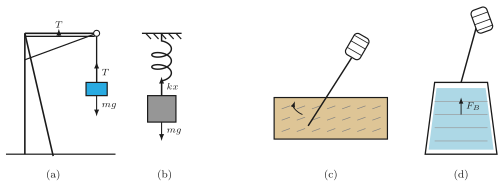
Fig. 4.9 shows four everyday situations, each illustrating a different kind of contact force -- a force that arises only because one body is touching another, as opposed to gravity, which acts even across empty space.
The first panel shows a crane hoisting a block. The rope running from the block, up over the crane's boom, and across to the tower is under tension, marked T at two points along its length. Tension is the pulling force a stretched rope, string, or cable exerts along its own length; it is the same throughout an ideal (massless, inextensible) rope, which is why both marked segments carry the same label T. The block hangs in equilibrium, so the rope's upward tension must balance its downward weight mg.
The second panel shows a mass hanging from a spring fixed to the ceiling. When a spring is stretched (or compressed) from its natural length, it pushes or pulls back with a restoring force, marked kx here -- proportional to the displacement x, with k the spring's force constant. This is Hooke's law, F = -kx, where the minus sign shows the force always opposes the displacement that caused it. The hanging mass stretches the spring until kx grows large enough to balance its weight mg, exactly as the rope's tension balanced the block's weight in the first panel.
The third panel shows a hand stirring a rigid rod into a tray of wet sand. As the rod pushes into the sand, the sand pushes back on the rod -- a resistive contact force from a granular medium, similar in spirit to friction. This force opposes the rod's motion through the sand and is what you feel as resistance when you push any object into a dense, packed material.
The fourth panel shows straws held upright in a glass of water. A solid partly submerged in a fluid experiences an upward buoyant force, equal to the weight of the fluid it displaces -- this is why the straws feel a gentle push and why objects immersed in water seem to weigh less. Viscous drag as the straws move through the water is another example of the same family of fluid contact forces. …