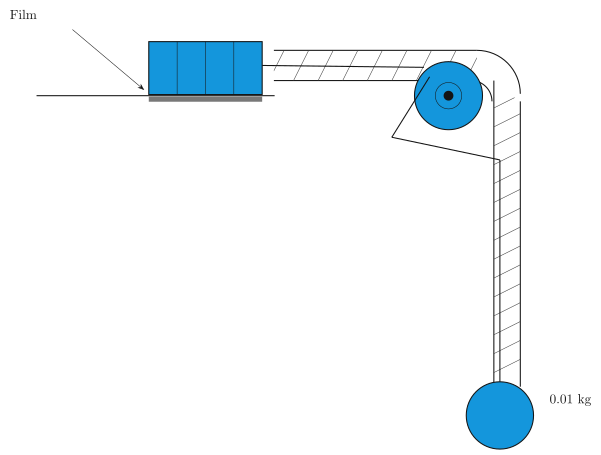
Q.A metal block of area 0.10 m2 is connected to a 0.010 kg mass via a string that passes over an ideal pulley (considered massless and frictionless). A liquid with a film thickness of 0.30 mm is placed between the block and the table. When released the block moves to the right with a constant speed of 0.085 m s−1. Find the coefficient of viscosity of the liquid.
🔒You're viewing a preview — the full solution, concept, methods & PYQ mapping are locked.
🔒 Start your 14-day free trial to unlock the full solution →Concept understanding — Viscous Force Balance
Viscous Force Balance: From Intuition to Precision
Imagine you're pushing a heavy box across a rough floor. The harder you push, the faster it moves — but there's a constant resistance from the floor trying to slow it down. If you push with a steady force, the box eventually moves at a constant speed. At that moment, your pushing force exactly equals the friction force. The box is in force balance.
Now replace the box with a tiny sphere falling through honey. The honey resists the motion — that resistance is a viscous force. As the sphere speeds up, the viscous force grows. Eventually, it becomes large enough to exactly balance the weight pulling the sphere down. The sphere then falls at a constant speed (terminal velocity). That's viscous force balance in action.
The Core Idea
Viscous force balance occurs when the net viscous (drag) force on an object moving through a fluid exactly cancels all other forces acting on it, resulting in zero net force and therefore constant velocity (no acceleration).
This is just Newton's first law applied to a fluid environment: if the sum of forces is zero, the object moves with constant velocity — it doesn't speed up or slow down.
The Precise Statement
For an object moving through a viscous fluid, the equation of motion is:
mdtdv=Fother−Fviscous
where:
- Fother is the sum of all non-viscous forces (gravity, buoyancy, applied forces, etc.)
- Fviscous is the drag force from the fluid
Viscous force balance is the condition:
Fviscous=Fother
which gives dtdv=0, i.e., constant velocity.
The Two Common Forms of Viscous Force
The exact expression for Fviscous depends on the flow regime:
| Regime | Viscous Force Formula | When It Applies |
|---|---|---|
| Stokes' law (low speed, small object) | F=6πηrv | Slow, streamlined flow (low Reynolds number) |
| Quadratic drag (high speed) | F=21CdρAv2 | Turbulent flow (high Reynolds number) |
Here η is fluid viscosity, r is object radius, ρ is fluid density, A is cross-sectional area, Cd is drag coefficient.
A Concrete Example: The Falling Sphere
Consider a sphere of mass m and radius r falling through a viscous fluid of density ρf. The forces are:
- Weight downward: mg
- Buoyancy upward: 34πr3ρfg
- Viscous drag upward (Stokes' law): 6πηrv
The net downward force is:
Fnet=mg−34πr3ρfg−6πηrv
At balance, Fnet=0, so:
mg−34πr3ρfg=6πηrv
Solving for the terminal velocity:
vt=6πηrmg−34πr3ρfg
The numerator is the effective weight (true weight minus buoyancy). The denominator is the viscous resistance coefficient. Terminal velocity is reached when these balance.
Why This Matters
Viscous force balance is not just a textbook concept — it's the principle behind:
- Sedimentation: particles settling in a liquid (used in water treatment, blood tests) …
Concept: Viscous Force Balance — at constant speed, the viscous drag on the block equals the weight of the hanging mass.
Step 1: Identify the forces.
The hanging mass m=0.010 kg provides a tension T=mg. Since the pulley is ideal and the block moves at constant speed (zero acceleration), the tension equals the viscous force F on the block.
Step 2: Write the viscous force formula.
For a thin film of liquid between two parallel surfaces,
F=ηAdv
where A=0.10 m2, v=0.085 m/s, and d=0.30 mm=3.0×10⁻⁴ m.
Step 3: Equate and solve for η. …
The weight of the hanging mass is transmitted as the viscous drag across the thin film. Using F=ηAhv, the coefficient of viscosity is η≈3.46×10⁻³ Pa⋅s.
The block moves at constant speed, so the net force on it is zero: the string tension (equal to the weight of the hanging mass) is exactly balanced by the viscous drag of the liquid film beneath the block. For a thin film confined between a moving surface and a stationary one, the velocity gradient is uniform, so Newton's law of viscosity applies directly.
Driving force. The tension equals the weight of the mass (ideal pulley, no acceleration):
F=mg=(0.010)(9.8)=0.098 N
Newton's law of viscosity. For a film of thickness h sheared at speed v over contact area A:
F=ηAhv⇒η=AvFh …
Constant speed: T=mg=viscous force. Thin-film: F=etaAv/d. eta=mgd/(Av)=(0.010*9. …
- KCET 2025Set D-41 markMCQQ.While determining the coefficient of viscosity of the given liquid, a spherical steel ball sinks by a distance h=0.9m. The radius of the ball r=3×10⁻³m. The time taken by the ball to sink in three trails are tabulated as follows.The difference between the densities of the steel ball and the liquid is 7000kg m−3. If g=10ms−2, then the coefficient of viscosity of the given liquid at room temperature is (A) 0.14Pa.s (B) 0.14×10⁻³Pa. s (C) 14Pa.s (D) 0.28Pa.s
Trial No. Time taken by the ball to fall by h (in second) 1. 2.75 2. 2.65 3. 2.70 ›Reveal solutionSolution
Average the three trial times to get the terminal velocity v=h/t, then invert the Stokes terminal-velocity formula v=9η2r2(ρ−σ)g to find η.
Step 1 — Why the ball is at terminal velocity.
A sphere falling through a viscous liquid quickly reaches a steady speed at which the three forces balance:
downweight=upupthrust+upviscous drag
34πr3ρg=34πr3σg+6πηrv
where ρ is the ball's density, σ the liquid's, and 6πηrv is Stokes' drag. Solving for v gives the standard terminal-velocity result:
v=9η2r2(ρ−σ)g⟹η=9v2r2(ρ−σ)g
Notice that only the difference of densities (ρ−σ) appears — which is exactly what the question gives us (7000 kgm−3). Since the ball falls with uniform velocity over the measured distance, using v=h/t is legitimate.
Step 2 — Find the mean time from the three trials.
t=32.75+2.65+2.70=38.10=2.70 s
Step 3 — Terminal velocity.
v=th=2.70 s0.9 m=31 ms−1≈0.333 ms−1
Step 4 — Square the radius.
r=3×10⁻³ m⇒r2=3×10⁻⁶ m2
(The awkward 3 in the data is there precisely so that r2 comes out clean.)
Step 5 — Substitute into the formula for η. …
- COMEDK 2024Set 2024-M1 markMCQQ.64 rain drops of the same radius are falling through air with a steady velocity of 0.5 cm s−1. If the drops coalesce, the terminal velocity would be (A) 1.25 cm s−1 (B) 0.08 ms−1 (C) 0.8 ms−1 (D) 1.25 ms−1
›Reveal solutionSolution
When 64 identical droplets coalesce, the new radius is 4 times the original, and since terminal velocity scales as radius squared, the new terminal velocity is 16 times the original, i.e., 8 cm/s=0.08 m/s.
Concept & Intuition
Terminal velocity in a viscous fluid (like air) is reached when the downward gravitational force is balanced by the upward viscous drag (Stokes’ law) and buoyancy. For small spherical droplets, Stokes’ law gives drag ∝rv, while weight minus buoyancy ∝r3. Equating them shows v∝r2. When droplets coalesce, volume is conserved, so the new radius is larger by the cube root of the number of drops. That squared gives the factor by which terminal velocity increases.
Step-by-step reasoning
- Volume conservation upon coalescence Let each original drop have radius r. The volume of one drop is 34πr3. 64 drops have total volume 64×34πr3. After coalescence, the single big drop has radius R and volume 34πR3. Equating:
34πR3=64⋅34πr3⇒R3=64r3⇒R=4r.
- Terminal velocity dependence on radius For a sphere moving slowly through a viscous fluid, Stokes’ law gives drag force Fd=6πηrv. The net downward force (weight minus buoyancy) is 34πr3(ρ−σ)g, where ρ is droplet density and σ is air density. At terminal velocity vt:
6πηrvt=34πr3(ρ−σ)g.
Solving for vt:
vt=92η(ρ−σ)gr2.
Hence vt∝r2.
- Apply the scaling …
- KCET 2022Set B-31 markMCQQ.A tiny spherical oil drop carrying a net charge q is balanced in still air, with a vertical uniform electric field of strength 781π×105 V/m. When the field is switched off, the drops is observed to fall with terminal velocity 2×10⁻³ ms−1. Here g=9.8 m/s2, Viscosity of air is 1.8×10⁻⁵ Ns/m2 and the density of oil is 900 kg m−3. The magnitude of ‘q’ is (A) 1.6×10⁻¹⁹ C (B) 3.2×10⁻¹⁹ C (C) 0.8×10⁻¹⁹ C (D) 8×10⁻¹⁹ C
›Reveal solutionSolution
This is Millikan's oil-drop experiment: get the radius from the terminal-velocity (Stokes) condition, use it to get the weight, then balance the weight against qE.
Step 1 — The two physical situations.
- Field ON: the drop is balanced (stationary), so the electric force exactly supports the weight:
qE=mg(1)
- Field OFF: the drop falls at terminal velocity, so the viscous drag exactly supports the weight (Stokes' law):
6πηrv=mg(2)
The weight mg is the common bridge between the two — that is the key to the whole problem.
Step 2 — Find the radius from the terminal-velocity condition.
Write the mass in terms of the drop's density and radius, m=ρ⋅34πr3, and substitute into (2):
6πηrv=34πr3ρg⟹r=2ρg9ηv
Substituting η=1.8×10⁻⁵, v=2×10⁻³, ρ=900, g=9.8:
r2=2(900)(9.8)9(1.8×10⁻⁵)(2×10⁻³)=1.764×1043.24×10−7=1.837×10⁻¹¹
r=4.286×10⁻⁶ m
Step 3 — Get the weight from Stokes' law, equation (2).
mg=6πηrv=6π(1.8×10⁻⁵)(4.286×10⁻⁶)(2×10⁻³)
mg=18.85×1.8×10−5×4.286×10−6×2×10−3
mg=2.91×10⁻¹² N
Step 4 — Evaluate the field.
E=781π×105=(11.571)(3.1416)×105=3.636×10⁶ V/m …
- COMEDK 2021Set 2021-B1 markMCQQ.Two glass balls of radii r and 3r are dropped in air. If the terminal velocity of the ball with radius 3r is 9 cm/s, then the terminal velocity of the ball with radius r will be (A) 3 cm/s (B) (1/9) cm/s (C) 1 cm/s (D) (1/3) cm/s
›Reveal solutionSolution
vt∝r2, so vr=v3r(r/3r)2=9×91=1 cm/s.
Terminal velocity in a viscous medium is
vt=9η2r2(ρ−σ)g∝r2.
For identical glass balls in air, only the radius differs, so …
🎓Unlock everything free for 14 days
- ✓Full step-by-step solutions
- ✓Concept-first explanations
- ✓Methods, shortcuts & mistakes
- ✓PYQ mapping + timed mock tests
Full access for 14 days. No credit card required.