Physics · Ch 8 — Mechanical Properties of Solids
Shear Modulus
Shear Modulus
Shear Modulus
When a solid is subjected to a force parallel to one of its faces while the opposite face is held fixed, the shape of the solid changes without any change in volume. This kind of deformation is called shear deformation. The shear modulus (also called the modulus of rigidity) measures the resistance of a solid to such shape-changing forces.
Consider a rectangular block fixed at its lower face. A tangential force is applied parallel to the upper face, of area . The upper face shifts sideways by a distance relative to the lower face. The height of the block (the perpendicular distance between the two faces) is .
The shearing stress is the tangential force per unit area:
The shearing strain is the angle of deformation (in radians). For small deformations, :
The shear modulus has the same SI unit as Young's modulus — the pascal (Pa). Only solids possess a shear modulus; liquids and gases cannot sustain a shearing stress because their layers can slide past one another freely.
Do not confuse shear strain (an angle, dimensionless) with the linear strain used in Young's modulus. They are conceptually different: shear strain measures how much a shape is skewed, not how much it is stretched or compressed.
Properties of Shear Modulus
Property 1: The shear modulus is always positive. A positive shear stress produces a positive shear strain (the block deforms in the direction of the applied force). If the force is reversed, the strain reverses sign. The ratio remains the same positive number.
Property 2: For a given material, the shear modulus is generally smaller than Young's modulus. This is because it is easier to change the shape of a solid (by sliding layers past each other) than to change its length (by pulling atoms apart or pushing them together). For most metals, is roughly times .
›Proof
Derivation of the relation between shear strain and displacement
Consider a cube of side fixed at its bottom face. A tangential force is applied to the top face. The top face shifts by relative to the bottom face.
The original vertical edges of the cube become slanted, making an angle with the vertical. From the geometry of the deformed cube:
For small deformations (which is the regime of Hooke's law), is small, so (in radians). Therefore:
This angle is the shear strain. It is dimensionless, being the ratio of two lengths.
Property 3: The shear modulus is independent of the dimensions of the specimen. It is an intrinsic property of the material, depending only on its composition and structure (e.g., crystal lattice, bonding, temperature).
Property 4: For a given material, the shear modulus decreases with increasing temperature. As thermal vibrations increase, the interatomic bonds become weaker, making it easier to slide layers past each other.
The shear modulus is also called the modulus of rigidity. In engineering contexts, it is often denoted by (after the physicist C. A. Coulomb, who studied torsion). Some textbooks use or .
Comparison with Young's Modulus
| Property | Young's Modulus () | Shear Modulus () |
|---|---|---|
| Type of stress | Tensile or compressive (normal) | Tangential (shear) |
| Material | G (10⁹ N m⁻² or GPa) |
|---|---|
| Aluminium | 25 |
| Brass | 36 |
| Copper | 42 |
| Glass | 23 |
| Iron | 70 |
| Lead | 5.6 |
| Nickel | 77 |
| Steel | 84 |
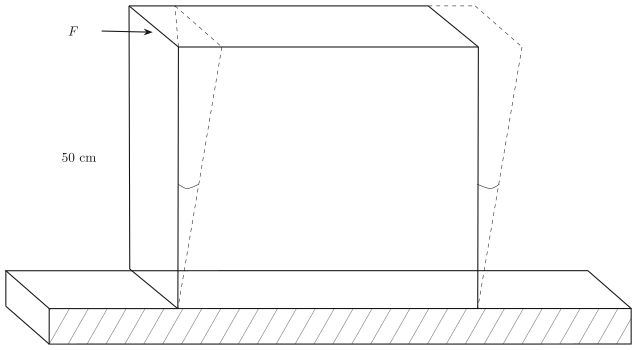
Drawn by us to help you understand the concept clearly, and verified to make sure it's accurate. For exams, practice from your textbook's own diagram.
Fig. 8.5 is a three-dimensional sketch of a lead slab being sheared. The block is drawn as a rectangular solid, with its bottom face resting on a hatched floor. That lower edge is riveted to the floor — it cannot move. A horizontal blue arrow labelled pushes to the right on the top narrow face. The result is that the top face shifts sideways relative to the fixed bottom, while the vertical edges remain straight but tilt. The left vertical edge is marked 50 cm, giving the slab’s height.
The figure teaches the geometry of shear deformation. Unlike stretching or compressing a rod, here the volume of the block does not change. Instead, each horizontal layer of the slab slides a little relative to the layer below it, like a deck of cards being pushed from the top. The key quantity is the shear strain , defined as the angle (in radians) through which a vertical line tilts. For small deformations, , where is the horizontal displacement of the top face and cm is the slab’s height.
The corresponding stress is the shear stress , which is the force divided by the area of the face parallel to the force — here, the top face (or any horizontal cross-section). So . The material’s resistance to this kind of deformation is measured by the shear modulus (also called the modulus of rigidity):
For a given force, a larger means a smaller tilt angle — the slab is stiffer against shearing. Lead has a low shear modulus, so the figure shows a noticeable sideways shift even under a modest force. …