Q.Which of the following examples represent (nearly) simple harmonic motion and which represent periodic but not simple harmonic motion?
Concept understanding — Simple Harmonic Motion
Simple Harmonic Motion: The Natural Rhythm of Things
Imagine a ball placed at the bottom of a perfectly smooth, U-shaped bowl. If you give it a gentle push, what happens? It rolls up one side, slows down, stops for an instant, then rolls back down, past the bottom, up the other side, stops, and returns. Left alone, it keeps doing this — back and forth, back and forth — in a steady, repeating rhythm.
That rhythm is the heart of Simple Harmonic Motion (SHM). It's the most fundamental kind of oscillatory (back-and-forth) motion in physics.
The Intuition: A Restoring Force That Fights Displacement
The key idea is this: the further you push the object from its resting (equilibrium) position, the stronger the force that tries to pull it back.
In the bowl, when the ball is at the bottom (equilibrium), gravity pulls straight down, and the bowl pushes straight up — no sideways force. But when you push the ball up the side, gravity now has a component that pulls it down the slope. The higher up the side you push it, the steeper the slope, and the stronger that pull-back force becomes.
This is a restoring force — it always points toward equilibrium. And crucially, in SHM, this restoring force is directly proportional to the displacement from equilibrium. Double the displacement, double the restoring force.
F=−kx
- F is the restoring force.
- x is the displacement from equilibrium.
- k is a positive constant (the "stiffness" of the system).
- The minus sign is crucial: it tells you the force is opposite to the displacement.
The Precise Statement
Simple Harmonic Motion is the motion of an object where the restoring force is directly proportional to the displacement from equilibrium and acts in the opposite direction.
That's it. That single condition — F=−kx — is the entire definition. Everything else (the sine waves, the formulas for period and frequency) follows mathematically from this one law.
What Does This Motion Look Like?
If you track the ball's position over time, you get a beautiful, smooth wave — a sine wave (or cosine wave). It's the same shape as the shadow of a spinning wheel cast on a wall.
The motion has three key descriptors:
- Amplitude (A): The maximum displacement from equilibrium. How far you initially pushed the ball up the side of the bowl.
- Period (T): The time it takes to complete one full back-and-forth cycle (e.g., from the leftmost point, back to the leftmost point).
- Frequency (f): How many cycles happen per second. f=1/T.
A remarkable fact: for a given system (fixed k and fixed mass m), the period and frequency do not depend on the amplitude. A big push and a tiny push take exactly the same time to complete one cycle. This is called isochronism — and it's why pendulums were used to keep time in clocks.
The Mathematical Description (Derived from F=−kx)
Using Newton's second law (F=ma) and the definition of acceleration (a=dt2d2x), the condition F=−kx becomes:
mdt2d2x=−kx
This is a differential equation. Its solution — the position as a function of time — is:
x(t)=Acos(ωt+ϕ)
Where:
- ω=mk is the angular frequency (radians per second). It tells you how fast the oscillation is.
- ϕ is the phase constant (determines where in the cycle you start measuring time).
From ω, you get the period: T=ω2π=2πkm.
Do not confuse angular frequency ω (rad/s) with ordinary frequency f (Hz). They are related by ω=2πf. Many exam errors come from mixing these up.
Real-World Examples
SHM is an idealization — a perfect model. But many real systems approximate it beautifully:
- A mass on a spring (horizontal or vertical) — the classic textbook example.
- A simple pendulum — but only for small angles (less than about 15∘). For large swings, the restoring force is no longer proportional to displacement, and the motion is not simple harmonic.
- The vibration of atoms in a solid — each atom is held in place by bonds that act like tiny springs.
- A tuning fork — the prongs vibrate in SHM, producing a pure tone.
The Bottom Line
Simple Harmonic Motion is any motion driven by a restoring force that is proportional to and opposite the displacement. It produces a sinusoidal oscillation with a constant period that is independent of amplitude. Everything else — the equations, the graphs, the energy transformations — is just unpacking that single, elegant idea.
Looking up "Simple Harmonic Motion: Definition, Formula & Real-World Examples" or "Simple Harmonic Motion important questions 11" is a common way students land here, and rightly so — simple harmonic motion is a core part of the Class 11 Physics NCERT/CBSE curriculum. Expect it to reappear, often in a slightly disguised form, across JEE Main, NEET and state engineering/medical entrance exams.
Concept: Simple Harmonic Motion (SHM) requires a restoring force proportional to displacement (F∝−x) and periodic motion. Periodic motion repeats at regular intervals but may not follow a sinusoidal law.
Step 1 – Check each case for periodicity and the SHM condition.
- Earth’s rotation is periodic (24-hour cycle) but the motion is uniform circular, not oscillatory about an equilibrium — no restoring force. Hence periodic, not SHM.
- Mercury in a U-tube: displaced height difference creates a restoring force proportional to displacement (for small oscillations). This is SHM.
- Ball bearing in a smooth curved bowl: for small displacements from the lowest point, the restoring force is proportional to displacement along the arc (like a simple pendulum). This is SHM.
- General vibrations of a polyatomic molecule: for small amplitudes, each normal mode is SHM, but the overall motion is a superposition of many modes — not a single SHM. It is periodic but not simple harmonic (unless only one mode is excited).
✓Final answer
- Periodic, not SHM;
- SHM;
- SHM;
- Periodic, not SHM.
Simple harmonic motion requires a restoring force exactly proportional to displacement (linear). Among the given examples, only the U-tube mercury column and the ball bearing in a smooth bowl are nearly SHM for small amplitudes; Earth’s rotation is periodic but not SHM, and polyatomic molecular vibrations are periodic but generally not simple harmonic.
The key to recognising simple harmonic motion (SHM) is the linear restoring force — the force must be proportional to the displacement from equilibrium and directed opposite to it. That gives the equation F=−kx, or equivalently a=−ω2x. If the force law is different (e.g., constant, or nonlinear), the motion is periodic but not simple harmonic.
Let’s examine each case.
-
Rotation of Earth about its axis
The Earth spins with a nearly constant angular velocity. There is no restoring force at all — it’s uniform circular motion, not oscillatory. The motion repeats every 24 hours, so it is periodic, but there is no force proportional to displacement. Hence it is periodic but not SHM.
-
Oscillating mercury column in a U-tube
When you push the mercury down on one side, the imbalance in height creates a pressure difference. The restoring force is proportional to the height difference h (since F∝ρgh), and for small displacements this gives a∝−h. That’s exactly the SHM condition.
TipThe U-tube oscillator is a classic example of SHM — the restoring force is linear because the weight of the unbalanced column is directly proportional to the displacement.
So this represents nearly SHM (exactly SHM for small amplitudes, ignoring friction).
-
Ball bearing inside a smooth curved bowl
For a bowl that is spherical (or parabolic near the bottom), the restoring force along the tangent is F=−mgsinθ. For small angles, sinθ≈θ, and the displacement along the arc is s=Rθ, so F≈−(mg/R)s, which is linear. Hence the motion is nearly SHM for small releases.
Watch outFor large amplitudes, sinθ=θ, and the motion becomes periodic but anharmonic (not SHM). The problem says “nearly” — so small oscillations qualify.
-
General vibrations of a polyatomic molecule
A polyatomic molecule has many vibrational modes. For very small displacements from equilibrium, the potential energy is approximately quadratic (Taylor expansion), so each normal mode is SHM. But the problem says “general vibrations” — that includes large-amplitude motions where anharmonic terms matter. Also, the molecule has many coupled oscillators; the overall motion is a superposition of many frequencies. It is periodic (if all frequencies are commensurate) but not simple harmonic because the net motion is not a single sine wave.
NoteIf the question meant a single normal mode at small amplitude, it would be SHM. But “general vibrations” implies the full, possibly anharmonic, motion — so it’s periodic but not SHM.
- Periodic but not SHM;
- nearly SHM;
- nearly SHM;
- periodic but not SHM.
Step 1: SHM needs a restoring force/torque strictly proportional to (linear in) displacement from equilibrium; a motion can be periodic without being SHM if it repeats but isn't governed by that linear law.
Step 2 (a): Earth's rotation is uniform circular motion at constant ω — there is no restoring force pulling it back to an equilibrium orientation, so although periodic (24 h), it is not SHM.
Step 3 (b): In a U-tube, a height imbalance h produces a net hydrostatic restoring force ∝h, giving a linear restoring force — nearly SHM for small oscillations.
Step 4 (c): Near the bottom of a smooth bowl, the tangential restoring force is −mgsinθ≈−mgθ for small θ (small-angle approximation), linear in the arc-displacement — nearly SHM, exactly like a pendulum.
Step 5 (d): A polyatomic molecule's general vibration is a superposition of several normal modes at different frequencies (only each individual normal mode, taken alone at small amplitude, is SHM) — the combined motion is periodic but not simple harmonic.
Showing the 12 most recent of 14 on this concept.
- COMEDK 2026Set 2026-A1 markMCQQ.Force constant of interatomic bond, in a certain element, is 7.1Nm−1. If the atom oscillates in SHM in a certain direction, what is its frequency? Given: Mole weight of the given element is 108 g and Avagadro's number =6.023×10²³ g mol−1 (A) 3.45×10²²s−1 (B) 0.005×10¹²s−1 (C) 1×10¹²s−1 (D) 6.667×10¹²s−1
›Reveal solutionSolution
The frequency of an atom oscillating in SHM is found from the spring constant and the mass of a single atom. Using the force constant k=7.1 N/m and the atomic mass (from mole weight and Avogadro’s number), the frequency is 1×10¹² s−1, which corresponds to option (C).
Concept & Intuition
An atom in a crystal bonded to its neighbours can be modelled as a simple harmonic oscillator: the interatomic bond acts like a tiny spring with force constant k. The frequency of oscillation for a mass m on a spring is f=2π1mk. Here the “mass” is the mass of a single atom. We are given the molar mass (108 g/mol) and Avogadro’s number, so we can find the mass of one atom. Then plug into the formula.
Step-by-step solution
- Find the mass of a single atom Molar mass M=108 g/mol=0.108 kg/mol (convert to kg for SI consistency). Avogadro’s number NA=6.023×10²³ atoms/mol. Mass of one atom:
m=NAM=6.023×10230.108 kg
Compute:
m=1.793×10⁻²⁵ kg
- Apply the SHM frequency formula For a mass m on a spring of constant k, the angular frequency ω=k/m, so the ordinary frequency is
f=2π1mk
Given k=7.1 N/m,
f=2π11.793×10−257.1
- Simplify inside the square root
1.793×10−257.1=1.7937.1×1025≈3.96×1025
(More precisely: 7.1/1.793≈3.960)
- Take the square root
3.96×1025=3.96×1012.5≈1.99×1012.5
But 1012.5=1012×100.5=1012×10≈3.162×10¹².
So:
3.96×1025≈1.99×3.162×1012≈6.29×10¹²
- Divide by 2π
f=2π6.29×10¹²≈6.2836.29×1012≈1.00×10¹² s−1
Thus the frequency is 1×10¹² Hz.
TipNotice that 2π≈6.283 and the square root came out to about 6.29×10¹², so they nearly cancel — a neat coincidence that gives a clean result.
Watch outA common mistake is forgetting to convert the molar mass from grams to kilograms. Using 108 g directly gives a mass 1000 times too small, leading to a frequency 1000 times too large (around 1015 Hz), which is not among the options — but it’s a trap.
✓Final answerThe correct option is (C).
ANSWER: C
- COMEDK 2025Set 2025-A1 markMCQQ.Time period of oscillation of a mass suspended from a spring is T . If the spring is cut into four equal parts and the same mass is suspended from one of the parts, the fractional change in time period is (A) 81 (B) 41 (C) 21 (D) 61
›Reveal solutionSolution
Cutting a spring into four equal parts increases its spring constant by a factor of 4, which reduces the time period by half, giving a fractional change of 1/2.
Concept & Intuition
The time period of a mass–spring system depends only on the mass and the spring constant: T=2πm/k. When you cut a uniform spring into equal pieces, each piece becomes stiffer — the spring constant is inversely proportional to the length. So cutting into four parts makes each part’s constant four times larger. Since T∝1/k, a fourfold increase in k halves the period. The fractional change is then (Tnew−Toriginal)/Toriginal.
Step-by-step reasoning
- Original time period For a spring of constant k and mass m:
T=2πkm.
- Effect of cutting the spring A spring’s constant is inversely proportional to its length: k∝1/L. Cutting into four equal parts means each part has length L/4, so its spring constant becomes
k′=4k.
- New time period With the same mass m suspended from one part:
T′=2πk′m=2π4km=21⋅2πkm=2T.
- Fractional change Fractional change is defined as
TT−T′=TT−T/2=TT/2=21.
(Note: Some define fractional change as (T′−T)/T, which would be −1/2; here the problem expects the magnitude, and the positive option 1/2 is given.)
Watch outA common mistake is to think cutting a spring makes it weaker — actually, shorter springs are stiffer. Also, don’t confuse this with cutting a spring in series (which would reduce the effective constant).
TipRemember: k∝1/L for a given spring material and cross-section. Halving the length doubles the constant; cutting into n parts multiplies k by n.
✓Final answerThe correct option is (C).
ANSWER: C
- COMEDK 2025Set 2025-M1 markMCQQ.Two simple harmonic motions are represented by equations y1=0.5sin[200πt+3π] and y1=0.5cosπt. The phase difference of the velocity of particle 1 with respect to the velocity of particle 2 is : (A) 2π (B) 6π (C) 6−π (D) 2−π
›Reveal solutionSolution
The phase difference between the velocities is found by differentiating each displacement, writing both velocities as sine functions, and subtracting their phases. The result is −π/6, so option (C) is correct.
Concept & Intuition
The phase difference between two oscillating quantities is the difference in their arguments when both are expressed using the same trigonometric function (e.g., both as sine or both as cosine). Here we have two SHM displacements, but the question asks for the phase difference of their velocities. Velocity is the time derivative of displacement, which shifts the phase by +π/2 for a sine (since dtdsin(ωt+ϕ)=ωcos(ωt+ϕ)=ωsin(ωt+ϕ+π/2)). So we differentiate each, rewrite both as sine functions, then subtract phases.
Step-by-step solution
- Write the given displacements clearly
y1=0.5sin(200πt+3π),y2=0.5cos(πt).
- Find the velocity of particle 1 Differentiate y1 with respect to time:
v1=dtdy1=0.5⋅200πcos(200πt+3π)=100πcos(200πt+3π).
Convert cosine to sine using cosθ=sin(θ+π/2):
v1=100πsin(200πt+3π+2π)=100πsin(200πt+65π).
- Find the velocity of particle 2 Differentiate y2:
v2=dtdy2=0.5⋅(−π)sin(πt)=−0.5πsin(πt).
Write the negative sign as a phase shift: −sinθ=sin(θ+π) (since sin(θ+π)=−sinθ). So
v2=0.5πsin(πt+π).
Alternatively, we could also write v2=0.5πsin(πt−π); either is fine — the key is to have a consistent sine form.
- Determine the phase difference The phase of v1 is ϕ1=200πt+65π. The phase of v2 is ϕ2=πt+π. The phase difference (velocity of 1 with respect to velocity of 2) is
Δϕ=ϕ1−ϕ2=(200πt+65π)−(πt+π)=(200π−π)t+65π−π.
The time-dependent part (200π−π)t is not constant — but wait: the frequencies are different! Particle 1 has angular frequency 200π rad/s, particle 2 has π rad/s. For a meaningful constant phase difference, the two motions must have the same frequency. Here they do not.
Watch outA phase difference is only well-defined and constant when the two oscillations have the same angular frequency. Here ω1=200π and ω2=π are vastly different, so the phase difference changes with time. The problem likely intends to compare the initial phase difference (at t=0) or assumes we compare the phase constants only.
Taking the phase constants (the parts independent of time):
For v1: phase constant = 65π.
For v2: phase constant = π.
So the constant phase difference is
Δϕ0=65π−π=−6π.
- Match with options −π/6 corresponds to option (C).
TipIf you forget the sign, note that cosθ leads sinθ by π/2. Here y2 is a cosine, so its velocity is −sin, which lags the sine form. Working carefully with the phase shifts avoids sign errors.
✓Final answerThe correct option is (C).
ANSWER: C
- COMEDK 2025Set 2025-M1 markMCQQ.A bar magnet is oscillating in the earth's magnetic field with a period T. When the length of the bar magnet is doubled and its mass is quadrupled, the time period is T1. The ratio of T1 to T is (A) 1:2 (B) 4:1 (C) 2:1 (D) 1:4
›Reveal solutionSolution
With T∝I (magnetic moment fixed) and I=ML2/12, quadrupling mass and doubling length multiplies I by 16, so T1/T=16=4, i.e. 4:1.
The time period of a bar magnet oscillating in field B:
T=2πmBI,
where I is the moment of inertia and m the magnetic moment.
Moment of inertia of a bar about its centre: I=12ML2.
New values: mass →4M, length →2L:
I′=12(4M)(2L)2=1216ML2=16I.
Taking the magnetic moment m (and B) unchanged,
TT1=II′=16=4.
So T1:T=4:1.
✓Final answerThe correct option is (B) — 4:1
- COMEDK 2024Set 2024-A1 markMCQQ.A circular disc of mass 20 kg, having radius 10 cm is suspended by a wire attached to its centre. The wire is twisted by rotating the disc and released. The time period of torsional oscillations is found to be 1 s. The torsional spring constant of the wire is (A) 6 N m rad−1 (B) 9.86 N m rad−1 (C) 3.94 N m rad−1 (D) 1.264 N m rad−1
›Reveal solutionSolution
The disc's moment of inertia is 0.1 kg·m²; a torsional period of 1 s gives spring constant k=4π2I≈3.94 N·m/rad.
Moment of inertia of a disc about its central axis:
I=21MR2=21(20)(0.10)2=0.1 kg m2.
Torsional period: T=2πkI, so
k=T24π2I=124π2(0.1)=0.4π2≈3.94 N m rad−1.
✓Final answerThe correct option is (C) — 3.94 N m rad−1
- COMEDK 2024Set 2024-E1 markMCQQ.A body is executing SHM. When its displacements from the mean position are 4 cm and 5 cm it has velocity 10 cms−1 and 8 cms−1 respectively. Its periodic time t is (A) 32πsec (B) 2π sec (C) 23πsec (D) π sec
›Reveal solutionSolution
Using the SHM velocity-displacement relation v2=ω2(A2−x2) with two data pairs, we solve for ω and then period T=2π/ω. The period comes out to π seconds, so option (D) is correct.
Concept & Intuition
In simple harmonic motion, the velocity is not constant — it depends on where the particle is. The relation v2=ω2(A2−x2) ties velocity v, displacement from mean x, angular frequency ω, and amplitude A. If we have two different (x,v) pairs, we can set up two equations and eliminate A to find ω directly. Once we have ω, the period is T=2π/ω.
- Write the SHM velocity equation for each data point. For a particle in SHM:
v2=ω2(A2−x2)
Given:
- When x1=4 cm, v1=10 cm/s
- When x2=5 cm, v2=8 cm/s
So we have:
102=ω2(A2−42)⇒100=ω2(A2−16)(1)
82=ω2(A2−52)⇒64=ω2(A2−25)(2)
- Eliminate A2 by subtracting the equations. Subtract (2) from (1):
100−64=ω2(A2−16)−ω2(A2−25)
36=ω2[(A2−16)−(A2−25)]=ω2(9)
So:
ω2=936=4⇒ω=2 rad/s
- Find the period T. The period is:
T=ω2π=22π=π seconds
TipNotice we never needed the amplitude A — it cancels out when we subtract the two equations. This is a classic trick: two (x,v) pairs are enough to find ω without finding A.
Watch outA common mistake is to forget that the velocity formula uses v2 and x2. Always square the given values before plugging in, and be careful with units — here they are consistent in cm and cm/s, so no conversion is needed.
✓Final answerThe correct option is (D).
ANSWER: D
- COMEDK 2024Set 2024-M1 markMCQQ.Two charges '−q' each are fixed, separated by distance '2d'. A third charge 'q' of mass 'm' placed at the mid-point is displaced slightly by 'x' (x<<d) perpendicular to the line joining the two fixed charges as shown in Fig. The time period of oscillation of 'q' will be (A) T=q28ε0 mπ2 d3 (B) T=q38ε0 mπ3 d3 (C) T=q24ε0 mπ3 d3 (D) T=q28ε0 mπ3 d3
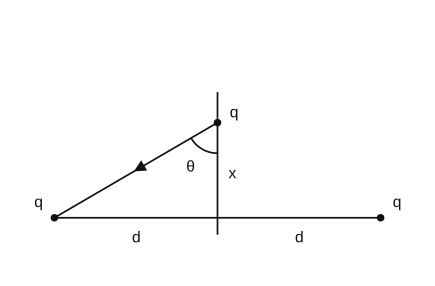
›Reveal solutionSolution
The problem reduces to simple harmonic motion because, for small perpendicular displacement, the net restoring force is proportional to the displacement. The time period is T=2πkm, leading to T=q28ε0mπ3d3, which matches option (D).
Concept & Intuition
When the third charge q is exactly at the midpoint, the forces from the two fixed −q charges are equal and opposite, so the net force is zero. If we displace it slightly perpendicular to the line joining the fixed charges, symmetry ensures the horizontal components of the forces cancel, but the vertical components add. For small x≪d, the net vertical force is approximately linear in x — that’s the hallmark of simple harmonic motion. So we can find an effective spring constant k and then the period T=2πm/k.
Step-by-step solution
- Set up the geometry and forces The two fixed charges are at (−d,0) and (d,0). The movable charge q is at (0,x) with x≪d. Distance from the movable charge to each fixed charge:
r=d2+x2.
The magnitude of the force from one fixed charge (−q) on the movable charge (q) is given by Coulomb’s law:
F=4πε01⋅r2∣q⋅(−q)∣=4πε01⋅d2+x2q2.
Since the charges are opposite, the force is attractive — each fixed charge pulls the movable charge toward itself.
- Resolve forces into components By symmetry, the horizontal components from the two fixed charges cancel. The vertical components add. From the geometry (see the figure), the angle θ satisfies sinθ=rx. The vertical component of the force from one fixed charge is
Fy=Fsinθ=4πε01⋅d2+x2q2⋅d2+x2x.
So the net vertical force (both charges pulling downward, opposite to the displacement direction if we take upward as positive) is
Fnet=−2⋅4πε01⋅(d2+x2)3/2q2x.
The negative sign indicates the force is restoring (toward the midpoint).
- Apply the small‑displacement approximation For x≪d, we expand (d2+x2)−3/2 using the binomial approximation:
(d2+x2)−3/2=d−3(1+d2x2)−3/2≈d−3(1−23d2x2+⋯).
Keeping only the leading term (since x2/d2 is negligible), we get
Fnet≈−4πε02⋅d3q2x=−2πε0d3q2x.
This is exactly Hooke’s law: F=−kx with
k=2πε0d3q2.
- Find the time period For a mass m attached to a spring of constant k, the angular frequency is ω=k/m, so the period is
T=2πkm=2π2πε0d3q2m.
Simplify:
T=2πq22πε0md3=q28π3ε0md3.
This matches option (D) exactly.
TipA common mistake is to forget the factor of 2 from the two forces, or to misplace the π when simplifying. Always write the net force carefully and then simplify the square root step by step.
Watch outDo not confuse the perpendicular displacement case with the axial displacement case (where the charge moves along the line joining the fixed charges). The geometry and the resulting force law are different — the axial case gives a different power of d in the period.
✓Final answerThe correct option is (D).
ANSWER: D
- KCET 2023Set A-31 markMCQQ.In series LCR circuit at resonance, the phase difference between voltage and current is (A) π (B) 4π (C) 2π (D) zero
›Reveal solutionSolution
At resonance in a series LCR circuit, the inductive and capacitive reactances cancel, making the circuit purely resistive — so voltage and current are in phase, meaning the phase difference is zero.
The key idea is that resonance in a series LCR circuit is defined by the condition where the inductive reactance XL=ωL exactly equals the capacitive reactance XC=ωC1. When that happens, the net reactance X=XL−XC becomes zero. The impedance of the circuit is then purely resistive: Z=R.
Since the impedance has no imaginary part, the voltage and current must rise and fall together — there is no lag or lead. The phase angle ϕ between voltage and current is given by tanϕ=RXL−XC. At resonance, XL−XC=0, so tanϕ=0, which gives ϕ=0.
Let’s walk through the reasoning step by step.
- Write the general expression for phase difference. In any series LCR circuit, the phase angle ϕ between the applied voltage and the current is:
tanϕ=RXL−XC
where XL=ωL, XC=ωC1, and R is the resistance.
- Apply the resonance condition. At resonance, the angular frequency ω0 satisfies:
ω0L=ω0C1
So XL=XC, and therefore XL−XC=0.
- Substitute into the phase formula.
tanϕ=R0=0
The only angle in the range −π to π whose tangent is zero is ϕ=0 (or π, but π would mean the current is exactly opposite to the voltage, which does not happen here because the impedance is positive real).
- Interpret physically. With zero net reactance, the circuit behaves like a pure resistor. The voltage across the resistor is in phase with the current, and since the total applied voltage equals the resistor voltage at resonance (the inductor and capacitor voltages cancel each other), the total voltage and current are in phase.
Watch outA common mistake is to think that at resonance the phase difference is 2π because you recall that in a pure inductor or pure capacitor the phase difference is ±2π. But resonance is the cancellation of those effects — the circuit becomes resistive, not purely reactive.
✓Final answerThe correct option is (D) zero.
- COMEDK 2023Set 2023-M1 markMCQQ.The phase difference between displacement and velocity of a particle in simple harmonic motion is (A) π rad (B) 3π/2 rad (C) zero (D) π/2 rad
›Reveal solutionSolution
Velocity is the time-derivative of displacement in SHM, and differentiation shifts the phase by 2π; hence the phase difference is π/2.
Let x=Asinωt. Then:
v=dtdx=Aωcosωt=Aωsin(ωt+2π).
The velocity leads the displacement by a phase of 2π radians.
✓Final answerThe correct option is (D) — π/2 rad
- COMEDK 2022Set 20221 markMCQQ.During the phenomenon of resonance (A) the amplitude of oscillation becomes large (B) the frequency of oscillation becomes large (C) the time period of oscillation becomes large (D) All of the above
›Reveal solutionSolution
The frequency of oscillation is set by the driver (it does not "become large"), and the time period likewise does not grow — it simply equals the natural period. So only (A) is correct.
Concept: Resonance in a driven oscillator.
Resonance occurs when the driving frequency equals (or is very near) the system's natural frequency. At that point the denominator of the steady-state amplitude,
A = F₀/m ÷ √[(ω₀² − ω²)² + (bω/m)²],
becomes minimal (only the damping term survives), so the amplitude of oscillation becomes very large.
The frequency of oscillation is set by the driver (it does not "become large"), and the time period likewise does not grow — it simply equals the natural period. So only (A) is correct.
✓Final answerThe correct option is (A) — the amplitude of oscillation becomes large
ANSWER: A
- COMEDK 2022Set 20221 markMCQQ.A particle is performing simple harmonic motion. Equation of its motion is x=5sin(4t−6π),x being the displacement from mean position. Velocity (in ms−1) of the particle at the instant when its displacement is 3, will be (A) 32π (B) 65π (C) 20 (D) 16
›Reveal solutionSolution
At x = 3: v = 4 √(5² − 3²) = 4 √(25 − 9) = 4 √16 = 4 × 4 = 16 m/s.
Concept: For SHM, v = ω√(A² − x²).
From x = 5 sin(4t − π/6): amplitude A = 5, angular frequency ω = 4 rad/s.
At x = 3:
v = 4 √(5² − 3²) = 4 √(25 − 9) = 4 √16 = 4 × 4 = 16 m/s.
✓Final answerThe correct option is (D) — 16
ANSWER: D
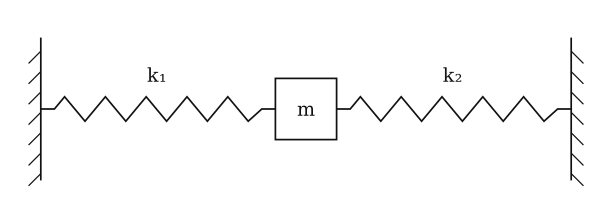
- COMEDK 2021Set 20211 markMCQQ.Two spring of force constant k1 and k2 are configured as the figure given below The angular frequency of this configuration is (A) mk1+k2 (B) mk1+k2 (C) k2mk1 (D) k1k2m
›Reveal solutionSolution
(Option A is dimensionally wrong for an angular frequency.)
Concept: springs on OPPOSITE sides of a block, each fixed to a wall, act in PARALLEL (both are stretched/compressed by the same displacement x of the block, and both push/pull it back).
From the figure: wall - k1 - block(m) - k2 - wall, all along one horizontal line.
Displace the block by x to the right: spring 1 stretches and pulls back with k1x, spring 2 compresses and pushes back with k2x. Both restoring forces add:
F = -(k1 + k2) x => k_eff = k1 + k2.
omega = sqrt(k_eff/m) = sqrt((k1 + k2)/m).
(Option A is dimensionally wrong for an angular frequency.)
✓Final answerThe correct option is (B) — mk1+k2
ANSWER: B
🎓Unlock everything free for 14 days
- ✓Full step-by-step solutions
- ✓Concept-first explanations
- ✓Methods, shortcuts & mistakes
- ✓PYQ mapping + timed mock tests
Full access for 14 days. No credit card required.