Q.A hollow spherical shell of radius R rests with its lower half embedded in sand and its upper half exposed to air; the interior of the lower hemisphere is packed with sand while the interior of the upper hemisphere contains only air. Four candidate points lie on the vertical diameter of the shell: point A lies slightly above the centre, point B lies exactly at the geometric centre, point C lies slightly below the centre (just inside the sand-filled region), and point D lies well below the centre near the bottom of the shell. Which of these points is the likely position of the centre of mass of the whole system?
Concept understanding — Center of Mass
What is the Center of Mass?
Imagine you pick up a broom by the handle and try to balance it horizontally on one finger. You instinctively slide your finger along the handle until the broom stays level. That point — the one where the broom doesn't tip — is its center of mass.
Now think about throwing a cricket bat. It spins and wobbles in the air, but there is one point on the bat that follows a smooth, parabolic path, as if all the bat's mass were concentrated there. That point is also the center of mass.
The core idea is simple: the center of mass is the average position of all the mass in an object. It's the point where you could imagine the entire mass of the object being concentrated, and the object would behave the same way under the influence of external forces.
Why does this matter?
When you push an object at its center of mass, it moves in a straight line without rotating. Push it anywhere else, and it will both move and spin. This is why:
- A car's stability depends on where its center of mass is (lower = safer).
- A tightrope walker holds a long pole — moving the pole shifts their combined center of mass back over the rope.
- In projectile motion, the center of mass of a system (like an exploding firework) continues along the original parabolic path, even though the fragments scatter.
The precise definition
For a system of particles, the center of mass is the weighted average of their positions, where the weight is the mass of each particle.
RCM=m1+m2+⋯+mnm1r1+m2r2+⋯+mnrn=∑mi∑miri
Here:
- RCM is the position vector of the center of mass
- mi is the mass of the i-th particle
- ri is the position vector of that particle
For a continuous object (like a rod or a sphere), the sum becomes an integral:
RCM=M1∫rdm
where M is the total mass and dm is an infinitesimal mass element.
Breaking it down with an example
Take two masses on a light rod: m1=2 kg at x=0, and m2=3 kg at x=5 m.
The center of mass is:
xCM=2+3(2)(0)+(3)(5)=50+15=3 m
So the center of mass is at x=3 m, closer to the heavier mass. That makes intuitive sense — the heavier mass "pulls" the average toward itself.
The center of mass does not have to be inside the object. A ring or a hollow sphere has its center of mass at the geometric center, which is empty space.
Key properties to remember
-
External forces only — Internal forces (like collisions between parts of the system) do not affect the motion of the center of mass. Only external forces can change its velocity.
-
If no external force acts, the center of mass moves with constant velocity (or stays at rest). This is the law of conservation of momentum applied to the whole system.
-
For symmetric objects with uniform density, the center of mass coincides with the geometric center. For irregular shapes, it shifts toward the region with more mass.
-
In a uniform gravitational field, the center of mass and the center of gravity are the same point. (They differ only if gravity varies significantly across the object — not something you'll see in school problems.)
A final intuition
Think of the center of mass as the balance point of an object. If you could place a tiny, invisible support exactly at that point, the object would be perfectly balanced in any orientation. Every piece of mass on one side is exactly counterbalanced by the pieces on the other side.
That's why, when you jump off a boat, the boat moves backward — your center of mass and the boat's center of mass shift relative to each other, but the center of mass of the whole system (you + boat) stays put (if no external horizontal force acts). This is the heart of why the center of mass concept is so powerful: it lets you treat a complicated, spinning, wobbling object as a single point for many problems.
Looking up "Center of Mass: definition, formula & real-world examples" is a good habit before an exam, and it is worth knowing that Center of Mass is a core, NCERT-aligned topic from the System of Particles and Rotational Motion portion of the Class 11 Physics curriculum, and it is tested regularly in CBSE board exams as well as in JEE Main and NEET. Cross-checking this explanation against the relevant NCERT Physics chapter and solving a few past-year questions will round out your preparation.
The shell's centre of mass is at O; the sand (lower hemisphere only) pulls the combined centre of mass down, but only as far as its own centre of mass, 0.375R below O.
A solid hemisphere's own centre of mass sits 83R=0.375R from its flat face. Since the combined centre of mass of shell + sand is a mass-weighted average of the shell's centre (at O) and the sand's centre (0.375R below O), it must lie strictly between the two — a small dip below O, never reaching as far down as R (near the bottom, point D).
Option (C) — the centre of mass lies just below the geometric centre, bounded within 0.375R of O.
The shell's own centre of mass sits exactly at the geometric centre O, since it is a uniform, symmetric shell. The sand fills only the lower solid hemisphere, and a solid hemisphere's own centre of mass sits 83R (= 0.375R) below its flat face. The combined centre of mass of shell + sand is therefore a mass-weighted average of these two points, so it must lie strictly between O and 0.375R below O — a small dip below centre. That matches point C, and rules out point D, which sits well below centre near the bottom of the shell.
Setting up the two pieces
The system has two parts: the uniform hollow shell (mass mshell, centre of mass at O, the geometric centre) and the solid sand filling the lower hemisphere (mass msand).
For a solid hemisphere of radius R, the standard result for its own centre of mass is
yˉ=83R
measured from its flat face, along the axis of symmetry, toward the curved surface. Here the flat face is the horizontal plane through O, so the sand's own centre of mass sits 83R=0.375R below O.
Combining the two centres of mass
The combined centre of mass is
ycm=mshell+msandmshell(0)+msand(−0.375R)
Because this is a weighted average of 0 (the shell's contribution) and −0.375R (the sand's contribution), ycm must lie between these two values — it can never go below −0.375R, no matter what the mass ratio is.
Ruling out the other points
- A (above centre) is impossible: all the extra mass (the sand) sits below O, so the combined centre of mass can only shift downward, never upward.
- B (exactly at centre) would require the sand's mass to be negligible, which it isn't — the sand fills an entire hemisphere.
- D (well below centre, near the bottom, i.e. close to y=−R) is impossible: the bound above shows the combined centre of mass can drop by at most 0.375R, far short of reaching the bottom of the shell at R.
- C (just below centre) is exactly what the bound predicts: a small dip below O, no more than 0.375R.
Option (C) — the centre of mass lies just below the geometric centre O, bounded between O and 0.375R below O.
Concept: Centre of Mass of a Composite Body (weighted average of parts)
Step 1: Identify the two parts
The uniform hollow shell has its own CM at the geometric centre O. The sand fills only the solid lower hemisphere; a solid hemisphere's own CM lies at 83R=0.375R from its flat face (here, below O).
Step 2: Combine as a weighted average
ycm=mshell+msandmshell(0)+msand(−0.375R)
This is a weighted average of 0 and −0.375R, so it must lie strictly between them.
Step 3: Rule out the extremes
- Point A (above O) is impossible — all the extra mass is below O, so the CM can only shift down.
- Point D (well below centre, near the bottom) is impossible — the CM cannot drop past 0.375R below O.
- Point B (exactly at O) would require the sand's mass to be negligible, which it isn't.
Step 4: Identify the correct point
Point C — a small dip below O, bounded within 0.375R — matches the weighted-average result.
Final Answer:
Option (C).
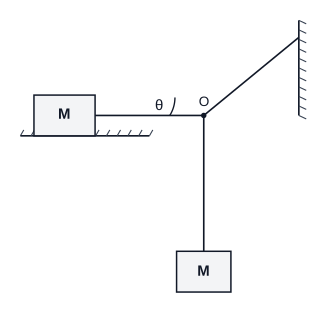
- KCET 2025Set D-41 markMCQQ.A wooden block of mass M lies on a rough floor. Another wooden block of the same mass is hanging from the point O through strings as shown in the figure. To achieve equilibrium, the co-efficient of static friction between the block on the floor with the floor itself is
 (A) μ=cotθ
(B) μ=sinθ
(C) μ=tanθ
(D) μ=cosθ
(A) μ=cotθ
(B) μ=sinθ
(C) μ=tanθ
(D) μ=cosθ›Reveal solutionSolution
Resolve the three string tensions at the junction O, get the horizontal pull on the floor block, then set that pull equal to the limiting friction μN with N=Mg.
Step 1 — Identify the forces at the junction O.
Three strings meet at O, so O is a massless point in equilibrium under three tensions:
- T1 — along the horizontal string that runs to the block on the floor (it pulls O towards that block, i.e. horizontally to the left).
- T2 — along the inclined string going up to the wall at angle θ above the horizontal (it pulls O up and to the right).
- T3 — along the vertical string, pulling O straight down. The hanging block of mass M is in equilibrium, so
T3=Mg
Step 2 — Equilibrium of the junction O.
Vertical direction: only the inclined string has an upward component, and it must hold up the hanging weight.
T2sinθ=T3=Mg⇒T2=sinθMg
Horizontal direction: the inclined string's horizontal component is balanced by the horizontal string.
T1=T2cosθ=sinθMg⋅cosθ=Mgcotθ
Step 3 — Equilibrium of the block on the floor.
The horizontal string pulls this block towards O with force T1=Mgcotθ. The only force that can oppose it is static friction from the floor. The string is horizontal, so it adds no vertical component and the normal reaction is just the block's own weight:
N=Mg
Friction available at most is fmax=μN=μMg. For the block to just stay in equilibrium (the limiting case the question asks for):
μMg=Mgcotθ
Step 4 — Solve.
μ=cotθ
Sanity check: as θ→90∘ the inclined string becomes vertical, it pulls O straight up, the horizontal string goes slack, and indeed cot90∘=0 — no friction needed. As θ becomes small the inclined string is nearly horizontal and must be pulled very taut, demanding a huge μ — and cotθ→∞. The formula behaves correctly at both limits.
✓Final answerThe correct option is (A) — μ=cotθ.
ANSWER: A
- KCET 2025Set D-41 markMCQQ.Three particles of mass 1 kg, 2 kg and 3 kg are placed at the vertices A, B and C respectively of an equilateral triangle ABC of side 1 m. The centre of mass of the system from vertex A (located at origin) is (A) (127,1233) (B) (129,1233) (C) (127,126+33) (D) (0,0)
›Reveal solutionSolution
Set up coordinates with A at the origin and AB along the x-axis, read off the vertex positions of the equilateral triangle, then apply the weighted-average centre-of-mass formula separately to x and y.
Step 1 — The concept and formula
The centre of mass of a system of discrete point masses is the mass-weighted average position:
xcm=∑mi∑mixi,ycm=∑mi∑miyi
It is a weighted average because each particle "pulls" the balance point toward itself in proportion to its mass. Note the answer depends entirely on our choice of origin — and the question fixes that for us: vertex A is the origin.
Step 2 — Set up the coordinates of the triangle
Take A at the origin and let side AB lie along the +x axis. For an equilateral triangle of side a=1 m:
- A=(0,0) — carries mA=1 kg
- B=(a,0)=(1,0) — carries mB=2 kg
- C=(2a, 23a)=(21, 23) — carries mC=3 kg
Why C sits there: C is equidistant from A and B, so it lies above the midpoint of AB, at x=a/2. Its height is found from Pythagoras on the half-triangle:
h=a2−(2a)2=a2−4a2=23a
Step 3 — Total mass
M=mA+mB+mC=1+2+3=6 kg
Step 4 — The x-coordinate
xcm=MmAxA+mBxB+mCxC=6(1)(0)+(2)(1)+(3)(21)
xcm=60+2+1.5=63.5=127 m
Step 5 — The y-coordinate
Only C is off the x-axis, so only it contributes:
ycm=6(1)(0)+(2)(0)+(3)(23)=6233=1233 m
(Equivalently 43≈0.433 m.)
Step 6 — Sanity check
xcm=7/12≈0.583 m. The heaviest mass (3 kg at C, x=0.5) and the 2 kg at x=1 pull the centre right of the origin, but the 1 kg at A holds it back — a value a little past the middle is exactly what we expect. Option (D), the origin, would require all the mass at A, so it is clearly wrong.
(xcm,ycm)=(127, 1233)
✓Final answerThe correct option is (A) — (127,1233).
ANSWER: A
- COMEDK 2025Set 2025-A1 markMCQQ.The separation between C and O atoms in CO is 0.12 nm . The distance of C atom from the centre of mass is (A) 0.1 nm (B) 0.05 nm (C) 0.03 nm (D) 0.07 nm
›Reveal solutionSolution
The center of mass of a diatomic molecule lies closer to the heavier atom. For CO, with atomic masses 12 u (C) and 16 u (O) and bond length 0.12 nm, the distance from C to the center of mass is 0.07 nm, so option (D) is correct.
The key idea is that the center of mass divides the bond in inverse proportion to the masses. The heavier atom (oxygen) is closer to the center of mass, so the lighter carbon atom is farther from it. We can find the exact distance by setting the torques (mass × distance) about the center of mass equal.
-
Define the system and variables
Let the carbon atom have mass mC=12 u (atomic mass units) and the oxygen atom have mass mO=16 u. The bond length (distance between nuclei) is d=0.12 nm. Let x be the distance from the carbon atom to the center of mass. Then the distance from oxygen to the center of mass is d−x.
-
Apply the center of mass condition
The center of mass is the point where the weighted distances balance:
mC⋅x=mO⋅(d−x)
This says the “mass × distance” on one side equals that on the other.
- Solve for x
12x=16(0.12−x)
12x=1.92−16x
12x+16x=1.92
28x=1.92
x=281.92=0.06857 nm≈0.07 nm
- Interpret the result The carbon atom is about 0.07 nm from the center of mass, and oxygen is 0.12−0.07=0.05 nm away. This makes sense: oxygen is heavier, so it sits closer to the balance point.
Watch outA common mistake is to assume the center of mass is at the midpoint (0.06 nm from each). That would only be true if the atoms had equal mass. Always check the mass ratio.
TipYou can also use the formula directly: distance from lighter atom = mlight+mheavymheavy×d. Here, 2816×0.12=0.0686 nm.
✓Final answerThe correct option is (D).
ANSWER: D
-
- COMEDK 2025Set 2025-E1 markMCQQ.Select the correct statement from the following: The position of the centre of mass of a system : (A) Remains the same in any translatory motion (B) Depend on the choice of coordinates (C) Does not depend on the shape and size of the system (D) Depends on the distribution of its mass.
›Reveal solutionSolution
The centre of mass is defined as the weighted average position of all mass in a system, so it inherently depends on how mass is distributed. The correct statement is (D).
The centre of mass (COM) is a conceptual point where the entire mass of a system can be considered to be concentrated for many mechanical purposes. To decide which statement is correct, we need to recall its definition and properties.
Definition: For a system of particles, the position vector of the centre of mass is
RCOM=∑mi∑miri
where mi are the masses and ri their positions. This formula makes clear that the COM depends on both the masses and their locations — i.e., the mass distribution.
Now evaluate each option:
-
Option (A): “Remains the same in any translatory motion.”
- If the whole system undergoes pure translation (all particles move by the same displacement), the COM also moves by that displacement. So its position changes relative to a fixed origin. This statement is false unless “remains the same” means relative to the system itself — but the wording “in any translatory motion” implies motion relative to an external frame, so it’s incorrect.
-
Option (B): “Depends on the choice of coordinates.”
- The numerical coordinates of the COM do change if you shift the origin or rotate axes, but the physical point in space is independent of coordinate choice. The statement is ambiguous; usually “depends on the choice of coordinates” is considered false because the COM is a physical property, not a coordinate artifact.
-
Option (C): “Does not depend on the shape and size of the system.”
- Shape and size directly affect where masses are located. For example, a uniform rod’s COM is at its midpoint; bend it into a ring, and the COM shifts to the centre (outside the material). So shape and size matter — this is false.
-
Option (D): “Depends on the distribution of its mass.”
- This is exactly what the definition says: different mass distributions (e.g., dense at one end vs. uniform) give different COM positions. This is true.
Watch outA common mistake is to think the COM is fixed during motion. It is fixed relative to the system’s own shape, but its absolute position changes when the system moves. Option (A) is tempting if you confuse “internal” with “external” reference.
TipThe COM formula is a weighted average — just like the average of numbers changes if you change the weights or the numbers. Here, weights are masses, numbers are positions. So the COM always depends on how mass is arranged.
✓Final answerThe correct option is (D).
ANSWER: D
-
- COMEDK 2025Set 2025-M1 markMCQQ.From a circular disc of radius 2 R , a smaller circular disc is cut with radius of the larger disc as its diameter. The centre of the hole is at a distance of R from the centre of the original disc. The distance of the centre of mass of the remaining portion from the centre is: (A) 3R (B) 4R (C) 6R (D) 2R
›Reveal solutionSolution
Treating the hole as negative mass, the centre of mass shifts by mremainingmholed=3πR2πR2⋅R=3R away from the hole — option (A).
Concept. The centre of mass of a body with a piece removed is found by modelling the removed piece as a body of negative mass located at its own centre, then combining it with the full body.
Step 1 — Geometry and masses.
Original disc radius 2R⇒ area =π(2R)2=4πR2.
The smaller disc has the larger disc's radius 2R as its diameter, so its radius is R and area =πR2. Its centre lies at distance R from the centre O.
Taking surface mass density σ:
mfull=4πR2σ,mhole=πR2σ,mremaining=3πR2σ.
Step 2 — Set up coordinates.
Put O at the origin and the hole's centre at (R,0). The full disc's centre of mass is at the origin, and it equals the mass-weighted average of the remaining part and the removed part:
mfull(0)=mremainingxcm+mhole(R).
Step 3 — Solve for the remaining part.
xcm=−mremainingmholeR=−3πR2σπR2σ⋅R=−3R.
The magnitude of the shift is 3R, directed away from the hole.
✓Final answerThe centre of mass of the remaining portion is at distance 3R from the centre. The correct option is (A).
ANSWER: A
- COMEDK 2024Set 2024-M1 markMCQQ.Which of the following statement is true regarding the centre of mass of a system? (A) The centre of mass depends on the size and shape but does not depend on the distribution of mass of the body. (B) The centre of mass depends on the coordinate system. (C) The centre of mass of a system depends on the size and shape of the body but independent of the co-ordinate system (D) The centre of mass of a body always lies inside the body.
›Reveal solutionSolution
The centre of mass is defined by the weighted average of positions of all mass elements; it depends on mass distribution and shape, but not on the choice of coordinate system. The correct option is (C).
The centre of mass (COM) is a point that represents the average location of the total mass of a system. The key idea is that it is a physical property of the mass distribution itself — not a mathematical artifact of where we place our axes. So any statement that says the COM depends on the coordinate system is false, because shifting the origin just shifts the COM coordinates by the same amount; the point in space remains the same relative to the body.
Let’s examine each option carefully.
- Option (A): “The centre of mass depends on the size and shape but does not depend on the distribution of mass of the body.” This is false. The COM formula is
RCOM=∑mi∑miri
for discrete masses, or
RCOM=M1∫rdm
for continuous bodies. Both explicitly involve how mass is arranged (the distribution). For example, a uniform rod and a rod with a heavy end have the same size and shape but different COM positions. So distribution matters.
-
Option (B): “The centre of mass depends on the coordinate system.”
This is a classic trap. If you change the coordinate system, the coordinates of the COM change, but the physical point in space does not. The COM is a property of the system, not of the axes. So this statement is false.
-
Option (C): “The centre of mass of a system depends on the size and shape of the body but independent of the co-ordinate system.”
This is correct. The COM depends on how mass is spread (size, shape, distribution) but is independent of the coordinate system — because shifting or rotating axes just transforms the coordinates of the same point. The physical location relative to the body is fixed.
-
Option (D): “The centre of mass of a body always lies inside the body.”
This is false. For example, a hollow ring or a horseshoe has its COM outside the material of the body. The COM can be in empty space.
Watch outA common mistake is to confuse “the coordinates of the COM change when you move the origin” with “the COM depends on the coordinate system.” The COM itself is invariant; only its numerical description changes.
TipThink of the COM as the “balance point.” If you hang a body from different points, the vertical line through the suspension always passes through the same COM — no matter where you put your graph paper.
✓Final answerThe correct option is (C).
ANSWER: C
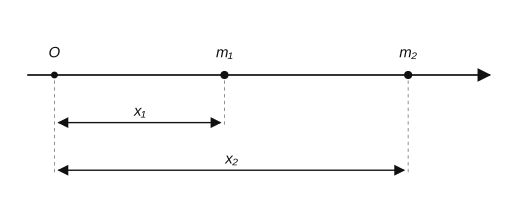
- COMEDK 2023Set 2023-M1 markMCQQ.In the diagram shown below, m1 and m2 are the masses of two particles and x1 and x2 are their respective distances from the origin O. The centre of mass of the system is (A) m1+m2m1x2+m2x2 (B) 2m1+m2 (C) m1+m2m1x1+m2x2 (D) m1+m2m1m2+x1x2
›Reveal solutionSolution
The definition of centre of mass gives m1+m2m1x1+m2x2.
For two particles of masses m1,m2 at coordinates x1,x2 from the origin, the centre of mass is
xcm=∑mi∑mixi=m1+m2m1x1+m2x2.
Option (A) has x2 twice (a misprint) and (B), (D) are dimensionally wrong.
✓Final answerThe correct option is (C) — m1+m2m1x1+m2x2
- COMEDK 2022Set 20221 markMCQQ.From a circular disc of radius R, a square is cut out with a radius as its diagonal. The centre of mass of remaining portion is at a distance (from the centre) (A) (4π−2)R (B) 2πR (C) π−2R (D) 2π−2R
›Reveal solutionSolution
Distance from the centre = R / (4pi - 2).
Concept: centre of mass of a body with a portion removed (negative-mass method).
The square is cut out with a RADIUS of the disc as its diagonal, so:
diagonal d = R -> side a = R/sqrt(2)
area of square = a^2 = R^2/2
The square's centre lies at the midpoint of that radius, i.e. at distance R/2 from the disc's centre.
Take surface density sigma = 1 (it cancels).
Whole disc: area = pi R^2, centre at x = 0
Removed square: area = R^2/2, centre at x = R/2
Centre of mass of the remaining portion (measured from the disc centre, on the side opposite the cut):
x_cm = [ (pi R^2)(0) - (R^2/2)(R/2) ] / [ pi R^2 - R^2/2 ]
= [ -R^3/4 ] / [ R^2 (pi - 1/2) ]
= -R / [ 4(pi - 1/2) ]
= -R / (4pi - 2)
Distance from the centre = R / (4pi - 2).
✓Final answerThe correct option is (A) — (4π−2)R
ANSWER: A
- KCET 2021Set B-21 markMCQQ.Two bodies of masses 8kg are placed at the vertices A and B of an equilateral triangle ABC. A third body of mass 2kg is placed at the centroid G of the triangle. If AG=BG=CG=1m, where should a fourth body of mass 4kg be placed so that the resultant force on the 2kg body is zero? (A) at C (B) at a point P on the line CG such that PG=21m (C) at a point P on the line CG such that PG=0.5m (D) at a point P on the line CG such that PG=2m
›Reveal solutionSolution
The net gravitational force on the 2 kg mass at the centroid is the vector sum of pulls from the two 8 kg masses at A and B. To cancel this resultant, the 4 kg mass must be placed on the extension of CG beyond G, at a distance PG=1/2 m from G. The correct option is (B).
The key idea is that gravitational forces are vectors. The two 8 kg masses at A and B pull the 2 kg mass at the centroid G along the lines GA and GB. Because the triangle is equilateral and G is the centroid, GA = GB = GC = 1 m, and the angle between GA and GB is 120°. The resultant of these two equal forces lies along the median from C (i.e., along CG), pointing from G toward C. To cancel it, the 4 kg mass must be placed on the same line CG, but on the opposite side of G, so that its pull on the 2 kg mass is exactly opposite and equal in magnitude to that resultant.
- Force from one 8 kg mass The gravitational force on the 2 kg mass due to a single 8 kg mass at distance 1 m is
F=G128×2=16G.
So each 8 kg mass exerts a force of magnitude 16G along GA and GB respectively.
- Resultant of the two forces The angle between GA and GB is 120° (since the centroid is equidistant from all vertices and the triangle is equilateral). The magnitude of the resultant of two equal forces F with angle θ is
R=F2+F2+2F2cosθ=F2(1+cosθ).
With cos120∘=−1/2,
R=16G2(1−21)=16G2×21=16G1=16G.
So the resultant force on the 2 kg mass from the two 8 kg masses has magnitude 16G and points along the median from C toward C (since the two pulls are symmetric about CG).
- Cancelling the resultant with the 4 kg mass Let the 4 kg mass be placed at a point P on the line CG, on the side opposite to C (i.e., beyond G away from C). The force it exerts on the 2 kg mass is
F4=Gr24×2=r28G,
where r=PG is the distance from G to P. This force must point from G away from C (i.e., opposite to the resultant R) and have the same magnitude 16G:
r28G=16G.
- Solve for r Cancel G (non-zero):
r28=16⇒r2=168=21⇒r=21m.
The positive root is taken because distance is positive.
Watch outA common mistake is to forget that the two 8 kg forces are not along the same line — their resultant is not simply 2×16G=32G. Always resolve vectorially, especially when the angle is not 0° or 180°.
TipIn an equilateral triangle, the centroid is also the circumcenter and the orthocenter. The angle between lines from the centroid to any two vertices is always 120°. This symmetry often simplifies force cancellation problems.
✓Final answerThe fourth body must be placed at a point P on the line CG such that PG=21m, which corresponds to option (B).
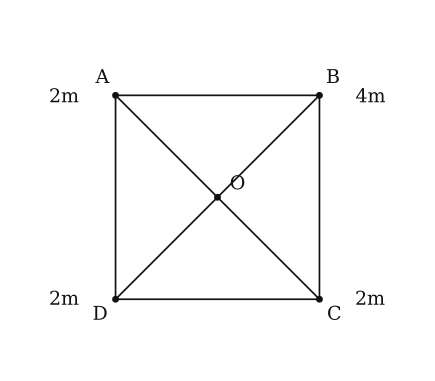
- COMEDK 2021Set 20211 markMCQQ.Centre of mass of the given system of particles will be at (A) OA (B) OB (C) OC (D) OD
›Reveal solutionSolution
So the CM is at (0.2, 0.2), i.e. displaced from O along the direction (1, 1) - straight towards corner B, the heavier 4m corner. It lies on OB.
Concept: centre of mass of discrete particles, R_cm = (sum m_i r_i)/(sum m_i).
From the figure, take O (the centre of the square, where the diagonals meet) as the origin, with the square of half-diagonal 1 unit. Corners:
A (top-left) = (-1, +1), mass 2m
B (top-right) = (+1, +1), mass 4m
C (bottom-right) = (+1, -1), mass 2m
D (bottom-left) = (-1, -1), mass 2m
Total mass = 10m.
x_cm = [2(-1) + 4(+1) + 2(+1) + 2(-1)]m / 10m = (-2 + 4 + 2 - 2)/10 = +0.2
y_cm = [2(+1) + 4(+1) + 2(-1) + 2(-1)]m / 10m = (2 + 4 - 2 - 2)/10 = +0.2
So the CM is at (0.2, 0.2), i.e. displaced from O along the direction (1, 1) - straight towards corner B, the heavier 4m corner. It lies on OB.
✓Final answerThe correct option is (B) — OB
ANSWER: B
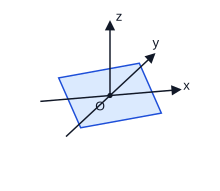
- KCET 2020Set A-11 markMCQQ.A thin uniform rectangular plate of mass 2 kg is placed in X-Y plane as shown in figure. The moment of inertia about x-axis is Ix=0.2 kg m2 and the moment of inertia about y-axis is Iy=0.3 kg m2. The radius of gyration of the plate about the axis passing through O and perpendicular to the plane of the plate is
 (A) 50 cm
(B) 5 cm
(C) 38.7 cm
(D) 31.6 cm
(A) 50 cm
(B) 5 cm
(C) 38.7 cm
(D) 31.6 cm›Reveal solutionSolution
Use the perpendicular-axis theorem to get Iz from Ix and Iy, then convert to a radius of gyration with I=Mk2.
Step 1 — Why the perpendicular-axis theorem applies.
The theorem states that for a planar (lamina) body, the moment of inertia about an axis z perpendicular to the plane equals the sum of the moments of inertia about two mutually perpendicular axes x and y lying in the plane and intersecting the z-axis:
Iz=Ix+Iy
A thin uniform rectangular plate is exactly such a lamina, and the figure shows x, y in the plane meeting at O with z perpendicular through O — every condition of the theorem is met.
Step 2 — Compute Iz.
Iz=Ix+Iy=0.2+0.3=0.5kg m2
Step 3 — Definition of the radius of gyration.
The radius of gyration k about an axis is the distance from that axis at which the whole mass could be concentrated to give the same moment of inertia:
I=Mk2⟹k=MI
Step 4 — Substitute (mass M=2 kg, axis = the z-axis through O).
k=MIz=20.5=0.25=0.5m
Step 5 — Convert units (the step the distractors punish).
k=0.5 m=50 cm
(Option (B) 5 cm is the decimal-slip trap; (D) 31.6 cm ≈0.1 m would come from forgetting to add Ix and Iy; (C) 38.7 cm comes from dividing by the wrong mass.)
✓Final answerThe correct option is (A) 50 cm.
ANSWER: A
🎓Unlock everything free for 14 days
- ✓Full step-by-step solutions
- ✓Concept-first explanations
- ✓Methods, shortcuts & mistakes
- ✓PYQ mapping + timed mock tests
Full access for 14 days. No credit card required.