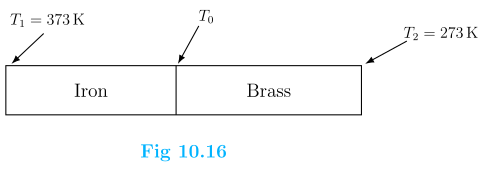
Q.An iron bar (L1=0.1 m, A1=0.02 m2, K1=79 W m−1 K−1) and a brass bar (L2=0.1 m, A2=0.02 m2, K2=109 W m−1 K−1) are soldered end to end as shown in Fig. 10.16. The free ends of the iron bar and brass bar are maintained at 373 K and 273 K respectively. Obtain expressions for and hence compute
🔒You're viewing a preview — the full solution, concept, methods & PYQ mapping are locked.
🔒 Start your 14-day free trial to unlock the full solution →Concept understanding — Thermal Conduction Through Bars
Thermal Conduction Through Bars
Imagine holding a metal rod with one end in a fire. Within seconds, the other end gets hot — even though it never touched the flame. Something travelled through the rod. That something is heat, and the process is thermal conduction.
The Intuition: What's Actually Happening?
At the microscopic level, atoms in the hot end vibrate violently. These vibrations bump into neighbouring atoms, passing energy along like a line of dominoes. In metals, free electrons also carry energy quickly — that's why a metal spoon feels cold at first (it steals heat from your hand fast) and heats up fast at the other end.
The key idea: heat flows from the hotter region to the colder region, and the rate of flow depends on three things:
- How big the temperature difference is
- How thick the bar is (cross-sectional area)
- What the bar is made of (its thermal conductivity)
The Precise Statement: Fourier's Law of Heat Conduction
For a bar of uniform cross-section, the rate of heat transfer Q/t (in joules per second, or watts) is given by:
tQ=kALT1−T2
Where:
- Q/t = rate of heat flow (W)
- k = thermal conductivity of the material (W/m·K) — a property like "how good is this at conducting heat"
- A = cross-sectional area of the bar (m²)
- T1−T2 = temperature difference between the hot end and cold end (K or °C)
- L = length of the bar (m)
The formula assumes steady state — temperatures at each end are constant, and heat flows at a constant rate. No heat is lost from the sides of the bar (perfect insulation).
Why It Makes Sense
Think of the bar as a pipe for heat. A wider pipe (larger A) lets more heat through. A longer pipe (larger L) makes it harder for heat to travel — like walking a longer corridor. A bigger temperature difference (T1−T2) is like a steeper hill — heat flows faster downhill.
The material constant k is the "conductivity" of the bar. Copper has k≈400 W/m·K, wood has k≈0.1 W/m·K. That's why a copper rod feels cold to touch (it pulls heat from your hand) while wood at the same temperature feels neutral.
A Worked Example
A copper rod (k=400 W/m·K) is 0.5 m long with cross-sectional area 2×10⁻⁴ m². One end is at 100°C, the other at 20°C. Find the heat flow.
tQ=400×(2×10−4)×0.5100−20
=400×2×10−4×160
=400×0.032=12.8 W
So 12.8 joules of heat flow through the rod every second. …
Concept: Thermal conduction through bars in series — the heat current is the same through both bars, and the total temperature drop is the sum of the drops across each bar.
Reasoning:
- Let T0 be the junction temperature. For steady state, the heat current H is the same in both bars:
H=L1K1A1(373−T0)=L2K2A2(T0−273).
Since $A_1 = A_2$ and $L_1 = L_2$, this simplifies to $K_1 (373 - T_0) = K_2 (T_0 - 273)$.
2. Solve for T0:
T0=K1+K2K1⋅373+K2⋅273=79+10979×373+109×273.
T0=18829467+29757=18859224=315 K.
- For two bars in series, the equivalent thermal conductivity Keq for the compound bar (total length L=L1+L2, same area A) satisfies: KeqAL=K1AL1+K2AL2⇒Keq2=K11+K21. …
Equating the heat current through the two series bars gives junction temperature T0≈315 K; the equivalent conductivity is Keq=K1+K22K1K2≈91.6 W m−1K−1, and the heat current is H≈916 W.
Two bars joined end to end behave like resistors in series: in steady state the same heat current flows through both. The bars have equal length (L1=L2=0.1 m) and equal area (A1=A2=0.02 m2).
- Junction temperature. With H=KAΔT/L the same through each bar, and A, L equal:
K1(373−T0)=K2(T0−273)
79(373−T0)=109(T0−273)
29467−79T0=109T0−29757
59224=188T0⇒T0=18859224≈315 K
- Equivalent thermal conductivity. For two equal bars in series the thermal resistances add, giving …
Use the electrical analogy explicitly: heat current is like current, temperature difference is like voltage, and each bar is a thermal resistor R=L/(KA). Because H is the same through both bars (a series circuit), the junction temperature is the conductivity-weighted average of the two end temperatures, T0=K1+K2K1(373)+K2(273) — giving more pull to whichever material conducts better (brass, at 109 W/m·K, drags the junction closer to its own end than iron does). Worth remembering as a pattern: for two equal-length rods in series, the compound bar's equi …
- COMEDK 2025Set 2025-A1 markMCQQ.Rods A and B have their lengths in the ratio 1:2. Their thermal conductivities are K1 and K2 respectively. The temperatures at the ends of each rod are T1 and T2. If the rate of flow of heat through the rods is equal, the ratio of area of cross section of A to that of B is (A) K12K2 (B) 4K1K2 (C) K1K2 (D) 2K1K2
›Reveal solutionSolution
The key is to equate the heat flow rates using Fourier’s law, accounting for the given length ratio. The required area ratio is 2K1K2, which corresponds to option (D).
The problem gives two rods with lengths in the ratio 1:2, thermal conductivities K1 and K2, and the same temperature difference ΔT=T2−T1 across each. The heat flow rates are equal. We need the ratio of their cross-sectional areas.
Concept & Intuition
Fourier’s law of heat conduction says the rate of heat flow through a rod is proportional to its cross-sectional area and thermal conductivity, and inversely proportional to its length. So if two rods have the same temperature difference and the same heat flow, the rod with larger length or smaller conductivity must compensate with a larger area. Here, rod B is twice as long as rod A, so to keep heat flow equal, its area must be adjusted accordingly.
- Write Fourier’s law for each rod For steady-state conduction, the heat flow rate Q is
Q=LKA(T2−T1)
where K is thermal conductivity, A is cross-sectional area, L is length, and (T2−T1) is the temperature difference.
- Set the heat flows equal Let rod A have length L, area AA, conductivity K1. Let rod B have length 2L, area AB, conductivity K2. Both have the same ΔT=T2−T1. Equality of heat flow gives:
LK1AA(T2−T1)=2LK2AB(T2−T1)
- Cancel common factors …
- COMEDK 2025Set 2025-E1 markMCQQ.The rate of heat conduction in the given two metal rods having the same length is found to be the same when the temperature difference between the ends is kept 30∘C If the area of cross section of the first rod is 8×10⁻² m2 then what will be area of cross section of the second rod? [ Given that the ratio of the thermal conductivity of the first rod to that of the second rod is 1:4 ] (A) 2×10⁻² m2 (B) 4×10⁻⁴ m2 (C) 2×10⁻⁴ m2 (D) 4×10⁻² m2
›Reveal solutionSolution
For steady-state heat conduction through rods of equal length and same temperature difference, the heat current is proportional to kA. Setting the rates equal gives A2=k2k1A1=41×8×10−2=2×10⁻²m2, so option (A) is correct.
The key concept here is Fourier’s law of heat conduction. For a rod of length L, cross-sectional area A, and thermal conductivity k, the rate of heat transfer (heat current) when a temperature difference ΔT is maintained across its ends is:
tQ=LkAΔT
Since both rods have the same length L and the same temperature difference ΔT=30∘C, the only factors that can differ are k and A. The problem states the heat conduction rates are equal, so we set the expressions equal and solve for the unknown area.
- Write the equality of heat currents For rod 1: tQ=Lk1A1ΔT For rod 2: tQ=Lk2A2ΔT Since the rates are equal:
Lk1A1ΔT=Lk2A2ΔT
- Cancel common factors L and ΔT are the same and non-zero, so they cancel:
k1A1=k2A2
- Rearrange for A2
A2=k2k1A1
- Insert the given ratio …
- COMEDK 2025Set 2025-M1 markMCQQ.A block of metal A is connected in series with another block of metal B such that the two metal blocks have the same area of cross sections. The thermal conductivity of metal A is K and the free end of metal A is at 80∘C. The temperature of the interface is 60∘C and the free end of metal B is at 20∘C. Assuming the two metals have the same thickness, the conductivity of metal B is: (A) 2K (B) 4K (C) 2K (D) 4K
›Reveal solutionSolution
In steady-state heat conduction through two series blocks of equal cross-section and thickness, the heat current is the same through both; equating the temperature gradients gives the unknown conductivity as K/2, so the correct option is (C).
The key concept here is steady-state heat conduction in series. When two materials are placed end-to-end and the system reaches a steady temperature profile, the rate of heat flow (heat current) through each material must be identical — otherwise heat would accumulate at the interface. For a slab of thickness L, cross-sectional area A, and thermal conductivity k, the heat current is given by Fourier’s law:
I=LkA(Thot−Tcold)
Since the problem states both blocks have the same cross-sectional area and the same thickness, the only variables are the conductivities and the temperature differences across each block.
- Identify the temperature drops. For block A: hot end at 80∘C, interface at 60∘C, so
ΔTA=80−60=20∘C.
For block B: interface at 60∘C, cold end at 20∘C, so
ΔTB=60−20=40∘C.
- Write the heat current for each block. Let the common cross-sectional area be A and the common thickness be L. Then
IA=LKA(20),IB=LkBA(40),
where kB is the unknown conductivity of metal B.
- Set the currents equal (steady state). Because the blocks are in series and no heat is lost at the interface,
- COMEDK 2023Set 2023-M1 markMCQQ.Two slabs are of the thicknesses d1 and d2. Their thermal conductivities are K1 and K2, respectively. They are in series. The free ends of the combination of these two slabs are kept at temperatures θ1 and θ2. Assume θ1>θ2. The temperature θ of their common junction is (A) θ1+θ2K1θ1+K2θ2 (B) K1d2+K2d1K1θ1d1+K2θ2d2 (C) K1d2+K2d1K1θ1d2+K2θ2d1 (D) K1+K2K1θ1+K2θ2
›Reveal solutionSolution
In steady state the heat current through both slabs is equal, giving θ=K1d2+K2d1K1θ1d2+K2θ2d1.
In steady state, the heat current through slab 1 equals that through slab 2 (same area A):
d1K1A(θ1−θ)=d2K2A(θ−θ2).
K1d2(θ1−θ)=K2d1(θ−θ2). …
- COMEDK 2023Set 2023-M1 markMCQQ.A cylinder of radius r and of thermal conductivity K1 is surrounded by a cylindrical shell of inner radius r and outer radius 2r made of a material of thermal conductivity K2. The effective thermal conductivity of the system is (A) 31(K1+2K2) (B) 21(2K1+3K2) (C) 31(3K2+2K1) (D) 41(K1+3K2)
›Reveal solutionSolution
The core and shell conduct heat in parallel (weighted by cross-sectional area), giving Keff=41(K1+3K2).
Heat flows along the cylinder axis, so the inner cylinder and the outer shell are thermal conductors in parallel (same length L, same ΔT).
- Core area: A1=πr2, conductivity K1.
- Shell area: A2=π(2r)2−πr2=3πr2, conductivity K2.
Parallel combination weights conductivity by area: …
- COMEDK 2022Set 20221 markMCQQ.Consider a compound slab consisting of two different materials having equal lengths, thickness and thermal conductivities K and 2K respectively. The equivalent thermal conductivity of the slab is (A) 2K (B) 3K (C) 34K (D) 32K
›Reveal solutionSolution
With K1 = K, K2 = 2K: K_eq = 2 (K)(2K)/(K + 2K) = 4K^2 / 3K = (4/3) K
Concept: two slabs of equal thickness in SERIES (heat flows through one and then the other) - thermal resistances add.
R_total = L/(K1 A) + L/(K2 A) = 2L/(K_eq A)
2/K_eq = 1/K1 + 1/K2
K_eq = 2 K1 K2 / (K1 + K2) …
🎓Unlock everything free for 14 days
- ✓Full step-by-step solutions
- ✓Concept-first explanations
- ✓Methods, shortcuts & mistakes
- ✓PYQ mapping + timed mock tests
Full access for 14 days. No credit card required.