Q.Which one among these represent the flow of genetic information?
🔒You're viewing a preview — the full solution, concept, methods & PYQ mapping are locked.
🔒 Start your 14-day free trial to unlock the full solution →Concept understanding — The Central Dogma of Molecular Biology
The Central Dogma of Molecular Biology
The central dogma, proposed by Francis Crick (1958), describes the directional flow of genetic information in a cell:
DNAtranscriptionRNAtranslationProtein
The two key processes are:
- Transcription — synthesis of an RNA molecule (mRNA) from a DNA template strand, catalysed by RNA polymerase.
- Translation — synthesis of a polypeptide (protein) from the mRNA message, read as triplet codons on ribosomes with the help of tRNA.
DNA replication (DNA → DNA) copies the genetic material before cell division but is not itself part of the informational flow of the dogma.
In some retroviruses (e.g. HIV), the enzyme reverse transcriptase copies RNA back into DNA (RNA → DNA); this reverse flow (teminism), described by Temin and Baltimore, is an exception to the original dogma.
Note the distinction from transformation (uptake of foreign DNA, Griffith's experiment) — a different phenomenon often used as a distractor. …
The central dogma of molecular biology fixes the direction in which genetic information moves - from stored DNA, to a messenger RNA copy, and finally to protein - so the cor …
The central dogma of molecular biology gives the flow of genetic information as DNA → mRNA → Protein.
According to the central dogma proposed by Francis Crick, genetic information flows from DNA to RNA (transcription) and from RNA to protein (translation): DNA → mRNA → Protein. The other options reverse or misorder these steps. (Retroviruses show RNA …
- CBSE 2025Set X11 markMCQQ.Which one among these represent the flow of genetic information?(a) mRNA → DNA → Protein(b) Protein → mRNA → DNA(c) DNA → mRNA → Protein(d) DNA → Protein → mRNA
›Reveal solutionSolution
The central dogma of molecular biology gives the flow of genetic information as DNA → mRNA → Protein.
According to the central dogma proposed by Francis Crick, genetic information flows from DNA to RNA (transcription) and from RNA to protein (translation): DNA → mRNA → Protein. The other options reverse or misorder these steps. (Retroviruses show RNA …
- CBSE 2024Set ANNUAL1 markQ.What is central dogma?
›Reveal solutionSolution
Francis Crick's central dogma describes the normal, one-way flow of genetic information: DNA is transcribed into RNA, and RNA is translated into protein.
The central dogma explains how genetic information stored in DNA is expressed as functional protein. DNA acts as the template for making RNA (transcription); this RNA (mRNA) then carries the genetic message to ribosomes, where it is translated into a specific sequence of amino acids to build a protein (translation). It is a unidirectional flow: DNA -> RNA -> Protein, information does not normally flow back from protein to nucleic acid. (A notable exception exists in retroviruses, where reverse transcri …
- CBSE 2023Set ANNUAL1 markQ.Write the Central dogma in Molecular biology.
›Reveal solutionSolution
The central dogma states that genetic information normally flows in one direction: DNA makes RNA, and RNA makes protein.
Proposed by Francis Crick, the Central Dogma of molecular biology describes the general pathway of flow of genetic information in a cell:
DNA → RNA → Protein
- Transcription: DNA is used as a template to synthesise messenger RNA (mRNA).
- Translation: The mRNA sequence is used to synthesise a specific protein at the ribosome. …
- CBSE 2019Set ANNUAL1 markQ.Diagrammatic representation of the central dogma given below is not correct. Make necessary corrections and redraw it.
›Reveal solutionSolution
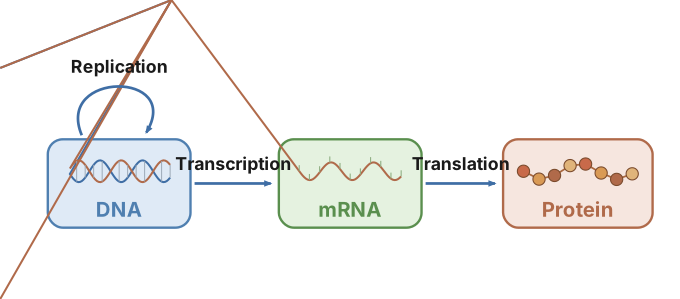
Figure — The (corrected) central-dogma flow diagram In the Central Dogma, DNA is copied into mRNA by Transcription, and mRNA is decoded into protein by Translation — the given diagram has these two labels interchanged, so correcting it means swapping 'Translation' and 'Transcription' on the two arrows.
The Central Dogma of molecular biology, proposed by Francis Crick, describes the normal, one-way flow of genetic information in a cell: DNA replicates itself, and DNA is expressed via RNA into Protein.
- Replication: DNA makes an identical copy of itself (the self-loop on DNA in the figure) — this part of the diagram is correct.
- Transcription: the process by which a DNA strand is used as a template to synthesise a complementary single-stranded mRNA molecule. So the arrow from DNA to mRNA must be labelled Transcription, not 'Translation' as printed. …
- CBSE 2015Set ANNUAL1 markQ.The flow of genetic information is shown below. Name the process of(a) and (b).
›Reveal solutionSolution
The central dogma of molecular biology: DNA replicates itself, is transcribed (a) into mRNA, and the mRNA is translated (b) into protein.
The central dogma
The diagram represents the central dogma of molecular biology, which describes the normal flow of genetic information in a cell:
- DNA undergoes self-replication (the looping arrow on DNA), making copies of itself that are passed on during cell division.
- DNA also directs the synthesis of messenger RNA (mRNA) using one of its strands as a template — this process, labelled (a), is transcription. …
- CBSE 2014Set ANNUAL1 markQ.Diagrammatic representation of 'Central dogma' is given below: Observe the diagram carefully and redraw it making appropriate corrections.
›Reveal solutionSolution
Figure — The (corrected) central-dogma flow diagram The printed diagram wrongly labels DNA→mRNA as 'translation' and mRNA→Protein as 'transcription'; the correct labels are the reverse.
The Central Dogma of molecular biology, first stated by Francis Crick, describes the normal one-way flow of genetic information in a cell:
DNA (replicates itself, shown by the looping arrow) → transcription → mRNA → translation → Protein
- Transcription is the process of copying genetic information from one strand of DNA into a complementary sequence of mRNA — this must be the DNA-to-mRNA step.
- Translation is the process of decoding the mRNA's codon sequence into a corresponding sequence of amino acids to build a polypeptide/protein — this must be the mRNA-to-Protein step. …
🎓Unlock everything free for 14 days
- ✓Full step-by-step solutions
- ✓Concept-first explanations
- ✓Methods, shortcuts & mistakes
- ✓PYQ mapping + timed mock tests
Full access for 14 days. No credit card required.