Q.Name a human genetic disorder due to the following :
🔒You're viewing a preview — the full solution, concept, methods & PYQ mapping are locked.
🔒 Start your 14-day free trial to unlock the full solution →Part (a)Concept understanding — Sex Determination — Ethics and Social Misuse
Sex Determination Ethics: A First Look
Imagine a family waiting for a baby. Relatives whisper, "Hope it's a boy" or "Thank God it's a girl." That casual reaction carries a heavy ethical weight. Sex determination ethics is the study of the moral questions surrounding the practice of choosing or knowing the sex of a child before birth, and the social consequences that follow.
The Core Idea
At its simplest, sex determination ethics examines whether it is morally right to use medical technology to find out whether an unborn baby is male or female, and then to act on that information — especially by aborting a fetus of the "unwanted" sex. The ethical problem is not about the technology itself (ultrasound, amniocentesis), but about what people do with that knowledge.
The NCERT textbook for Class 12 (Biology, Chapter 4: Reproductive Health) states this clearly: "Amniocentesis — a technique to determine the sex of the unborn child — is being misused to kill the female foetuses." The textbook calls this a "severe" misuse and links it directly to the declining child sex ratio in India.
Why Does This Become an Ethical Issue?
Three things make sex determination an ethical problem, not just a medical one:
- Discrimination against females. The practice is overwhelmingly used to abort female fetuses. This treats being female as a defect or a burden, which is a form of gender-based violence before birth.
- Social imbalance. When many more boys are born than girls, society faces a shortage of women. This leads to forced marriages, trafficking, and increased violence against women. The NCERT notes that the child sex ratio in India has dropped alarmingly — from 945 females per 1000 males in 1991 to 919 in 2011.
- Violation of the child's right to exist. The fetus is not given a chance to live simply because of its sex. This raises deep questions about equality and the value of every human life.
The Indian government made sex determination illegal under the Pre-Conception and Pre-Natal Diagnostic Techniques (PCPNDT) Act, 1994. This law bans doctors from telling parents the sex of the fetus, and bans any advertisement or test done solely for sex selection. Violation can lead to imprisonment and heavy fines.
The Everyday Intuition
Think of it this way: if you were told that your school would only admit boys next year, you would immediately see that as unfair. Sex determination ethics extends that same intuition to the womb. It asks: Is it fair to decide that a girl should not be born, simply because she is a girl?
The answer, from an ethical standpoint, is no. Every child — boy or girl — has equal moral worth. Using technology to eliminate an entire sex is a form of systematic discrimination that harms individuals and destabilises society.
Why It Matters for a Commerce/Humanities Student
You might think this is a "science topic," but it is deeply connected to what you study:
- Economics: A skewed sex ratio affects labour markets, marriage markets, and long-term economic growth. Fewer women mean fewer workers, consumers, and entrepreneurs.
- Political Science: Laws like the PCPNDT Act are examples of the state intervening to protect fundamental rights (right to life, right to equality). You can analyse how effective such laws are.
- Sociology: Sex determination reflects deep-rooted patriarchy, son preference, and dowry practices. It is a case study in how social norms shape — and are shaped by — technology.
- Ethics (if you study it): This is a classic dilemma: individual choice (parents wanting a son) versus social good (gender balance). Where do you draw the line?
A Few Key Points to Remember …
Part (b)Concept understanding — Mendelian Genetics Basics
Mendelian Genetics Basics
Imagine you have a box of coloured beads — red and white. If you pick one bead from the box, you get either red or white. Now imagine that the colour of your eyes, or the shape of your earlobe, is decided by something like that: a tiny "packet" inside your cells that comes in two versions, and you inherit one from each parent. That is the core idea of Mendelian genetics.
The everyday intuition
You have probably noticed that children often look like their parents — same hair colour, same dimples, same height. But they are never exact copies. Why? Because each parent contributes half of the "instructions" for building a child. Those instructions come in pairs, one from mother and one from father. Sometimes one instruction overrides the other; sometimes they blend. Gregor Mendel, a 19th-century monk, figured out the rules by watching pea plants — tall vs short, yellow vs green seeds — and counting what appeared in the next generation.
The precise meaning
Mendelian genetics is the study of how traits are passed from parents to offspring through genes. A gene is a unit of heredity — a stretch of DNA that codes for a specific characteristic, like flower colour. Each gene comes in different versions called alleles. For every gene, you inherit two alleles: one from your mother, one from your father.
If the two alleles are identical, you are homozygous for that trait. If they are different, you are heterozygous. In a heterozygous pair, one allele may be dominant — it shows up in the appearance — and the other recessive — it stays hidden unless both alleles are recessive.
Mendel's key insight was that traits are not blended like paint. Instead, alleles remain separate and are passed on intact. A recessive allele can skip a generation and reappear later, unchanged.
Why it matters
Mendelian genetics is the foundation of modern biology. It explains:
- Why some diseases run in families (like cystic fibrosis or sickle-cell anaemia)
- How plant and animal breeders create new varieties
- Why you might have your grandmother's eyes but not your mother's
The NCERT textbook states that Mendel's work established the laws of inheritance — the Law of Dominance, the Law of Segregation, and the Law of Independent Assortment. These laws describe how alleles separate during the formation of eggs and sperm, and how different genes are inherited independently of one another.
Key terms at a glance
- Gene: a unit of heredity on a chromosome
- Allele: a variant form of a gene
- Dominant: the allele that expresses itself even when paired with a different allele
- Recessive: the allele that expresses itself only when paired with an identical recessive allele
- Homozygous: having two identical alleles for a gene
- Heterozygous: having two different alleles for a gene …
Part (a)
(a) Additional X-chromosome in a male (47, XXY): Klinefelter's syndrome. …
Part (a): additional X in a male → Klinefelter's syndrome (XXY); loss of an X in a female → Turner's syndrome (XO).
Part (b): aneuploidy → genetic disorders / developmental abnormalities from unbalanced chromosome number.
Part (a)
A normal human has 46 chromosomes (23 pairs); errors in chromosome number cause specific syndromes.
- (a) An additional X-chromosome in a male gives a karyotype of 47, XXY. This causes Klinefelter's syndrome — the individual is phenotypically male but often shows some feminine features (e.g. gynaecomastia), small testes and sterility. …
- KCET 2026Set UNKNOWN1 markMCQQ.Thalassemia and Sickle cell anaemia are due to a problem in globin molecule synthesis. Select the correct statement. (A) Sickle cell anaemia is due to a quantitative problem of globin molecule. (B) Both are due to qualitative defects in globin chain synthesis. (C) Both are due to quantitative defects in globin chain synthesis. (D) Thalassemia is due to less synthesis of globin molecules.
›Reveal solutionSolution
Distinguishing the two disorders comes down to qualitative versus quantitative defects: sickle cell anaemia changes the structure of the globin chain, while thalassemia reduces the amount of a normal globin chain that is made.
Step 1 — Recall the defect in sickle cell anaemia
Sickle cell anaemia results from a point mutation that changes one amino acid (glutamic acid to valine) in the beta-globin chain — this alters the structure/quality of the globin molecule produced, not the amount made. This is a qualitative defect.
Step 2 — Recall the defect in Thalassemia
Thalassemia is caused by mutations (often deletions or defects in regulatory/synthesis machinery) that reduce or completely stop the synthesis rate of one of the globin chains (alpha or beta) — the globin chains produced are structurally normal, but fewer of them are made. This is a quantitative defect.
Step 3 — Evaluate the options …
- KCET 2025Set C-41 markMCQQ.A colourblind man marries a carrier woman. The percentage of their colourblind progeny in the next generation will be ___ (A) 50% (B) 75% (C) 100% (D) 25%
›Reveal solutionSolution
Write the X-linked recessive genotypes and run a 2×2 Punnett square; count the affected offspring.
Step 1 — Set the genotypes (X-linked recessive inheritance).
Colourblindness is carried on the X chromosome; XC = normal allele, Xc = colourblind allele.
- Colourblind man: a male is hemizygous — one X only — so he is XcY.
- Carrier woman: phenotypically normal but heterozygous, XCXc.
Step 2 — Gametes.
- Father: Xc and Y
- Mother: XC and Xc
Step 3 — Punnett square.
XC Xc Xc XCXc — carrier girl (normal vision) XcXc — colourblind girl Y XCY — normal boy XcY — colourblind boy - KCET 2025Set C-41 markMCQQ.In a practical examination, the following pedigree chart was given as a spotter for identification. The students identify the given pedigree chart as_____:
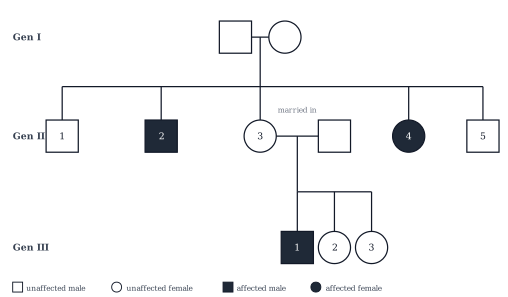 (A) Autosomal recessive
(B) Sex-linked document
(C) Sex-linked recessive
(D) Autosomal dominant
(A) Autosomal recessive
(B) Sex-linked document
(C) Sex-linked recessive
(D) Autosomal dominant›Reveal solutionSolution
Unaffected × unaffected parents giving affected children ⇒ recessive; affected individuals of both sexes, including an affected daughter from an unaffected father ⇒ autosomal, not X-linked.
Step 1 — Read the pedigree.
- Generation I: an unaffected male × an unaffected female.
- Generation II: five children — an affected son, an affected daughter, and three unaffected children.
- Generation III: an unaffected Gen-II daughter married to an unaffected male produces an affected son plus two unaffected daughters.
Step 2 — Dominant or recessive?
The trait skips: both Gen-I parents are unaffected, yet affected children appear. A dominant allele must be expressed in at least one parent (an affected child of a dominant trait must have an affected parent). Since the phenotype disappears in a generation and reappears, it is carried silently by heterozygotes ⇒ the allele is recessive. Both parents are carriers (Aa×Aa→41 aa affected).
This kills options (B) "Sex-linked dominant" and (D) "Autosomal dominant".
Step 3 — Autosomal or sex-linked (X-linked)?
Test the X-linked recessive hypothesis on the Gen-I family. An affected daughter would need genotype XaXa, i.e. one Xa from her mother (a carrier, fine) and one Xa from her father. But a father's only X carries the allele he expresses — so an Xa-bearing father would himself be affected. The Gen-I father is drawn unaffected. Contradiction. …
- KCET 2024Set B-41 markMCQQ.When a flower has both stamens and carpels it is described as (A) Asexual (B) Unisexual (C) Bisexual (D) Dioecious
›Reveal solutionSolution
Both stamens and carpels in the same flower ⇒ bisexual (perfect/hermaphrodite) flower.
1. Define the two reproductive whorls
A complete flower has four whorls, of which two are reproductive:
- Androecium — made of stamens; this is the male whorl (anther + filament, producing pollen).
- Gynoecium (pistil) — made of carpels; this is the female whorl (stigma, style, ovary, producing ovules).
2. The classification of flowers by sex
Term Definition Example Bisexual (perfect / hermaphrodite) Flower has BOTH androecium (stamens) and gynoecium (carpels) Hibiscus, mustard, pea Unisexual (imperfect) Flower has only one of the two — either staminate (male only) or pistillate (female only) Cucurbits, maize, papaya The question's flower has both stamens and carpels ⇒ bisexual.
3. Why the other options are wrong
- (A) Asexual — asexual means reproduction without gametes/fusion at all (budding, fragmentation, vegetative propagation). A flower is by definition a sexual reproductive structure, so "asexual flower" is a contradiction. …
- KCET 2023Set B-41 markMCQQ.In male heterogametic type of sex determination (A) Males do not produce gametes. (B) Male parent produces similar gametes. (C) Female parent produces dissimilar gametes. (D) Male parent produces dissimilar gametes.
›Reveal solutionSolution
Break the term apart: hetero-gametic = producing unlike gametes; so in male heterogamety the male makes two different types of gamete.
Step 1 — Understand the terminology
- Homogametic sex → produces only one type of gamete with respect to the sex chromosome.
- Heterogametic sex → produces two different types of gamete.
Step 2 — Apply it to male heterogamety
Male heterogamety covers two systems:
System Female Male Male's gametes XY (humans, Drosophila) XX XY X or Y — two types XO (grasshopper) XX XO X or no sex chromosome — two types In both, the male is the one making dissimilar gametes; the female (XX) makes only X-bearing eggs and is homogametic. The sex of the offspring is therefore decided by the sperm.
Step 3 — Eliminate the other options …
- KCET 2023Set B-41 markMCQQ.Which of the following statements is correct? (A) Female carrier for haemophilia may transmit the disease to sons. (B) Thalassemia is a qualitative problem. (C) Change in whole set of chromosomes is called aneuploidy. (D) Sickle cell anaemia is a quantitative problem.
›Reveal solutionSolution
Only (A) survives: haemophilia is X-linked recessive, so a carrier mother transmits it to ~50% of her sons. (B), (C) and (D) each state the opposite of the correct fact.
1. Statement (A) — check the cross
Haemophilia is a sex-linked (X-linked) recessive disorder. Let XH = normal allele, Xh = haemophilia allele.
A carrier mother is heterozygous XHXh (she is normal, because the dominant XH masks Xh). Cross her with a normal father XHY:
XHXh×XHY
XH (from mother) Xh (from mother) XH (father) XHXH — normal daughter XHXh — carrier daughter Y (father) XHY — normal son XhY — HAEMOPHILIC SON A son receives his single X from his mother and a Y from his father. With no second X to carry a masking dominant allele, he is hemizygous and expresses whatever is on that X. Hence half the sons of a carrier mother are haemophilic — statement (A) is CORRECT. ✓
2. Why the other three are wrong
(B) "Thalassemia is a qualitative problem." ✗ — inverted. The standard contrast is:
Disorder Defect Thalassemia QUANTITATIVE — reduced synthesis (too few globin chains are made) of an otherwise normal α or β globin chain Sickle-cell anaemia QUALITATIVE — a normal amount of globin is made, but it is structurally abnormal (Glu → Val at position 6 of the β-chain) So thalassemia is quantitative, not qualitative. …
- KCET 2022Set A-11 markMCQQ.XO type of sex determination and XY type of sex determination are the examples of (A) Male Homogamety (B) Male Heterogamety (C) Female Homogamety (D) Female Heterogamety
›Reveal solutionSolution
The key idea is that sex determination type is named by which sex produces two different gametes (heterogametic). In both XO and XY systems, males produce two types of sperm (with or without X, or with X vs Y), so they are heterogametic. The correct answer is (B).
The concept here is gamety — whether a sex produces identical or different gametes with respect to sex chromosomes. "Homo" means same, "hetero" means different. The system is named after the sex that is heterogametic, because that's the one that determines the offspring's sex.
In the XO system (found in grasshoppers, for example), females have two X chromosomes (XX) and produce only X-bearing eggs — they are homogametic. Males have only one X (XO) and produce two types of sperm: half with X, half with no sex chromosome (O). That makes males heterogametic.
In the XY system (humans, Drosophila), females are XX and produce only X eggs — again homogametic. Males are XY and produce X-bearing and Y-bearing sperm — heterogametic.
So in both systems, the female is homogametic and the male is heterogametic. The question asks for the example these systems represent — they are both cases of male heterogamety.
Let's walk through the options:
- Male Homogamety — This would mean males produce only one type of gamete. That's false here; males in both systems produce two types.
- Male Heterogamety — Correct. Males produce two different gamete types (X and O, or X and Y). …
- KCET 2021Set C-31 markMCQQ.Match the Column - I with Column - II Column - I i. Autosomal trisomy ii. Allosomal trisomy iii. Allosomal Monosomy iv. Cystic fibrosis Column - II p. Turner’s Syndrome q. Mendelian disorder r. Klinefelter’s Syndrome s. Down’s Syndrome (A) i-p, ii-q, iii-r, iv-s (B) i-p, ii-q, iii-s, iv-r (C) i-s, ii-r, iii-q, iv-p (D) i-s, ii-r, iii-p, iv-q
›Reveal solutionSolution
Classify each disorder by which chromosome set is affected and whether a chromosome is gained or lost — that fixes all four matches.
Step 1 — The two vocabularies you need
Autosome vs allosome: autosomes are chromosome pairs 1–22; allosomes (sex chromosomes) are the X and Y.
Trisomy vs monosomy: these are aneuploidies, caused by the failure of chromatids to segregate during cell division (non-disjunction):
- Trisomy = one EXTRA chromosome (2n+1).
- Monosomy = one chromosome MISSING (2n−1).
Separately, a Mendelian disorder is one caused by an alteration/mutation in a SINGLE GENE (not a change in chromosome number).
Step 2 — Work through Column I
i. Autosomal trisomy → (s) Down's Syndrome.
An extra copy of chromosome 21 (trisomy 21) — chromosome 21 is an autosome. Karyotype 47, i.e. 2n+1. Features: short stature, small round head, furrowed tongue, partially open mouth, palm crease, retarded mental and physical development.
ii. Allosomal trisomy → (r) Klinefelter's Syndrome.
Karyotype 47, XXY — an extra X on the SEX chromosomes. The individual is masculine in development but has gynaecomastia (feminine development, e.g. breast development) and is sterile.
iii. Allosomal monosomy → (p) Turner's Syndrome.
Karyotype 45, XO — one of the X chromosomes is MISSING, again on the SEX chromosomes. Such females are sterile, have rudimentary ovaries and lack other secondary sexual characters.
iv. Cystic fibrosis → (q) Mendelian disorder. …
- KCET 2019Set A-11 markMCQQ.From the Chromosomal Complements given below, identify the one which shows female heterogamety. (A) XX−XY (B) ZZ−ZW (C) XX−XO (D) XX−XXY
›Reveal solutionSolution
Female heterogamety means the female produces two different types of gametes (e.g., ZW), while the male produces only one type (ZZ). The correct chromosomal complement showing this is ZZ−ZW, which corresponds to option (B).
The key idea here is the sex determination system in organisms. In most mammals, including humans, males are heterogametic (XY) and females are homogametic (XX). But in some species — notably birds, some reptiles, and butterflies — the pattern is reversed: the female is the heterogametic sex. This system is denoted by the letters Z and W, where females are ZW and males are ZZ.
Let’s examine each option carefully.
-
Option (A): XX−XY
This is the familiar mammalian system. Females are XX (homogametic — all eggs carry an X chromosome), and males are XY (heterogametic — sperm carry either X or Y). So here, male heterogamety is shown, not female.
-
Option (B): ZZ−ZW
In this notation, males are ZZ (homogametic — all sperm carry Z), and females are ZW (heterogametic — eggs carry either Z or W). This is exactly female heterogamety. The female produces two types of gametes, determining the sex of the offspring.
-
Option (C): XX−XO
This system is found in some insects like grasshoppers. Females are XX (homogametic), and males are XO (they have only one X chromosome, no second sex chromosome). Males produce sperm with either X or no sex chromosome — so again, male heterogamety.
-
Option (D): XX−XXY …
-
🎓Unlock everything free for 14 days
- ✓Full step-by-step solutions
- ✓Concept-first explanations
- ✓Methods, shortcuts & mistakes
- ✓PYQ mapping + timed mock tests
Full access for 14 days. No credit card required.