Q.Benzophenone can be obtained by ___________. (Two or more than two options may be correct.)
🔒You're viewing a preview — the full solution, concept, methods & PYQ mapping are locked.
🔒 Start your 14-day free trial to unlock the full solution →Concept understanding — Clemmensen Reduction Cannizzaro Reaction
Clemmensen Reduction & Cannizzaro Reaction: Two Completely Different Reactions
These two reactions are often grouped together in textbooks because they both involve carbonyl compounds (C=O), but they do entirely different things. Let's take them one at a time.
Clemmensen Reduction
Intuition first. Imagine you have a ketone or aldehyde — a molecule with a C=O group. You want to remove that oxygen entirely and replace the C=O with two hydrogen atoms, turning it into a simple hydrocarbon chain. That's a reduction (adding hydrogen, removing oxygen). The Clemmensen reduction is a brute-force way to do this using a strongly acidic, reducing environment.
The precise reaction:
A ketone or aldehyde is heated with zinc amalgam (Zn-Hg) and concentrated hydrochloric acid (HCl). The C=O group is reduced to a CH₂ group.
R−C(=O)−RX′+4[H]Zn(Hg),HCl,heatR−CHX2−RX′+HX2O
Aldehyde or KetoneZn(Hg), conc. HCl, ΔHydrocarbon
Key points for exams:
- Works only for ketones and aldehydes that are stable in strong acid.
- Does not work for compounds that get destroyed by conc. HCl (e.g., acid-sensitive groups like esters, nitriles).
- The mechanism is complex and not usually tested in detail — just know it's a reductive removal of C=O.
- The product is always a saturated hydrocarbon (alkane).
Clemmensen reduction cannot reduce carboxylic acids, esters, or amides. Only aldehydes and ketones.
Example:
Acetophenone (CX6HX5−CO−CHX3) → Ethylbenzene (CX6HX5−CHX2−CHX3)
Cannizzaro Reaction
Intuition first. This is a disproportionation reaction — one molecule of aldehyde gets oxidised (to a carboxylic acid) while another gets reduced (to an alcohol). It happens only with aldehydes that have no alpha-hydrogen atoms (i.e., the carbon next to the C=O has no H). Why? Because if there were alpha-hydrogens, the aldehyde would undergo aldol condensation instead.
The precise reaction:
An aldehyde without α-hydrogen is treated with concentrated aqueous or alcoholic base (NaOH/KOH). Two molecules of aldehyde react: one becomes a carboxylate salt, the other becomes a primary alcohol.
2R−CHO+OHX−R−COOX−+R−CHX2OH
After acidification, the carboxylate salt gives the carboxylic acid.
2HCHOconc. NaOHHCOONa+CH3OH
(Formaldehyde → sodium formate + methanol)
Key points for exams:
- Only works for aldehydes with no α-hydrogen: formaldehyde, benzaldehyde, trimethylacetaldehyde, etc.
- The base must be concentrated (dilute base won't work).
- Formaldehyde is the most common example — it gives formic acid (as formate) and methanol.
- Crossed Cannizzaro: When formaldehyde is mixed with another aldehyde (like benzaldehyde), formaldehyde is always the one that gets oxidised (to formate), and the other aldehyde gets reduced (to alcohol). This is because formaldehyde is the strongest reducing agent among aldehydes.
In a crossed Cannizzaro, formaldehyde always becomes the carboxylate. The other aldehyde becomes the alcohol. This is a common exam question.
Example: …
Why this formula?
Okay, let's break down these two very different reactions. They are often studied together because they both involve carbonyl compounds (C=O), but their mechanisms and purposes are completely opposite.
The Core Idea: Two Paths from a Carbonyl
Think of a carbonyl group (C=O) as a reactive hub. The carbon is electrophilic (electron-loving) because the oxygen pulls electron density away. The reactions it undergoes depend entirely on the conditions (acidic, basic, reducing) and the structure of the molecule (does it have an α-hydrogen?).
- Clemmensen Reduction is about removing the oxygen entirely.
- Cannizzaro Reaction is about disproportionating the molecule (one gets reduced, one gets oxidized).
1. Clemmensen Reduction: Why it Removes Oxygen
What it does: Converts a carbonyl group (C=O) in an aldehyde or ketone into a methylene group (CHX2).
RX2C=OZn(Hg)/HCl,heatRX2CHX2
Why this formula holds (The Mechanism):
The key is the reducing power of zinc amalgam in a strongly acidic environment.
- Protonation: The carbonyl oxygen is basic. In the strong HCl, it gets protonated first.
RX2C=O+HX+RX2C=OHX+
This makes the carbon *even more* electrophilic.
2. Electron Transfer from Zinc: Zinc metal (Zn) is a good reducing agent. It donates electrons to the electron-deficient carbon. This is a single electron transfer (SET) process, not a simple hydride transfer.
- The zinc inserts itself, forming an organozinc intermediate (a carbenoid species).
- This intermediate is highly reactive.
- Protonation and Elimination: The acidic medium provides plenty of HX+ ions. The intermediate gets protonated, and the oxygen (now as HX2O) is eliminated. The zinc is oxidized to ZnX2+.
The "Why" in a nutshell: The strong acid activates the carbonyl, and the zinc metal provides the electrons needed to break the C=O bond and replace it with two C−H bonds. The reaction does not work under basic conditions because you need the acid to protonate the oxygen first.
2. Cannizzaro Reaction: Why it Disproportionates
What it does: An aldehyde without an α-hydrogen (like formaldehyde HCHO or benzaldehyde CX6HX5CHO) reacts with a strong base to give a carboxylic acid and an alcohol.
2HCHOconc⋅NaOHHCOONa+CHX3OH
Why this formula holds (The Mechanism):
The key is the absence of α-hydrogens. If there were an α-hydrogen, the base would deprotonate that instead, leading to an aldol reaction. Here, the base has no choice but to attack the carbonyl itself.
- Nucleophilic Attack: The strong base (OHX−) attacks the electrophilic carbonyl carbon.
RCHO+OHX−R−CH(OH)OX−
This forms a **tetrahedral intermediate** (an alkoxide).
2. The Crucial Hydride Transfer: This is the unique step. The tetrahedral intermediate is unstable. It can't lose OHX− (that would just give back the aldehyde). Instead, it acts as a hydride donor (HX−).
- The carbon bearing the negative charge (from the OHX− attack) is very electron-rich. It kicks out a hydride ion (HX−) to a second molecule of aldehyde.
- This is a hydride shift.
R−CH(OH)OX−+RCHORCOOH+RCHX2OX− …
The key idea is that benzophenone (Ph2C=O) can be prepared by Friedel–Crafts acylation, organocadmium reactions, and the Gattermann–Koch reaction, but not by Grignard addition (which gives a tertiary alcohol).
Step 1: Option (i) is a standard Friedel–Crafts acylation: benzoyl chloride reacts with benzene in the presence of AlCl3 to give benzophenone directly.
Step 2: Option (ii) uses diphenylcadmium, which reacts with benzoyl chloride to give the ketone without over-addition — organocadmium reagents are less reactive than Grignards. …
Benzophenone (C6H5)2CO is a symmetrical diaryl ketone. It forms by Friedel–Crafts acylation of benzene with benzoyl chloride, and by the reaction of benzoyl chloride with diphenylcadmium. The correct options are (i) and (ii).
(i) Benzoyl chloride + benzene + AlCl3 — Friedel–Crafts acylation. AlCl3 generates the acylium ion C6H5CO+, which acylates benzene to give benzophenone. Correct.
(ii) Benzoyl chloride + diphenylcadmium — organocadmium reagents convert acyl chlorides to ketones and are unreactive enough to stop at the ketone. C6H5COCl+(C6H5)2Cd→(C6H5)2CO. Correct. …
Method: Retrosynthetic Analysis & Named Reaction Mapping
This question tests your ability to identify which reactions produce benzophenone — a ketone with the structure C6H5COC6H5.
Step 1: Recall the structure of benzophenone
Benzophenone = diphenyl ketone:
C6H5–CO–C6H5
It has two phenyl rings attached to a carbonyl carbon.
Step 2: Map each option to a known reaction
Option (A): Benzoyl chloride + benzene + AlCl3
→ This is Friedel-Crafts acylation.
Benzoyl chloride (C6H5COCl) reacts with benzene in presence of AlCl3 to give benzophenone.
✓ Correct
Option (B): Benzoyl chloride + diphenylcadmium
→ This is a cadmium reagent reaction (related to organometallic synthesis).
Diphenylcadmium (C6H5)2Cd reacts with benzoyl chloride to give benzophenone.
✓ Correct
Option (C): Benzoyl chloride + phenylmagnesium chloride
→ This is a Grignard reaction.
Phenylmagnesium chloride (C6H5MgCl) reacts with benzoyl chloride.
But Grignard reagents react twice with acid chlorides — the first addition gives a ketone, but the second addition gives a tertiary alcohol (triphenylmethanol), not benzophenone.
✗ Incorrect
Option (D): Benzene + carbon monoxide + ZnCl2
→ This is the Gattermann-Koch reaction (formylation). …
Let’s break this down step-by-step — first the concept, then the common mistakes, and finally how to avoid them.
🧪 Concept Recap: Making Benzophenone
Benzophenone is a diaryl ketone (Ph2C=O).
It can be made by several methods — but not all reactions that look right actually work.
✓ Correct Options
(A) Benzoyl chloride + benzene + AlCl3
→ Friedel–Crafts acylation — works perfectly.
Benzoyl chloride acts as acylating agent, benzene as substrate, AlCl3 as catalyst.
(B) Benzoyl chloride + diphenylcadmium
→ Cadmium reagent method — works.
Diphenylcadmium (Ph2Cd) reacts with acid chlorides to give ketones.
(C) Benzoyl chloride + phenylmagnesium chloride
→ ✗ Does NOT give benzophenone — gives a tertiary alcohol (triphenylmethanol) because Grignard reagent adds twice.
(D) Benzene + carbon monoxide + ZnCl2
→ ✗ Does NOT work — this is not a standard method.
(Compare: Gattermann–Koch uses CO+HCl+AlCl3 to give benzaldehyde, not benzophenone.)
Correct answers: (A) and (B)
✗ Common Mistakes & How to Avoid Them
1. Thinking Grignard + acid chloride always gives ketone
- Mistake: Students assume one equivalent of Grignard stops at ketone.
- Why it’s wrong: Grignard reagents are very reactive — they attack the ketone product immediately to form a tertiary alcohol.
- Avoid: Remember:
Grignard + acid chloride → tertiary alcohol (unless you use a special reagent like cadmium or copper).
2. Confusing Gattermann–Koch with benzophenone synthesis
- Mistake: Option (D) looks like Gattermann–Koch, so students think it gives benzophenone.
- Why it’s wrong: Gattermann–Koch uses CO+HCl+AlCl3 and gives benzaldehyde, not benzophenone. Also, ZnCl2 is not the correct catalyst here.
- Avoid: Memorise the exact reagents for each named reaction — don’t swap catalysts or skip HCl.
3. Assuming any organometallic with acid chloride gives ketone
- Mistake: Students think “organometallic + acid chloride = ketone” is universal.
- Why it’s wrong: Only less reactive organometallics (like R2Cd, R2CuLi) stop at ketone. Grignard and organolithium go further.
- Avoid: Classify organometallics by reactivity:
- Low reactivity (Cd, Cu) → ketone
- High reactivity (Mg, Li) → tertiary alcohol …
- KCET 2025Set D-41 markMCQQ.Statement – I : Reduction of ester by DIABL-H followed by hydrolysis gives aldehyde. Statement – II : Oxidation of benzyl alcohol with aqueous KMnO4 leads to the formation to Benzaldehyde. Among the above statements, identify the correct statement. (A) Both statements – I and II are false (B) Statement – I is true but statement – II is false (C) Statement – I is false but statement – II is true (D) Both statements – I and II are true.
›Reveal solutionSolution
Statement I is true (DIBAL-H is a partial reducing agent that stops at the aldehyde); Statement II is false (aqueous KMnO4 over-oxidises benzyl alcohol to benzoic acid, not benzaldehyde).
Step 1 — Assess Statement I: DIBAL-H on an ester.
R−COOR′(ii) H3O+(i) DIBAL-H, −78∘CR−CHO
DIBAL-H = di-isobutylaluminium hydride, [(CH3)2CHCH2]2AlH.
Why it stops at the aldehyde — and does not run on to the alcohol — is the whole point of the reagent:
- It is bulky and delivers only one hydride to the ester carbonyl.
- The species formed is a tetrahedral hemiacetal-type aluminium alkoxide, which is stable at low temperature (−78∘C) and does not collapse to expel OR′ while the reducing agent is still present.
- Only on the separate aqueous work-up (hydrolysis) does that intermediate break down to release the aldehyde — by which time there is no hydride left to reduce it further.
A strong, unselective reducing agent such as LiAlH4 would deliver hydride twice and take the ester straight through to the primary alcohol. So DIBAL-H's value is precisely that it is a partial (controlled) reducing agent.
⟹Statement I is TRUE.
Step 2 — Assess Statement II: benzyl alcohol + aqueous KMnO4.
Benzyl alcohol, C6H5CH2OH, is a primary alcohol. Its oxidation proceeds in two stages:
C6H5CH2OH[O]C6H5CHO[O]C6H5COOH
The aldehyde formed in the first stage is itself very easily oxidised — more easily, in fact, than the alcohol was. So the outcome depends entirely on how strong the oxidant is:
- Strong oxidants — acidified or aqueous KMnO4, K2Cr2O7/H+ — cannot be halted at the aldehyde. They sweep straight through to the carboxylic acid: C6H5CH2OHKMnO4 (aq.)C6H5COOH(benzoic acid) …
- COMEDK 2025Set 2025-A1 markMCQQ.An organic compound " A " reacts with Zn/Hg / Conc. HCl to form p-Xylene. It reduces Tollen's reagent and on oxidation with KMnO4/H+it yields 1, 4-benzenedicarboxylic acid. Identify compound A. (A) p-methylbenzaldehyde. (B) p- Cresol. (C) m-Cresol. (D) 4-Methylacetophenone.
›Reveal solutionSolution
The compound must be an aldehyde that reduces Tollen’s reagent, and its reduction with Zn(Hg)/HCl gives p-xylene; oxidation yields terephthalic acid. Only p-methylbenzaldehyde fits all clues.
Concept & Intuition
We are given three reactions of compound A:
- Clemmensen reduction (Zn/Hg + conc. HCl) converts a carbonyl group (C=O) into a methylene group (CH₂). The product is p-xylene, which has two methyl groups para to each other. So A must have a carbonyl group attached to a benzene ring that already has a methyl group para to it.
- Tollen’s test (reduces Ag⁺ to Ag mirror) is specific to aldehydes (and α-hydroxy ketones, but not simple ketones). So A must be an aldehyde.
- Oxidation with KMnO₄/H⁺ of a methyl group attached to a benzene ring gives a carboxylic acid. The product is 1,4-benzenedicarboxylic acid (terephthalic acid), meaning both substituents on the ring are oxidized to –COOH. So A must have a methyl group and an aldehyde group para to each other.
Thus A is p-methylbenzaldehyde (also called 4-methylbenzaldehyde).
Step-by-step reasoning
- Identify the reduction product Clemmensen reduction converts a carbonyl (C=O) to CH₂. If the product is p-xylene (1,4-dimethylbenzene), then the starting compound must have a carbonyl group attached to a benzene ring that already has a methyl group at the para position. So the skeleton is:
CH3–C6H4–C(=O)–R
where R is H or an alkyl group. After reduction, the –C(=O)–R becomes –CH₂–R, and for the final product to be p-xylene, R must be H (so that –CH₂–R = –CH₃). Hence A is a para-substituted benzaldehyde.
-
Confirm with Tollen’s test
Tollen’s reagent (ammoniacal Ag⁺) is reduced only by aldehydes (and some α-hydroxy ketones). A ketone like 4-methylacetophenone (option D) would not give a silver mirror. So A must be an aldehyde. This eliminates options B, C, and D.
-
Check oxidation product
KMnO₄/H⁺ oxidizes both –CH₃ and –CHO on a benzene ring to –COOH. If A is p-methylbenzaldehyde, oxidation gives:
CH3–C6H4–CHOKMnO4/H+HOOC–C6H4–COOH
which is 1,4-benzenedicarboxylic acid (terephthalic acid). This matches the given product.
- Eliminate other options …
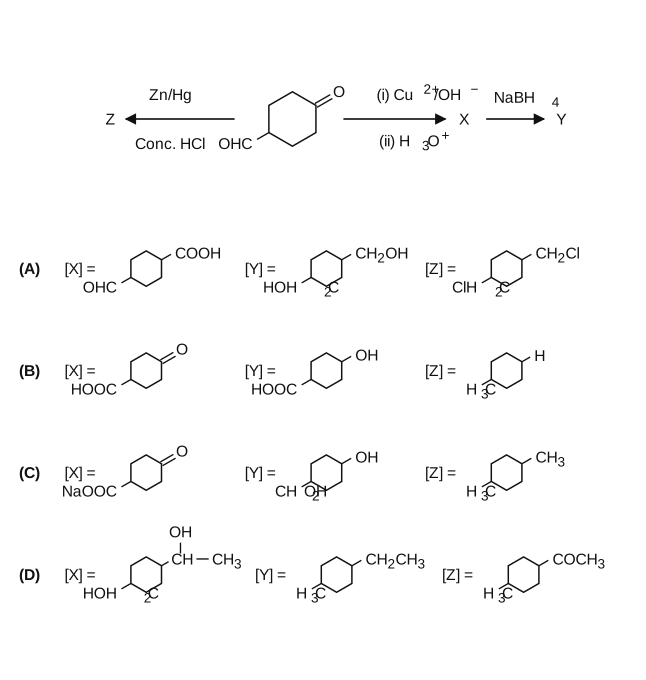
- COMEDK 2025Set 2025-E1 markMCQQ.Identify X, Y and Z formed in the reaction: (A) (B) (C) (D)
›Reveal solutionSolution
The starting compound is 4-formylcyclohexanone. Tollen’s-type oxidation (Cu²⁺/OH⁻ then H⁺) selectively oxidises the aldehyde to a carboxylic acid, leaving the ketone untouched, giving X. NaBH₄ reduces the ketone in X to an alcohol, giving Y. Clemmensen reduction (Zn/Hg, conc. HCl) reduces both carbonyls to methylene groups, giving Z. The correct match is option (B).
Concept & Intuition
The molecule is a cyclohexane ring with two different carbonyl groups: a ketone (C=O) on one carbon and an aldehyde (–CHO) on the opposite carbon. These groups react differently under the given conditions because aldehydes are more easily oxidised than ketones, and NaBH₄ reduces ketones to secondary alcohols, while the Clemmensen reduction removes both carbonyl oxygens entirely, replacing each C=O with CH₂. The key is to track which functional group is transformed at each step.
Step-by-step reasoning
-
Identify the starting compound
The stem shows a cyclohexane ring with a ketone (C=O) at one vertex and an aldehyde group (written as OHC–, i.e. –CHO) at the opposite (1,4‑) vertex. This is 4‑formylcyclohexanone.
-
First reaction (right arrow): Cu²⁺/OH⁻ then H₃O⁺ → X
- Cu²⁺ in basic medium (Fehling’s or Tollen’s‑type conditions) is a mild oxidising agent that selectively oxidises aldehydes to carboxylic acids. Ketones are not oxidised under these conditions.
- The –CHO group becomes –COOH. The ring ketone remains unchanged.
- After acidification (H₃O⁺), the carboxylate salt is protonated to the free carboxylic acid.
- Therefore, X is 4‑oxocyclohexane‑1‑carboxylic acid (a cyclohexane ring with a ketone at C‑1 and –COOH at C‑4).
- This matches the structure shown in option (B) for X: ring with C=O and HOOC– opposite.
-
Second reaction: X → NaBH₄ → Y
- NaBH₄ is a selective reducing agent that reduces aldehydes and ketones to alcohols. It does not reduce carboxylic acids under normal conditions.
- In X, the ketone (C=O) is reduced to a secondary alcohol (–CHOH–). The –COOH group is untouched.
- Therefore, Y is 4‑hydroxycyclohexane‑1‑carboxylic acid (ring with –OH at one carbon and –COOH at the opposite carbon).
- This matches the structure in option (B) for Y: ring with OH and HOOC– opposite.
-
Third reaction (left arrow): Zn/Hg, conc. HCl → Z
- This is the Clemmensen reduction, which reduces carbonyl groups (both aldehydes and ketones) to methylene (CH₂) groups.
- The starting compound has two carbonyls: the ring ketone and the aldehyde. Both are reduced.
- The ring C=O becomes CH₂ (the ring carbon becomes a simple methylene).
- The –CHO becomes –CH₃ (a methyl group).
- Therefore, Z is 4‑methylcyclohexane (a cyclohexane ring with a methyl group at C‑4; the other carbonyl site becomes a plain CH₂).
- This matches the structure in option (B) for Z: ring with an H (implicitly a CH₂) at the former ketone carbon and a –CH₃ at the opposite carbon.
-
Check the other options …
-
- COMEDK 2025Set 2025-M1 markMCQQ.Two statements, one Assertion (A) and the other Reason (R) are given. Choose the correct option. Assertion: Compound [X] reacts with Hydrazine in presence of KOH/ Glycol to form the product [Y]. Reason: Reduction reaction occurs and Carbonyl group is reduced to Methylene group. (A) Both A and R are correct but R is not the correct explanation of A . (B) Both A and R are correct and R is the correct explanation of A . (C) A is wrong but R is correct. (D) A is correct but R is wrong.
![The stem drawing shows compound [X] on the left and compound [Y] on the right, joined by a](/figures/comedk/2025-M-chemistry-q20.svg)
›Reveal solutionSolution
The key idea is that the Wolff–Kishner reduction converts an aldehyde (or ketone) carbonyl into a methylene group under basic, high‑temperature conditions. Here, the Assertion is correct (the reaction shown is exactly that), and the Reason correctly describes the reduction of a carbonyl to a methylene group, so both are true and the Reason is the correct explanation of the Assertion.
Concept and intuition:
The reaction shown is the classic Wolff–Kishner reduction. In this reaction, hydrazine (NH2NH2) reacts with a carbonyl group (here an aldehyde) to form a hydrazone intermediate. Under strongly basic conditions (KOH) and high heat (glycol provides a high‑boiling solvent), the hydrazone decomposes, releasing nitrogen gas and replacing the carbonyl oxygen with two hydrogen atoms — effectively reducing C=O to CHX2. The rest of the molecule (including the bromine substituent) remains unchanged because the reaction conditions are not strongly reducing toward alkyl halides. So the Assertion that compound [X] (a bromo‑aldehyde) reacts with hydrazine/KOH/glycol to give [Y] (the same chain but with a methylene group at the end) is correct. The Reason states that a reduction occurs and the carbonyl group is reduced to a methylene group — that is precisely what happens. Therefore the Reason correctly explains the Assertion.
Step‑by‑step reasoning:
-
Identify the functional groups in [X].
[X] is a six‑carbon chain with a bromine atom on the second carbon (from the left) and an aldehyde group (−CHO) at the right‑hand end. The rest are methylene (CHX2) groups and a terminal methyl (CHX3). So [X] is a bromo‑aldehyde.
-
Identify the product [Y].
[Y] has the same carbon skeleton and the same bromine atom in the same position, but the aldehyde group is gone — the right‑hand end is simply a methyl group (CHX3). This means the C=O has been replaced by CHX2.
-
Recall the Wolff–Kishner reduction.
The reaction of an aldehyde or ketone with hydrazine in the presence of a strong base (like KOH) and a high‑boiling solvent (like glycol or ethylene glycol) is the standard Wolff–Kishner reduction. The overall transformation is:
R−CHONHX2NHX2,KOH,glycol,heatR−CHX3
The carbonyl oxygen is removed and two hydrogens are added, converting C=O into CHX2.
- Check the Assertion (A). …
-
- KCET 2023Set D-21 markMCQQ.In the reaction: C6H5CN (i) SnCl2+HCl X con. KOH Y + Z, (ii) H3O+ Formation of X, formation of Y and Z are known by (A) Rosenmund reduction, Cannizaro reaction. (B) Clemmensen reduction, Sandmeyer reaction. (C) Wolff-Kishner reduction, Wurtz reaction. (D) Stephen reaction, Cannizaro reaction.
›Reveal solutionSolution
Nitrile + SnCl2/HCl then H3O+ = Stephen reaction → benzaldehyde; an α-H-free aldehyde + conc. KOH = Cannizzaro → alcohol + carboxylate salt.
Step 1 — Identify X (the Stephen reaction)
Benzonitrile is reduced by stannous chloride in the presence of hydrochloric acid. SnCl2 is a mild reducing agent that stops at the imine stage, forming an aldimine hydrochloride, which is then hydrolysed by H3O+ to the aldehyde:
C6H5C≡NSnCl2/HClC6H5CH=NHH3O+C6H5CHO+NH3
X=benzaldehyde
This conversion of a nitrile to an aldehyde is the Stephen reaction. (It is not Rosenmund reduction, which converts an acyl chloride RCOCl to an aldehyde using H2/Pd-BaSO4 — that rules out option (A).)
Step 2 — Identify Y and Z (the Cannizzaro reaction)
Benzaldehyde, C6H5CHO, has no α-hydrogen (the carbon next to −CHO is part of the aromatic ring). An aldehyde lacking α-H cannot undergo aldol condensation; instead, with concentrated alkali it undergoes self-oxidation–reduction (disproportionation) — the Cannizzaro reaction:
2C6H5CHOconc. KOHY (reduced)C6H5CH2OH+Z (oxidised)C6H5COOK …
- KCET 2022Set B-31 markMCQQ.Reaction by which benzaldehyde cannot be prepared is (A) Toluene (i)Cl2,Cl2 in CS2 (B) Benzoyl chloride + H2 Pd-BaSO4 (C) Benzene + CO + HCl anhydrous AlCl3 (D) Benzoic acid Zn-Hg and conc.HCl
›Reveal solutionSolution
Identify each named reaction; three of the four are textbook routes to benzaldehyde, while Zn-Hg/conc. HCl (Clemmensen) is a deoxygenation that cannot make an aldehyde from benzoic acid.
1. Test each option
(A) Toluene Cl2, light / CS2 then hydrolysis — WORKS
Free-radical chlorination of the methyl side chain gives benzal chloride, which hydrolyses to the aldehyde:
C6H5CH3Cl2C6H5CHCl2H2O/ aq. NaOHC6H5CHO
(The related Etard reaction, CrO2Cl2 on toluene, does the same job.)
(B) Benzoyl chloride + H2Pd-BaSO4 — WORKS: this is the Rosenmund reduction
C6H5COCl+H2Pd-BaSO4(poisoned Pd)C6H5CHO+HCl
The BaSO4 support (with a sulphur poison) deliberately deactivates the palladium so the reduction stops at the aldehyde instead of running on to the alcohol.
(C) Benzene + CO+HClanhyd. AlCl3 — WORKS: this is the Gattermann–Koch reaction
C6H6+CO+HClanhyd. AlCl3/CuClC6H5CHO
CO + HCl behave as an in situ source of the formyl cation HCOX+, which formylates the ring (a Friedel–Crafts type electrophilic substitution).
(D) Benzoic acid Zn-Hg, conc. HCl — DOES NOT WORK
Zinc amalgam + concentrated HCl is the Clemmensen reduction. Its scope is the complete reduction of an aldehyde/ketone carbonyl to a methylene group: …
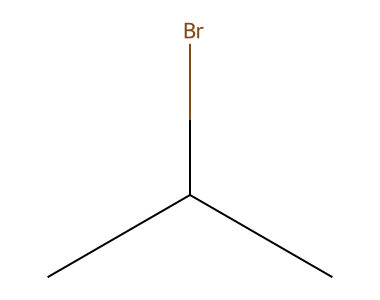
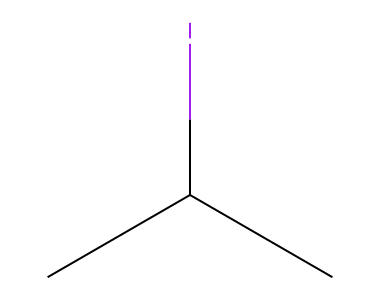
- KCET 2022Set B-31 markMCQQ.Identify A and B in the reaction: Propene HBr, Benzoyl Peroxide A (major product) Propene HI B (major product) A and B respectively are: (A) A =
 , B =
, B = 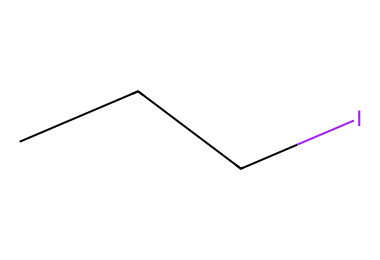 (B) A = , B =
  (C) A =
  , B =
(D) A = , B =
, B =
(D) A = , B = ›Reveal solutionSolution
HBr + peroxide is the one classic exception to Markovnikov's rule (anti-Markovnikov, via a free-radical chain mechanism); HI always adds normally since it never undergoes the peroxide effect.
Step 1 — Propene + HBr/peroxide → A.
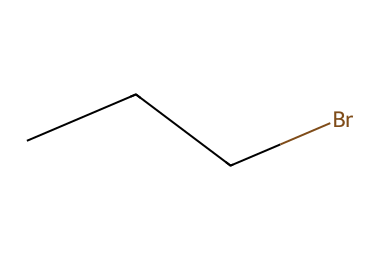
Benzoyl peroxide initiates a free-radical chain mechanism. The bromine radical adds to give the more stable secondary radical, so the SECOND H ends up on the more-substituted carbon and Br on the LESS-substituted one: CH3−CH2−CH2−Br (1-bromopropane), the anti-Markovnikov product.
Step 2 — Propene + HI → B. …
- KCET 2021Set B-21 markMCQQ.The reagent which can do the conversion CH3COOH→CH3CH2OH is (A) LiAlH4/ether (B) H2, Pt (C) NaBH4 (D) Na and C2H5OH
›Reveal solutionSolution
The carboxyl group is the hardest carbonyl to reduce, so only the strongest hydride reagent, LiAlH4, converts CH3COOH into CH3CH2OH.
Step 1 — The concept: why −COOH resists reduction
In a carboxylic acid the carbonyl carbon is already electron-rich because the −OH oxygen donates a lone pair into the C=O by resonance:
−C∥O−OH⟷−C∣O−=O+H
That resonance makes the carbonyl carbon a poor electrophile — far less reactive towards a hydride than an aldehyde or ketone. Hence a mild hydride donor simply bounces off it.
Step 2 — Test each reagent
(A) LiAlH4 / ether — lithium aluminium hydride is the strongest common hydride donor (AlH4− releases H− readily). It reduces the acid through the aldehyde stage straight to the primary alcohol:
CH3COOHLiAlH4/dry etherH3O+CH3CH2OH
This is the standard laboratory acid → 1° alcohol conversion. ✓
(B) H2, Pt — catalytic hydrogenation reduces C=C, C≡C, −NO2, nitriles etc., but the carboxyl group is essentially inert to H2/Pt under ordinary conditions. ✗ …
- KCET 2021Set B-21 markMCQQ.CH3CHO(i) CH3MgBr(ii) H2O+AConc. H2SO4,ΔB(i) B2H6(ii) H2O2,OH−C A and C are (A) Identical (B) Position isomers (C) Functional isomers (D) Optical isomers
›Reveal solutionSolution
The reaction sequence converts acetaldehyde into an alkene (via Grignard addition and dehydration), then hydroboration‑oxidation adds water anti‑Markovnikov to give a primary alcohol. The final product C is a structural isomer of the starting aldehyde A, specifically a functional isomer.
The key is to track the carbon skeleton and functional group through each step. The first reaction is a classic Grignard addition to a carbonyl, which lengthens the chain by one carbon. The second step is an acid‑catalysed dehydration that forms an alkene. The third step is hydroboration‑oxidation, which adds water across the double bond in the opposite regiochemistry to acid‑catalysed hydration.
Let’s work through it step by step.
- Grignard addition to acetaldehyde Acetaldehyde (CH3CHO) reacts with methylmagnesium bromide (CH3MgBr). The Grignard reagent acts as a nucleophile, attacking the electrophilic carbonyl carbon. After aqueous work‑up (H2O+), the product is a secondary alcohol:
CH3CHO+CH3MgBr→CH3CH(OH)CH3
This is 2‑propanol (isopropyl alcohol). So compound A is CH3CH(OH)CH3.
- Dehydration to an alkene Concentrated H2SO4 with heat causes elimination of water from the alcohol. The major product follows Zaitsev’s rule: the more substituted alkene is favoured.
CH3CH(OH)CH3Conc. H2SO4,ΔCH3CH=CH2+H2O
Compound B is propene (CH3CH=CH2).
- Hydroboration‑oxidation of propene Diborane (B2H6) adds to the double bond in a syn fashion, with boron attaching to the less substituted carbon (anti‑Markovnikov addition). Oxidation with alkaline hydrogen peroxide replaces the boron with a hydroxyl group, retaining the stereochemistry.
CH3CH=CH2(i) B2H6(ii) H2O2,OH−CH3CH2CH2OH
Compound C is 1‑propanol (a primary alcohol).
Now compare A and C: …
- COMEDK 2021Set 2021-B1 markMCQQ.Identify the INCORRECT method for the preparation of benzaldehyde from the following: (A) Benzoyl chloride (C6H5COCl) with H2 / Pd-BaSO4 (Rosenmund reduction) (B) Benzene with CO and HCl in presence of anhydrous AlCl3 (Gattermann-Koch reaction) (C) Methyl benzoate (C6H5COOCH3) with DIBAL-H in toluene at -78 °C, then H2O (D) Benzoic acid (C6H5COOH) with Zn-Hg and conc. HCl (Clemmensen reduction)
›Reveal solutionSolution
The Clemmensen route from benzoic acid is the incorrect method — Clemmensen cannot reduce –COOH to –CHO.
Assessing each route to benzaldehyde:
- (A) Rosenmund reduction of benzoyl chloride with H2/Pd-BaSO4 → benzaldehyde. Valid.
- (B) Gattermann-Koch (benzene + CO + HCl / AlCl3) → benzaldehyde. Valid.
- (C) Methyl benzoate + DIBAL-H at −78∘C, one-hydride delivery, then hydrolysis → benzaldehyde. Valid. …
- KCET 2018Set A-11 markMCQQ.Electrolytic refining is used to purify which of the following metals? (A) Cu and Zn (B) Ge and Si (C) Zr and Ti (D) Zn and Hg
›Reveal solutionSolution
Match each pair to its characteristic refining method: electrolytic refining is used for Cu and Zn; the other pairs each name a metal purified by a different technique.
Step 1 — How electrolytic refining works.
- Anode: a block of the impure metal.
- Cathode: a thin strip of the pure metal.
- Electrolyte: a solution of a soluble salt of the metal (e.g. acidified CuSO4 for copper).
On passing current, the metal dissolves from the anode and deposits in pure form on the cathode:
At anode: M→Mn++ne−At cathode: Mn++ne−→M
Impurities that are less reactive than the metal (Ag, Au, Pt) do not dissolve and collect below the anode as anode mud; more reactive impurities stay dissolved in solution.
Step 2 — Test each option against its actual method.
- (A) Cu and Zn — both are standard electrolytic-refining metals (copper especially — this is how the >99.95% copper for electrical wiring is made; zinc is refined electrolytically too). ✓ …
- KCET 2018Set A-11 markMCQQ.VERSION: 22-A 56. The appropriate reagent for the following transformation is HOO∣∣CH3CH3⟶HO∣∣CH3 (A) Zn – Hg/HCl (B) H2N−NH2, KOH/ethylene glycol (C) Ni/H2 (D) NaBH4
›Reveal solutionSolution
The transformation is a deoxygenation of a ketone to a CH2 group in a molecule that also carries an acid-sensitive −OH — that is exactly what the basic Wolff–Kishner reduction is for.
Step 1 — Identify what the reaction actually does.
Compare the two structures: the C=O present in the substrate is gone in the product (no oxygen left on that carbon), while the −OH group is still there. So the required change is
>C=O⟶>CH2
This is a complete reduction of the carbonyl to a methylene group, not a reduction to an alcohol.
Step 2 — Eliminate the hydride/hydrogenation reagents.
- (D) NaBH4 is a mild hydride donor: it reduces C=O only as far as the alcohol, >CH−OH. The product would still contain oxygen on that carbon. ✗
- (C) Ni/H2 (catalytic hydrogenation) likewise stops at the alcohol under normal conditions. ✗
Step 3 — Choose between the two genuine deoxygenation methods.
Two reagents convert C=O into CH2:
Method Reagent Medium Clemmensen Zn–Hg / conc. HCl strongly acidic Wolff–Kishner H2N−NH2, then KOH/ethylene glycol, 453–473 K strongly basic They are complementary: use Clemmensen for base-sensitive substrates and Wolff–Kishner for acid-sensitive substrates.
Step 4 — Apply the rule to this substrate. …
🎓Unlock everything free for 14 days
- ✓Full step-by-step solutions
- ✓Concept-first explanations
- ✓Methods, shortcuts & mistakes
- ✓PYQ mapping + timed mock tests
Full access for 14 days. No credit card required.