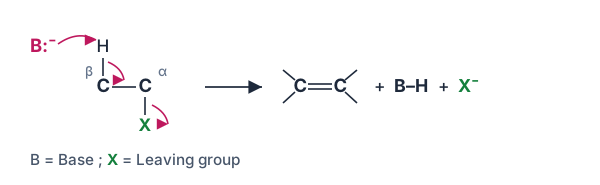
Imagine you have a molecule that is "unstable" in a specific way — it carries a halogen atom (like Cl, Br, I) on one carbon and a hydrogen atom on the neighbouring carbon. If you treat it with a strong base, the base can pull off that hydrogen, and simultaneously the halogen leaves as a negative ion. The two carbons that lost these atoms now form a double bond between them. That's the core idea: dehydrohalogenation is the elimination of H and X (halogen) from adjacent carbons, producing an alkene.
The name itself tells you what happens: dehydro (removal of hydrogen) + halogenation (removal of halogen). So you are literally removing a hydrogen halide (HX) from the molecule.
The Precise Reaction
A haloalkane (alkyl halide) is treated with alcoholic KOH (potassium hydroxide dissolved in ethanol). The KOH acts as a strong base. The reaction follows this general pattern:
R−CH2−CH2−XKOHalcoholicR−CH=CH2+KX+H2O
For example, bromoethane gives ethene:
CH3−CH2−BrKOHalcoholicCH2=CH2+KBr+H2O
Watch out
Aqueous KOH (KOH in water) does not cause elimination — it gives substitution (an alcohol). The alcoholic medium is essential because it keeps the base strong enough to pull off the hydrogen, and it does not favour the competing substitution reaction.
Why Alcoholic KOH and Not Aqueous?
In water, the hydroxide ion (OH−) is heavily solvated — surrounded by water molecules — which reduces its basic strength. In ethanol, the solvation is weaker, so OH− is a much stronger base. A strong base is needed to abstract the β-hydrogen (the hydrogen on the carbon next to the one bearing the halogen). The reaction proceeds via a one-step concerted mechanism (E2) where the base pulls the H, the halogen leaves, and the double bond forms — all at once.
General dehydrohalogenation (beta-elimination): a base removes the hydrogen on the beta-carbon while the halogen X leaves from the alpha-carbon, forming a C=C double bond
Saytzeff's Rule — Which Alkene Forms?
When the haloalkane has more than one possible β-hydrogen (i.e., the carbon next to the halogen is attached to two different sets of hydrogens), more than one alkene can form. Saytzeff's rule tells you which one is the major product:
In dehydrohalogenation, the alkene with the more substituted double bond (the one with more alkyl groups attached to the double-bonded carbons) is the major product.
Why? More substituted alkenes are more stable (hyperconjugation and inductive effects). The reaction favours the pathway that leads to the more stable alkene.
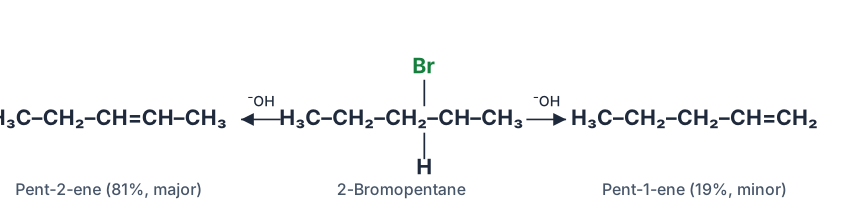
NCERT's own example uses 2-bromopentane, and the preference is just as clear there:
Saytzeff's rule illustrated with 2-bromopentane: alcoholic KOH gives pent-2-ene (81 percent, the more substituted major product) and pent-1-ene (19 percent, minor)
Example: 2-bromobutane has two possible β-hydrogens: …
Same / Similar Concept — real previous-year questions on the same or a closely similar concept, not this exact question.
COMEDK 2025Set 2025-M1 markMCQ
Q.Which of the following haloalkanes will give more than one isomeric product, on being heated with alc. KOH ?
(A) 1- Chloro-2-methylbutane
(B) 1-Chloropentane.
(C) 2-Chloro-3, 3-dimethylpentane
(D) 2- Chlorobutane.
›Reveal solutionSolution
The key is that dehydrohalogenation with alc. KOH follows Zaitsev’s rule, and multiple isomeric alkenes arise when the starting haloalkane has more than one distinct β‑carbon. Among the options, only 2‑chlorobutane has two different β‑positions, giving two alkene products. The correct option is (D).
Concept & Intuition
Alcoholic KOH is a strong base that promotes elimination (E2) of HX from a haloalkane, forming an alkene. The reaction removes a hydrogen from a β‑carbon (adjacent to the carbon bearing the halogen) and the halogen itself. If the haloalkane has two or more different β‑carbons (i.e., hydrogens on distinct types of neighbouring carbons), then elimination can occur in more than one way, yielding a mixture of isomeric alkenes. The major product usually follows Zaitsev’s rule (the more substituted alkene is favoured), but the question asks only whether more than one isomeric product is possible — not which is major.
Step‑by‑step analysis
Identify the β‑carbons for each compound
For a haloalkane R–CHX–R', the β‑carbons are those directly bonded to the carbon that holds the halogen. Count how many distinct types of β‑carbons exist (different in terms of substitution or structure).
Option (A): 1‑Chloro‑2‑methylbutane
Structure: CH₃–CH(CH₃)–CH₂–CH₂Cl
The chlorine is on a primary carbon (C1). The only β‑carbon is C2 (the carbon next to C1). C2 is a single type (it has one H and is attached to two methyl groups).
→ Only one β‑carbon → only one possible alkene (2‑methyl‑1‑butene).
Result: Only one product.
Option (B): 1‑Chloropentane
Structure: CH₃–CH₂–CH₂–CH₂–CH₂Cl
Chlorine on a primary carbon (C1). The only β‑carbon is C2. All β‑hydrogens are equivalent.
→ Only one alkene (1‑pentene).
Result: Only one product.
Option (C): 2‑Chloro‑3,3‑dimethylpentane
Structure: CH₃–CH₂–C(CH₃)₂–CHCl–CH₃
Chlorine is on C2. The β‑carbons are C1 and C3.
C1 (CH₃–) has three equivalent hydrogens.
C3 is a quaternary carbon (no hydrogens) — it cannot lose a hydrogen.
So only C1 can serve as a β‑carbon.
→ Only one alkene (3,3‑dimethyl‑1‑pentene).
Result: Only one product.