Q.Write structures of the following compounds:
🔒You're viewing a preview — the full solution, concept, methods & PYQ mapping are locked.
🔒 Start your 14-day free trial to unlock the full solution →Concept understanding — Structural Isomerism
Structural Isomerism: The First Meeting
Imagine you have a box of identical Lego bricks — four red, ten blue, and six yellow. You build two different models: a car and a house. Both use exactly the same number of each colour brick, but the structures are completely different. That is the core idea of isomerism: same atoms, different arrangement.
In chemistry, molecules are not just a list of atoms. How those atoms are connected matters enormously. Two molecules can have the exact same molecular formula (same number of each atom) but be connected in different ways. Those are structural isomers (also called constitutional isomers).
The Precise Statement
Structural isomers are compounds that have the same molecular formula but different connectivity of atoms — that is, different structural formulas.
The key word is connectivity. Which atom is bonded to which? If you change that, you get a different substance with different physical and chemical properties.
A Concrete Example: C₄H₁₀
Take butane, C₄H₁₀. There are exactly two ways to connect four carbon atoms and ten hydrogen atoms:
- n-Butane — a straight chain: C–C–C–C
- Isobutane (2-methylpropane) — a branched chain: a central carbon bonded to three methyl groups
Both have formula C₄H₁₀. But n-butane boils at –0.5 °C, while isobutane boils at –11.7 °C. Same atoms, different connectivity → different substance.
Structural isomers are not the same molecule. They are distinct compounds that happen to share a molecular formula. You cannot rotate or flip one to get the other — you must break and reform bonds.
The Three Main Types
Structural isomerism comes in three flavours:
| Type | What changes | Example (C₃H₆O) |
|---|---|---|
| Chain isomerism | The carbon skeleton (straight vs. branched) | Butane vs. isobutane |
| Position isomerism | The location of a functional group or substituent | Propan-1-ol vs. propan-2-ol (OH on carbon 1 vs. carbon 2) |
| Functional group isomerism | The atoms are rearranged into a different functional group | Propanal (aldehyde) vs. propanone (ketone) — both C₃H₆O |
Do not confuse structural isomers with stereoisomers. Stereoisomers have the same connectivity but differ in spatial arrangement (like left and right hands). That is a completely different chapter. For now: structural isomers = different bond connections.
Why This Matters …
Why this formula?
Structural Isomerism: Why the Key Ideas Hold
Structural isomerism arises when molecules share the same molecular formula but differ in the connectivity of atoms. There is no single "formula" for structural isomerism — instead, the key is understanding why different arrangements are possible.
The Core Principle: Connectivity ≠ Composition
A molecular formula tells you how many of each atom are present, but not how they are joined. Structural isomers exist because atoms can form bonds in multiple distinct sequences while satisfying valency rules.
Why This Happens: The Valency Constraint
Each atom has a fixed bonding capacity (valency):
- Carbon: 4 bonds
- Hydrogen: 1 bond
- Oxygen: 2 bonds
- Nitrogen: 3 bonds
Example: For C4H10, the formula satisfies 4(4)+10(1)=26 valence electrons. But the carbon atoms can be arranged as:
- A straight chain: CH3−CH2−CH2−CH3 (n-butane)
- A branched chain: CH3−CH(CH3)−CH3 (isobutane)
Both satisfy valency, but the connectivity differs.
The "Formula" for Counting Isomers: Why It's Not Simple
There is no closed-form formula to count structural isomers for a given molecular formula. The number grows rapidly and depends on:
- Carbon skeleton branching possibilities
- Functional group positions
- Ring formation possibilities
Why No Simple Formula Exists
The problem is combinatorial — the number of possible trees (acyclic graphs) with n carbon atoms grows exponentially. For example:
- C4H10: 2 structural isomers
- C5H12: 3 structural isomers
- C6H14: 5 structural isomers
- C10H22: 75 structural isomers
The pattern follows Cayley's formula for trees, but even that counts only carbon skeletons — not functional group positions.
Key Reasoning: The Branching Principle
The fundamental reason structural isomers exist is that carbon chains can branch. Consider C5H12:
- Straight chain: C−C−C−C−C (n-pentane)
- One branch: C−C−C(C)−C (isopentane) — the branch can be at position 2 or 3, but these are identical due to symmetry
- Two branches: C−C(C)(C)−C (neopentane) — a quaternary carbon
Why position matters: The branch location changes the carbon's environment, altering physical and chemical properties.
The Functional Group Position Rule
For compounds with functional groups (e.g., alcohols CnH2n+2O), the position of the -OH group creates isomers:
- CH3CH2CH2OH (propan-1-ol) — OH at end
- CH3CH(OH)CH3 (propan-2-ol) — OH in middle …
Concept: Structural Isomerism — drawing correct carbon skeletons and placing substituents per IUPAC naming.
Reasoning steps:
-
2-Chloro-3-methylpentane: Pentane backbone (5 carbons). Chlorine on C2, methyl on C3.
Structure: CH3CHClCH(CH3)CH2CH3
-
1-Chloro-4-ethylcyclohexane: Cyclohexane ring. Chlorine at C1, ethyl at C4 (trans/cis not specified — draw one, e.g., trans).
Structure: ethyl group on C4 opposite to Cl on C1.
-
4-tert-Butyl-3-iodoheptane: Heptane chain. Iodine on C3, tert-butyl (−C(CH3)3) on C4.
Structure: CH3CH2CHICH[C(CH3)3]CH2CH2CH3
-
1,4-Dibromobut-2-ene: But-2-ene (4 carbons, double bond between C2 and C3). Bromines on C1 and C4.
Structure: BrCH2CH=CHCH2Br (geometric isomers possible — draw trans as common).
-
1-Bromo-4-sec-butyl-2-methylbenzene: Benzene ring. Bromine at C1, sec-butyl (−CH(CH3)CH2CH3) at C4, methyl at C2.
The two ring compounds — (ii) and (v) — are drawn below (the same verified figure used in the detailed answer): …
The key idea is to interpret the IUPAC name as a structural blueprint: identify the parent chain, number the substituents, and place each group at the correct carbon. The final structures are drawn as line‑bond or condensed formulas for each compound.
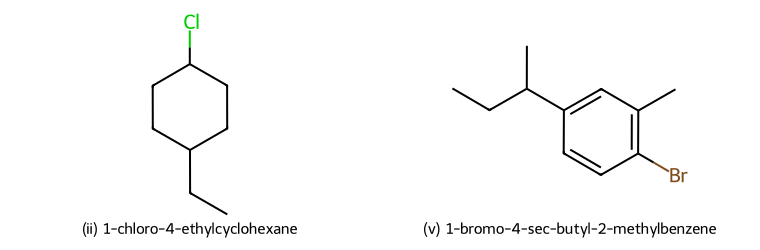
Why this approach works
IUPAC nomenclature is a systematic code. Every part of the name tells you exactly where to put atoms and bonds.
- The parent name (pentane, cyclohexane, heptane, butene, benzene) gives the longest carbon chain or the ring.
- Prefixes (chloro, methyl, ethyl, etc.) are substituents attached at the numbered positions.
- Suffixes (-ane, -ene, -ol, etc.) tell you about unsaturation or functional groups.
- Stereodescriptors (like tert., sec.) describe the branching of the substituent itself.
If you misread the parent chain or the locant numbers, the structure will be wrong. So we go step by step.
1. 2‑Chloro‑3‑methylpentane
Parent chain: pentane → 5‑carbon straight chain.
Substituents:
- Chloro at carbon 2
- Methyl at carbon 3
Number the pentane chain from the end that gives the lowest locants to the substituents. Here, both 2 and 3 are already the smallest possible.
   Cl
    |
CH3-CH-CH-CH2-CH3
      |
     CH3
Condensed: CH3CHClCH(CH3)CH2CH3
Always check that the parent chain is the longest continuous carbon chain. In this case, “pentane” is unambiguous.
2. 1‑Chloro‑4‑ethylcyclohexane
Parent: cyclohexane (6‑carbon ring).
Substituents:
- Chloro at position 1
- Ethyl at position 4
Number the ring so that the substituents get the lowest possible numbers. Here, 1 and 4 are the smallest set (ring structure shown in the diagram above).
The ethyl group is a straight chain of two carbons attached to the ring.
A common mistake is to draw the ethyl group as a methyl group. Count carbons: ethyl = C2H5, not CH3.
3. 4‑tert.‑Butyl‑3‑iodoheptane
Parent: heptane → 7‑carbon straight chain.
Substituents:
- Iodo at carbon 3
- tert.‑Butyl at carbon 4
The tert.‑butyl group is −C(CH3)3 — a central carbon bonded to three methyl groups.
Number the heptane chain from the end that gives the lower locant to the first substituent (iodo at 3, tert.‑butyl at 4).
        I
        |
CH3-CH2-CH-CH-CH2-CH2-CH3
          |
          C(CH3)3
Condensed: CH3CH2CHICH[C(CH3)3]CH2CH2CH3
The tert.‑butyl group is bulky and often drawn as a branched substituent. Do not confuse it with sec.‑butyl or iso‑butyl.
4. 1,4‑Dibromobut‑2‑ene
Parent: but‑2‑ene → 4‑carbon chain with a double bond between carbons 2 and 3.
Substituents:
- Bromo at carbon 1
- Bromo at carbon 4
Number the chain so that the double bond gets the lowest possible number (it is already at 2). The bromines go at the ends.
Method: IUPAC Nomenclature to Structure Drawing
Method Name: Backbone-First Construction Method
This method works by first building the parent chain (backbone), then adding substituents at the correct positions.
Steps for Each Compound
(i) 2-Chloro-3-methylpentane
Step 1: Identify the parent chain — pentane (5-carbon straight chain).
Step 2: Number the carbons from the end nearest the first substituent.
Step 3: Add substituents at the correct positions:
- Chloro at C-2
- Methyl at C-3
Structure:
    Cl   CH₃
     |    |
CH₃—C—C—CH₂—CH₃
     |    |
     H    H
Or in condensed form:
CH3—CH(Cl)—CH(CH3)—CH2—CH3
(ii) 1-Chloro-4-ethylcyclohexane
Step 1: Parent chain is cyclohexane (6-carbon ring).
Step 2: Number the ring carbons — start at the carbon bearing the chloro group (C-1).
Step 3: Add substituents:
- Chloro at C-1
- Ethyl at C-4
Structure:
(iii) 4-tert. Butyl-3-iodoheptane
Step 1: Parent chain — heptane (7-carbon straight chain).
Step 2: Number from the end nearest the first substituent.
Step 3: Add substituents:
- Iodo at C-3
- tert-Butyl at C-4 (tert-butyl = —C(CH3)3)
Structure:
         I   H
         |   |
CH₃—CH₂—C—C—CH₂—CH₂—CH₃
         |   |
         H   C(CH₃)₃
Condensed:
CH3—CH2—CH(I)—CH[C(CH3)3]—CH2—CH2—CH3
(iv) 1,4-Dibromobut-2-ene
Step 1: Parent chain — but-2-ene (4-carbon chain with a double bond between C-2 and C-3).
Step 2: Number from the end nearest the double bond. …
Here are the most common mistakes students make when drawing structures from IUPAC names, along with clear strategies to avoid them.
1. Misidentifying the Parent Chain (For Acyclic Compounds)
- The Mistake: For (i)
2-Chloro-3-methylpentane, students often draw a hexane chain because they count the carbon in the-methylsubstituent as part of the main chain. They might drawCH3-CHCl-CH(CH3)-CH2-CH3but then think the parent is hexane. - Why it happens: Confusing a substituent (methyl) with a main chain carbon. The name ends in
-pentane, so the longest continuous carbon chain has exactly 5 carbons. - How to Avoid:
- Rule: The parent chain is the longest continuous carbon chain. The suffix (e.g.,
-pentane,-heptane) tells you exactly how many carbons are in this chain. - Action: First, draw a straight chain of the parent length (5 carbons for pentane). Then, attach the substituents (chloro at C-2, methyl at C-3) to this pre-drawn chain.
- Rule: The parent chain is the longest continuous carbon chain. The suffix (e.g.,
2. Incorrect Numbering of the Parent Chain
- The Mistake: For (iii)
4-tert. Butyl-3-iodoheptane, students might number the heptane chain from the wrong end, placing the-iodogroup at C-4 and thetert-butylgroup at C-3. - Why it happens: Forgetting the lowest locant rule. When numbering, you give the first point of difference the lowest number. Here,
3-iodois lower than4-iodo, so numbering must start from the end closest to the iodine. - How to Avoid:
- Rule: Number the parent chain so that the substituents get the lowest possible set of locants.
- Action: Before drawing, write the parent chain (7 carbons). Try numbering from left to right, then right to left. Choose the numbering that gives the smallest number to the first substituent encountered. In this case, iodine at position 3 is correct.
3. Misinterpreting Complex Substituents (e.g., tert. butyl, sec. butyl)
- The Mistake: For (iii)
4-tert. Butyl-3-iodoheptane, students draw a straight chain of 4 carbons for thetert-butylgroup. For (v)1-Bromo-4-sec. butyl-2-methylbenzene, they draw a straight chain forsec. butyl. - Why it happens: Not knowing the structure of common alkyl groups.
tert-butyl=-C(CH3)3(a central carbon bonded to three methyl groups).sec-butyl=-CH(CH3)CH2CH3(a central carbon bonded to one methyl and one ethyl group).
- How to Avoid:
- Memorize the common alkyl groups: methyl, ethyl, propyl, isopropyl, butyl, sec-butyl, tert-butyl, isobutyl.
- Draw the substituent separately: Before attaching it to the main chain, draw the exact carbon skeleton of the substituent. For
tert-butyl, draw a carbon with three methyl groups attached.
4. Forgetting to Show the Correct Position of Double Bonds (For Alkenes)
- The Mistake: For (iv)
1,4-Dibromobut-2-ene, students draw the double bond between C-1 and C-2, or they forget to show theE/Zisomerism (geometric isomerism) if required. - Why it happens: The locant
-2-enemeans the double bond starts at carbon 2. Also,but-2-enecan exist ascis(Z) ortrans(E) isomers. - How to Avoid:
- Rule: The locant for the double bond is the lower-numbered carbon of the double bond.
- Action: Draw the 4-carbon chain. Place the double bond between C-2 and C-3. Then, place the bromine atoms on C-1 and C-4. If the question doesn't specify
EorZ, you can draw either one, but be aware that both are possible.
5. Incorrectly Placing Substituents on a Ring (For Cyclic Compounds)
- The Mistake: For (ii)
1-Chloro-4-ethylcyclohexane, students place the ethyl group on C-1 and the chloro group on C-4, or they forget that the ring itself is the parent chain. - Why it happens: Confusing the numbering of the ring. The substituents must be placed at the positions indicated by the locants.
- How to Avoid:
- Rule: For monosubstituted rings, the substituent is at position 1. For disubstituted rings, number the ring so that the substituents get the lowest possible locants. …
- COMEDK 2026Set 2026-M1 markMCQQ.The number of structural isomers possible for a compound with molecular formula C3H9 N is: (A) 3 (B) 4 (C) 2 (D) 5
›Reveal solutionSolution
The key is to count all distinct amine and quaternary ammonium structures for C₃H₉N by considering different carbon skeletons and nitrogen substitution patterns. The total number of structural isomers is 4.
Concept & Intuition
For a molecular formula C₃H₉N, the nitrogen can be primary (‑NH₂), secondary (‑NH‑), tertiary (‑N‑), or quaternary (‑N⁺‑ with a counterion, but here we treat neutral amines). The carbon skeleton can be a straight chain (propyl) or branched (isopropyl). Each arrangement of the nitrogen along the chain and its degree of substitution gives a distinct structural isomer. We systematically list all possibilities, being careful not to double-count.
Step-by-step reasoning
-
Identify possible carbon skeletons
With three carbons, only two skeletons exist:
- Straight chain: C–C–C (propyl)
- Branched: C–C(C) (isopropyl, i.e., a central carbon with two methyl groups)
-
Place nitrogen as a primary amine (–NH₂)
- On the straight chain:
- 1‑aminopropane: CH₃–CH₂–CH₂–NH₂
- 2‑aminopropane: CH₃–CH(NH₂)–CH₃
- On the branched skeleton:
- The only distinct primary amine is 2‑aminopropane again (same as above). So no new isomer. → 2 primary amines (1‑aminopropane and 2‑aminopropane).
- On the straight chain:
-
Place nitrogen as a secondary amine (–NH–)
The nitrogen is inserted between two carbon groups.
- Straight chain possibilities:
- N‑methyl‑ethylamine: CH₃–NH–CH₂–CH₃ (ethyl group + methyl group on N)
- N‑ethyl‑methylamine is the same compound.
- Branched skeleton:
- N‑methyl‑isopropylamine: (CH₃)₂CH–NH–CH₃
- Also consider N‑propylamine? That would be primary. So only these two. → 2 secondary amines (N‑methylethylamine and N‑methylisopropylamine).
- Straight chain possibilities:
-
Place nitrogen as a tertiary amine (–N– with three carbon groups)
- All three carbons must be attached to nitrogen.
- The only possibility is trimethylamine: (CH₃)₃N
- No other arrangement (e.g., ethyldimethylamine would need 4 carbons). → 1 tertiary amine.
-
Check for quaternary ammonium (salt) structures
The formula C₃H₉N is neutral; a quaternary ammonium would require a counterion (e.g., Cl⁻) and would have formula C₃H₁₀N⁺, so not counted here.
→ 0 quaternary isomers.
-
Total count
Primary: 2
Secondary: 2
Tertiary: 1
Total = 5? Wait — we must check for duplicates.
- 2‑aminopropane (primary) and N‑methylisopropylamine (secondary) are different.
- However, note that N‑methylethylamine and N‑methylisopropylamine are distinct. So total distinct structural isomers = 2 + 2 + 1 = 5. But the options given are 2, 3, 4, 5. The correct answer is 4? Let’s re-examine carefully.
Watch outA common mistake is to count 2‑aminopropane and N‑methylisopropylamine as separate, but they are indeed different. However, many textbooks consider only amine isomers (primary, secondary, tertiary) and sometimes forget that N‑methylethylamine and N‑methylisopropylamine are both valid. Let’s list them explicitly:
- (1) CH₃CH₂CH₂NH₂ (1‑aminopropane)
- (2) CH₃CH(NH₂)CH₃ (2‑aminopropane)
- (3) CH₃CH₂NHCH₃ (N‑methylethylamine)
- (4) (CH₃)₂CHNHCH₃ (N‑methylisopropylamine)
- (5) (CH₃)₃N (trimethylamine) …
-
- KCET 2026Set D31 markMCQQ.The number of chain isomers possible for the hydrocarbon with molecular formula C5H12 is (A) 4 (B) 3 (C) 2 (D) 1
›Reveal solutionSolution
Enumerate the distinct carbon-skeleton (chain) arrangements possible for the saturated hydrocarbon C5H12 (pentane).
Step 1 — List possible skeletons
For C5H12, the carbon skeleton can be arranged as:
- A straight, unbranched chain of 5 carbons: n-pentane (CH3CH2CH2CH2CH3)
- A 4-carbon main chain with one methyl branch: 2-methylbutane / isopentane
- A 3-carbon main chain with two methyl branches on the central carbon: 2,2-dimethylpropane / neopentane
Step 2 — Confirm no further distinct skeletons exist …
- KCET 2024Set B-21 markMCQQ.When a tertiary alcohol ‘A’ (C4H10O) reacts with 20% H3PO4 at 358 K, it gives a compound ‘B’ (C4H8) as a major product. The IUPAC name of the compound ‘B’ is : (A) But-1-ene (B) But-2-ene (C) Cyclobutane (D) 2-Methylpropene
›Reveal solutionSolution
Only one C4H10O isomer is tertiary — tert-butanol — and its acid-catalysed dehydration can give only one alkene, 2-methylpropene.
1. Identify alcohol A from the formula + the word "tertiary"
C4H10O has four alcohol isomers:
Isomer Structure Class Butan-1-ol CH3CH2CH2CH2OH primary Butan-2-ol CH3CH2CH(OH)CH3 secondary 2-Methylpropan-1-ol (CH3)2CHCH2OH primary 2-Methylpropan-2-ol (CH3)3C−OH tertiary A tertiary alcohol is one whose carbinol carbon (the C bearing the −OH) is attached to three other carbons. Only (CH3)3C−OH qualifies.
A=(CH3)3C−OH(tert-butyl alcohol)
2. Recognise the reaction
20% H3PO4 at 358 K is the standard acid-catalysed dehydration condition, and the product C4H8 has one degree of unsaturation more than C4H10O minus water — exactly C4H10O−H2O=C4H8. So B is an alkene.
Note how mild the conditions are: tertiary alcohols dehydrate most easily (3∘>2∘>1∘) because the E1 mechanism goes through a stable tertiary carbocation. That is why only 20% acid and a modest 358 K are needed — a primary alcohol would need ~95% H2SO4 at 440 K.
3. Mechanism (E1)
- Protonation of the −OH to make a good leaving group:
(CH3)3C−OH+H+⟶(CH3)3C−O+H2
- Loss of water ⇒ the stable tertiary carbocation:
(CH3)3C−O+H2⟶(CH3)3C++H2O
- Loss of a β-hydrogen from one of the three (equivalent) methyl groups:
(CH3)3C+⟶(CH3)2C=CH2+H+
4. The product is unique …
- KCET 2022Set B-31 markMCQQ.An organic compound with molecular formula C7H8O dissolves in NaOH and gives a characteristic colour with FeCl3. On treatment with bromine, it gives a tribromo derivative C7H5OBr3. The compound is (A) m-Cresol (B) p-Cresol (C) Benzyl alcohol (D) o-Cresol
›Reveal solutionSolution
The NaOH/FeCl3 tests identify a phenol; the fact that three bromines go in cleanly pins it as the meta isomer, whose 2-, 4- and 6-positions are activated by both substituents.
Step 1 — The molecular formula.
C7H8O, degree of unsaturation =22(7)+2−8=4 — a benzene ring plus no other unsaturation. The candidates are the three cresols (CH3−C6H4−OH), benzyl alcohol (C6H5CH2OH) and anisole.
Step 2 — Test 1: dissolves in NaOH ⇒ it is acidic ⇒ phenolic −OH.
Phenols (pKa≈10) are acidic enough to react with NaOH, because the phenoxide ion is resonance-stabilised over the ring:
ArOH+NaOH⟶ArO−Na++H2O
Alcohols are not: benzyl alcohol (pKa≈16, no resonance stabilisation of its alkoxide) is insoluble in NaOH. ⇒ (C) benzyl alcohol is eliminated.
Step 3 — Test 2: violet colour with FeCl3 ⇒ phenol confirmed.
Phenols form coloured iron(III)–phenoxide complexes of the type [Fe(OAr)6]3−. This is the classic confirmatory test for a phenolic −OH, and it again rules out benzyl alcohol and anisole. So the compound is one of the cresols.
Step 4 — Test 3: bromination gives a TRIbromo derivative — this is what selects the isomer.
Both −OH (strongly) and −CH3 (weakly) are activating, o/p-directing groups. Ask, for each isomer, how many ring positions are activated by both groups.
- m-Cresol (−OH at C-1, −CH3 at C-3):
- ortho/para to −OH (C-1) ⇒ C-2, C-4, C-6.
- ortho/para to −CH3 (C-3) ⇒ C-2, C-4, C-6. The two groups reinforce each other at exactly three free positions — 2, 4 and 6 — all of which are vacant. Bromination therefore substitutes cleanly at all three: C7H8O+3Br2⟶2,4,6-tribromo-3-methylphenolC7H5OBr3+3HBr …
- m-Cresol (−OH at C-1, −CH3 at C-3):
- KCET 2021Set B-21 markMCQQ.C6H5CH2Clalc. NH3A2CH3ClB The product B is (A) N, N-Dimethyl phenyl methanamine (B) N, N-Dimethyl benzenamine (C) N-Benzyl-N-methyl methanamine (D) phenyl-N, N-dimethyl methanamine
›Reveal solutionSolution
The reaction sequence is a two-step nucleophilic substitution: benzyl chloride reacts with alcoholic ammonia to give benzylamine (A), which then undergoes exhaustive methylation with excess methyl chloride to yield the quaternary ammonium salt N-benzyl-N,N-dimethylmethanaminium chloride — but the question asks for the neutral tertiary amine formed before the final salt, which is N,N-dimethyl phenyl methanamine (option A).
The key here is to recognise that alcoholic ammonia (alc. NH3) acts as a nucleophile in an SN2 displacement. Benzyl chloride (C6H5CH2Cl) has a benzylic carbon that is highly reactive toward nucleophilic substitution because the developing positive charge in the transition state is stabilised by resonance with the benzene ring. Ammonia, being a good nucleophile, attacks this carbon, displacing chloride and forming a primary amine.
-
First step — formation of A:
C6H5CH2Cl+2NH3→C6H5CH2NH2+NH4Cl
The product A is benzylamine (phenylmethanamine). Two equivalents of ammonia are needed: one acts as the nucleophile, the other picks up the liberated HCl.
-
Second step — exhaustive methylation:
Benzylamine (A) is now treated with excess methyl chloride (2CH3Cl). This is a classic Hofmann alkylation: the amine nitrogen, being nucleophilic, attacks methyl chloride repeatedly.
- First methylation: C6H5CH2NH2+CH3Cl→C6H5CH2NH(CH3)+Cl− (a secondary ammonium salt).
- In the presence of excess methyl chloride and the basic conditions provided by the excess ammonia (or by the amine itself), the free base is regenerated and undergoes a second methylation: C6H5CH2NH(CH3)+CH3Cl→C6H5CH2N(CH3)2+Cl− The product after two methylations is the tertiary amine — N,N-dimethylbenzylamine — as its hydrochloride salt. The question likely intends the neutral amine, which is N,N-dimethyl phenyl methanamine (IUPAC: N-benzyl-N-methylmethanamine).
Watch outA common mistake is to think that the second step produces a quaternary ammonium salt. With only two equivalents of CH3Cl, the reaction stops at the tertiary amine stage. A third equivalent would give the quaternary salt. The problem specifies 2CH3Cl, so the product is the tertiary amine, not the quaternary.
- Identifying the correct option: …
-
- KCET 2020Set A-11 markMCQQ.The steps involved in the conversion of propan −2− ol to propan −1− ol are in the order (A) dehydration, addition of HBr in presence of peroxide, heating with alc. KOH (B) dehydration, addition of HBr, heating with aq. KOH (C) heating with PCl5, heating with alc. KOH, acid catalysed addition of water (D) heating with PCl5, heating with alc. KOH, hydroboration - oxidation
›Reveal solutionSolution
To convert propan-2-ol (a secondary alcohol) to propan-1-ol (a primary alcohol), we must rearrange the carbon skeleton so that the OH group moves from the middle carbon to an end carbon. This is achieved by: (1) dehydrating the alcohol to propene, (2) adding HBr in the presence of peroxide (anti-Markovnikov addition) to get 1-bromopropane, and (3) hydrolysing the alkyl halide with aqueous KOH to obtain propan-1-ol. The correct sequence is option (A).
The key insight here is that you cannot simply swap the OH group from one carbon to another in one step. You need to break and reform bonds in a controlled way. The strategy is to first create a double bond (alkene) from the starting alcohol, then add HBr across that double bond in the anti-Markovnikov fashion so that the bromine ends up on the terminal carbon, and finally replace the bromine with an OH group.
Let's walk through each step.
- Dehydration of propan-2-ol to propene Propan-2-ol is a secondary alcohol. When heated with a strong acid like concentrated H2SO4 (or passed over alumina at high temperature), it undergoes dehydration (elimination of water) to form propene.
CH3CH(OH)CH3conc. H2SO4heatCH3CH=CH2+H2O
This step creates the carbon-carbon double bond that we will later use to attach the bromine at the correct position.
- Addition of HBr in the presence of peroxide (anti-Markovnikov addition) Normally, HBr adds to an unsymmetrical alkene following Markovnikov's rule — the hydrogen attaches to the carbon with more hydrogens, and bromine goes to the more substituted carbon. For propene, that would give 2-bromopropane, which would take us back to a secondary alkyl halide. However, in the presence of organic peroxides (like benzoyl peroxide), the addition follows a free radical mechanism that reverses the regioselectivity. The bromine radical attacks the less substituted carbon (the terminal carbon), so the product is 1-bromopropane.
CH3CH=CH2+HBrperoxideCH3CH2CH2Br
This is the critical step that moves the halogen to the terminal position.
Watch outA common mistake is to forget the peroxide and simply add HBr, which would give 2-bromopropane (Markovnikov product) and fail to produce the desired primary alcohol after hydrolysis. Always check the reaction conditions.
- Heating with aqueous KOH (hydrolysis) The final step is a nucleophilic substitution. 1-bromopropane is a primary alkyl halide, so it undergoes SN2 reaction with the hydroxide ion from aqueous KOH. The OH group replaces the bromine atom, giving propan-1-ol.
CH3CH2CH2Br+KOH(aq)heatCH3CH2CH2OH+KBr
Aqueous KOH is used here because it provides free hydroxide ions; alcoholic KOH would favour elimination (forming propene again), which is not what we want.
Now, let's check the options against this sequence: …
- KCET 2019Set A-11 markMCQQ.The reaction scheme below shows a starting material converted to three different products via reactions A, B and C:
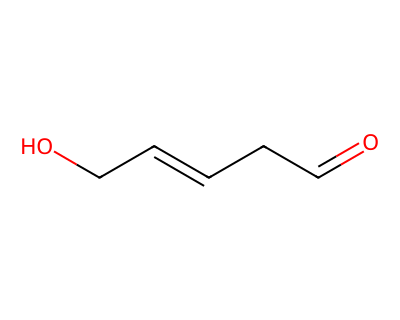 Reaction A converts the starting material to:
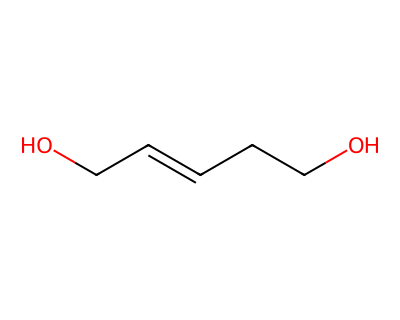 Reaction B converts the starting material to:
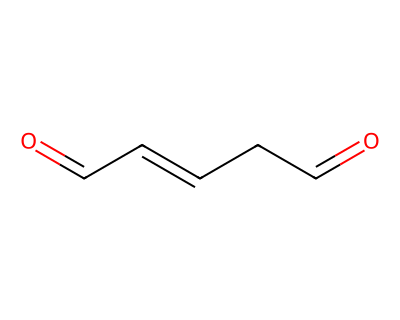 Reaction C converts the starting material to:
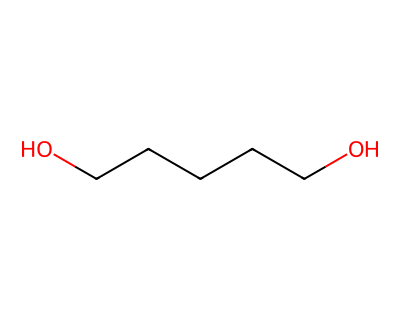 The reagents A, B and C respectively are
(A) H2/Pd, PCC, NaBH4
(B) NaBH4, PCC, H2/Pd
(C) NaBH4, alk. KMnO4, H2/Pd
(D) H2/Pd, alk. KMnO4, NaBH4
The reagents A, B and C respectively are
(A) H2/Pd, PCC, NaBH4
(B) NaBH4, PCC, H2/Pd
(C) NaBH4, alk. KMnO4, H2/Pd
(D) H2/Pd, alk. KMnO4, NaBH4›Reveal solutionSolution
Match each product to the selectivity of the reagent: NaBH4 reduces C=O but not C=C; PCC oxidises 1° alcohol only as far as the aldehyde; H2/Pd hydrogenates everything (C=C and C=O).
The starting material is HOH2C−CH=CH−CH2−CHO — it carries three reducible/oxidisable handles: a primary alcohol (left end), a C=C double bond (middle) and an aldehyde (right end). Each arrow attacks a different one, so this is a pure chemoselectivity question.
Step 1 — Reaction A: HOH2C−CH=CH−CH2−CHO→HOH2C−CH=CH−CH2−CH2OH
What changed: the aldehyde has become a primary alcohol. What did NOT change: the C=C is still drawn — it survives.
So A must be a reducing agent that attacks C=O but leaves C=C alone. That is exactly sodium borohydride, NaBH4: the hydride H− adds to the electron-poor (electrophilic) carbonyl carbon, but an isolated alkene is electron-rich and is not attacked by a nucleophilic hydride.
Could A be H2/Pd? No — Pd would hydrogenate the C=C as well, and the product still shows the double bond. ⇒ A = NaBH4.
That single observation already eliminates options (A) and (D), both of which begin with H2/Pd.
Step 2 — Reaction B: HOH2C−CH=CH−CH2−CHO→OHC−CH=CH−CH2−CHO
What changed: the primary alcohol has been oxidised to an aldehyde (giving the dialdehyde). What did NOT change: the C=C survives, and the new –CHO has not been over-oxidised to –COOH.
This demands a mild, selective oxidant that stops at the aldehyde: PCC (pyridinium chlorochromate). Being anhydrous (in CH2Cl2), it gives no gem-diol intermediate, so the reaction cannot proceed to the carboxylic acid. …
- KCET 2019Set A-11 markMCQQ.The alkyl halides required to prepare 2-methylpentane, CH3−CH(CH3)−CH2−CH2−CH3, shown below, by Wurtz reaction are
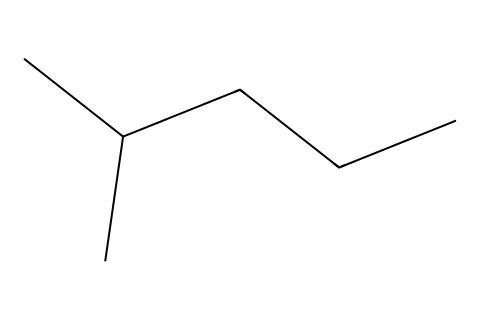 (A) CH3CH2CH2CH2−Cl (n-butyl chloride) and CH3CH2−Cl (ethyl chloride)
(B) (CH3)2CH−Cl (isopropyl chloride) and CH3CH2CH2−Cl (n-propyl chloride)
(C) (CH3)2CH−Cl (isopropyl chloride) and CH3−Cl (methyl chloride)
(D) (CH3)3C−Cl (tert-butyl chloride) and CH3CH2−Cl (ethyl chloride)
(A) CH3CH2CH2CH2−Cl (n-butyl chloride) and CH3CH2−Cl (ethyl chloride)
(B) (CH3)2CH−Cl (isopropyl chloride) and CH3CH2CH2−Cl (n-propyl chloride)
(C) (CH3)2CH−Cl (isopropyl chloride) and CH3−Cl (methyl chloride)
(D) (CH3)3C−Cl (tert-butyl chloride) and CH3CH2−Cl (ethyl chloride)›Reveal solutionSolution
Split the target 2-methylpentane at the bond joining its two halves — isopropyl + n-propyl — and take the corresponding chlorides; that is the Wurtz pair.
Step 1 — The Wurtz reaction.
2R−X+2Nadry etherR−R+2NaX
With two different halides R−X and R′−X you get the cross-coupled alkane R−R′ (along with R−R and R′−R′ as by-products). To design the synthesis, you disconnect the target alkane at one C–C bond and put a halogen on each fragment.
Step 2 — Write and number the target.
2-Methylpentane:
C1H3−C2H(CH3)−C3H2−C4H2−C5H3(C6H14)
It has 6 carbons in total (5 in the main chain + 1 methyl branch).
Step 3 — Disconnect at C2–C3.
Breaking the bond between C-2 and C-3 gives two 3-carbon fragments:
- Left fragment: CH3−CH(CH3)− = isopropyl group, (CH3)2CH− (C-1, C-2 and the branch methyl).
- Right fragment: −CH2CH2CH3 = n-propyl group (C-3, C-4, C-5).
So the halides are (CH3)2CHCl and CH3CH2CH2Cl, and
(CH3)2CHCl+CH3CH2CH2Cl2Nadry ether(CH3)2CH−CH2CH2CH3=2-methylpentane.✓
Step 4 — Rule out the other pairs (check the product each would give). …
- KCET 2018Set A-11 markMCQQ.Identify the following compound which exhibits geometrical isomerism : (A) But-2-ene (B) But-1-ene (C) Butane (D) Isobutane
›Reveal solutionSolution
Apply the two-part test for cis–trans isomerism: (i) restricted rotation about a C=C, and (ii) two different substituents on each of the doubly-bonded carbons. Only but-2-ene passes both.
Step 1 — Why a double bond is essential.
A C=C consists of a σ bond plus a π bond formed by sideways overlap of p-orbitals. Rotating about the axis would break that π overlap, which costs far too much energy at ordinary temperature. This restricted rotation locks the substituents in place, so two spatially distinct arrangements can exist and be isolated. In a single-bonded (saturated) compound, free rotation instantly interconverts such arrangements — they are mere conformers, not isomers.
Step 2 — The second condition.
Writing the alkene as
bCa=dCc,
geometrical isomerism requires a=b and c=d. If either carbon carries two identical groups, flipping them gives the same molecule.
Step 3 — Test each option. …
🎓Unlock everything free for 14 days
- ✓Full step-by-step solutions
- ✓Concept-first explanations
- ✓Methods, shortcuts & mistakes
- ✓PYQ mapping + timed mock tests
Full access for 14 days. No credit card required.