Q.a) Give a reason for each of the following :
🔒You're viewing a preview — the full solution, concept, methods & PYQ mapping are locked.
🔒 Start your 14-day free trial to unlock the full solution →Concept understanding — Magnetic Properties of Transition Metals
Magnetic Properties of Transition Metals
The Intuition: Why Do Some Metals Get Pulled Into a Magnetic Field?
Imagine a tiny bar magnet. If you bring it near a strong magnet, it either gets pulled in or pushed away. Transition metals behave like collections of these tiny magnets — but the "magnet" inside each atom is the electron itself.
An electron is not just a charged particle; it also spins. That spin makes it behave like a microscopic current loop, which generates a magnetic field. In most atoms, electrons pair up with opposite spins, and their magnetic effects cancel out. But in transition metals, the d-orbitals are being filled one electron at a time. When an orbital has an unpaired electron, that electron's magnetic field is not cancelled. The atom as a whole becomes a tiny permanent magnet.
Now bring a bunch of these atomic magnets near an external magnetic field. They will try to align with it, and the material gets pulled into the field. That is paramagnetism. The more unpaired electrons an ion has, the stronger the pull.
This is completely different from ferromagnetism (like iron nails). Ferromagnetism requires the atomic magnets to cooperate and align permanently with each other, even after the external field is removed. Paramagnetism is weaker and only exists while the external field is present.
The Precise Statement
The magnetic moment of a transition metal ion arises almost entirely from the spin of its unpaired electrons. The orbital contribution (the electron's motion around the nucleus) is usually "quenched" — suppressed by the electric field of surrounding atoms in a crystal or solution.
The magnitude of this spin-only magnetic moment is given by:
μ=n(n+2) Bohr magnetons
where n is the number of unpaired electrons.
μs=n(n+2) μB
This formula comes from quantum mechanics. Each unpaired electron has a spin quantum number s=1/2. For n unpaired electrons, the total spin quantum number S=n/2. The magnetic moment in Bohr magnetons is:
μ=gS(S+1)
where g≈2 for a free electron (the gyromagnetic ratio). Substituting S=n/2 gives:
μ=22n(2n+1)=n(n+2)
How to Use It: A Quick Table
| Number of unpaired electrons (n) | μ (Bohr magnetons) |
|---|---|
| 1 | 3≈1.73 |
| 2 | 8≈2.83 |
| 3 | 15≈3.87 |
| 4 | 24≈4.90 |
| 5 | 35≈5.92 |
Memorise the pattern: the values are roughly n+1 for small n, but the exact formula is what you need in exams. For n=5, the moment is nearly 6 — the maximum possible for a first-row transition metal ion.
A Common Mistake to Avoid …
Each part follows from a structural fact: Sc3+ has an empty d-shell, transition metals have closely similar atomic sizes, and the manganate ion has four oxygens arranged around a central Mn, so its magnetic moment, alloy-forming ability and shape can each be reasoned out. …
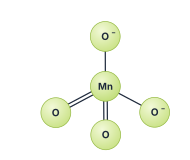
Sc3+ is d0 so μ=0; transition metals form alloys because of similar atomic sizes; MnO42− is tetrahedral.
(a)(i) Spin-only magnetic moment of Sc3+ is zero.
Scandium (Z = 21) is [Ar]3d14s2. On forming Sc3+ it loses the two 4s and one 3d electron, giving [Ar]3d0. With no unpaired electrons (n=0),
μ=n(n+2)=0=0 BM
(a)(ii) Alloys are readily formed by transition metals.
Transition metals have nearly the same atomic radii (small, comparable sizes across a series). Hence the atoms of one transition metal can easily replace the atoms of another in the metallic crystal lattice, producing solid-solution alloys.
(b) Structure of the manganate ion MnO42−. …
Showing the 12 most recent of 19 on this concept.
- CBSE 2026Set ANNUAL1 markMCQQ.Ion having maximum unpaired electrons is(a) Ti2+(b) V2+(c) Fe2+(d) Ni2+
›Reveal solutionSolution
Number of unpaired electrons is found by filling the five 3d orbitals singly first (Hund's rule) before pairing.
- Ti2+: 3d2 -> 2 unpaired
- V2+: 3d3 -> 3 unpaired
- Fe2+: 3d6 -> 4 unpaired (one orbital pairs, the other four stay singly occupied) …
- CBSE 2025Set X11 markQ.Paramagnetism arised from the presence of __________ electrons.
›Reveal solutionSolution
Paramagnetism arises from the presence of unpaired electrons.
A substance is paramagnetic when it contains one or more electrons that are not paired. Each unpaired electron has a magnetic moment, so the species is attracted into a magnetic field. The more unpaired ele …
- CBSE 2025Set ANNUAL1 markMCQQ.Which of the following is diamagnetic ion -(a) Co2+(b) Ni2+(c) Zn2+(d) All of these
›Reveal solutionSolution
A diamagnetic ion has all electrons paired; Zn2+ has a fully-filled 3d10 configuration.
Electronic configurations:
- Co2+: [Ar]3d7 — 3 unpaired electrons — paramagnetic
- Ni2+: [Ar]3d8 — 2 unpaired electrons — paramagnetic …
- CBSE 2025Set D1 markMCQQ.Which of the following ions is diamagnetic?(a) Cr2+(b) V2+(c) Sc3+(d) Ti3+
›Reveal solutionSolution
Sc3+ has a 3d0 configuration (no unpaired electrons), so it alone is diamagnetic.
Check the d-electron count of each ion (Ar core = [Ar]):
- Sc3+ (Z = 21): [Ar] 3d0 -> 0 unpaired -> diamagnetic.
- Ti3+ (Z = 22): [Ar] 3d1 -> 1 unpaired -> paramagnetic. …
- CBSE 2025Set ANNUAL1 markMCQQ.Which of the following is a diamagnetic ion?(a) V2+(b) Sc3+(c) Cu2+(d) Mn3+
›Reveal solutionSolution
A diamagnetic ion has no unpaired electrons; checking each ion's d-electron count shows only Sc3+ has an empty (d0) d-subshell.
Electronic configurations (after removing electrons for the given charge):
- V2+ (Z=23): [Ar] 3d3 - 3 unpaired electrons - paramagnetic
- Sc3+ (Z=21): [Ar] 3d0 - 0 unpaired electrons - diamagnetic
- Cu2+ (Z=29): [Ar] 3d9 - 1 unpaired electron - paramagnetic …
- CBSE 2025Set ANNUAL1 markMCQQ.The number of unpaired electron in Ni2+ is:(a) zero(b) 4(c) 2(d) 8.
›Reveal solutionSolution
Ni (Z = 28) has ground-state configuration [Ar]3d84s2; removing the two 4s electrons to form Ni2+ gives [Ar]3d8, which by Hund's rule leaves exactly 2 unpaired electrons.
Nickel has atomic number 28, so its electronic configuration is [Ar]3d84s2. When forming Ni2+, the two 4s electrons are removed first (as is typical for transition metals, since 4s electrons are lost before 3d electrons), giving:
Ni2+:[Ar]3d8
…
- CBSE 2024Set D1 markMCQQ.Which of the following has maximum number of unpaired electrons?(a) Mg2+(b) Ti3+(c) V3+(d) Fe3+
›Reveal solutionSolution
Write each ion's d-configuration and count unpaired electrons. Fe3+ is 3d5 with all five d-electrons unpaired -> maximum (5).
Configurations (unpaired electrons):
- Mg2+ = [Ne] (no d electrons) -> 0
- Ti3+ = [Ar]3d1 -> 1
- V3+ = [Ar]3d2 -> 2 …
- CBSE 2024Set D1 markMCQQ.The number of unpaired electrons in Cu2+ ion (Z = 29) is(a) 0(b) 1(c) 2(d) 3
›Reveal solutionSolution
Cu (Z = 29) = [Ar]3d10 4s1; losing two electrons gives Cu2+ = [Ar]3d9, with one unpaired d-electron.
Copper atom: [Ar]3d10 4s1.
For Cu2+ remove two electrons (first the 4s electron, then one 3d electron): Cu2+ = [Ar]3d9.
…
- CBSE 2024Set ANNUAL1 markQ.The transition elements are paramagnetic due to the presence of ______.
›Reveal solutionSolution
Transition elements (and their ions) are paramagnetic because most of them have one or more unpaired electrons in their partially filled (n-1)d orbitals.
Paramagnetism arises when a substance contains unpaired electrons; each unpaired electron behaves like a tiny magnet due to its spin, and the substance is weakly attracted into an external magnetic field.
Transition elements have a partly filled (n-1)d subshell in the ground state or in one of their common oxidation states. Because these d-orbitals are filled singly first (Hund's rule) before pairing, many transition metal atoms/ions possess unpaired d-electrons. The magnetic moment increases with the number of unpaired electrons, following mu = sqrt(n(n+2)) Bohr Magnetons, where n = number of unpaired el …
- CBSE 2023Set F1 markMCQQ.Which of the following ions of transition elements is paramagnetic?(a) Ag+(b) Cu2+(c) Zn2+(d) Au+
›Reveal solutionSolution
A species is paramagnetic only if it has one or more unpaired electrons. Among the given ions only Cu2+ (3d9) has an unpaired electron.
Write the d-electron configuration of each ion:
- Ag+ : [Kr]4d10 → all paired → diamagnetic
- Cu2+ : [Ar]3d9 → one unpaired electron → paramagnetic
- Zn2+ : [Ar]3d10 → all paired → diamagnetic
- Au+ : [Xe]4f14 5d10 → all paired → diamagnetic …
- CBSE 2023Set ANNUAL1 markMCQQ.Which one of the following is diamagnetic in nature?(a) Co2+(b) Ni2+(c) Cu2+(d) Zn2+
›Reveal solutionSolution
A species is diamagnetic only if it has zero unpaired electrons; checking each ion's d-electron count shows only Zn2+ qualifies.
- Co2+ (Co, Z=27, [Ar]3d7 4s2): Co2+ = [Ar]3d7, 3 unpaired electrons -> paramagnetic.
- Ni2+ (Ni, Z=28, [Ar]3d8 4s2): Ni2+ = [Ar]3d8, 2 unpaired electrons -> paramagnetic. …
- CBSE 2023Set TERM21 markMCQQ.The number of unpaired electrons in Fe²⁺ ion are :(a) 3(b) 2(c) 4(d) 5.
›Reveal solutionSolution
Fe²⁺ has the configuration [Ar]3d⁶, which by Hund's rule places 4 unpaired electrons in the d-orbitals.
Iron (Fe, Z = 26) has the ground-state configuration [Ar]3d64s2.
To form Fe2+, the two 4s electrons are removed first (as 4s electrons are lost before 3d electrons on ionisation), giving:
Fe2+:[Ar]3d6
Distributing 6 electrons among the 5 d-orbitals by Hund's rule (maximum multiplicity — each orbital singly filled before any is doubly filled):
…
🎓Unlock everything free for 14 days
- ✓Full step-by-step solutions
- ✓Concept-first explanations
- ✓Methods, shortcuts & mistakes
- ✓PYQ mapping + timed mock tests
Full access for 14 days. No credit card required.