Q.Refer to Exercise 15. Determine the maximum distance that the man can travel.
🔒You're viewing a preview — the full solution, concept, methods & PYQ mapping are locked.
🔒 Start your 14-day free trial to unlock the full solution →Concept understanding — Linear Programming Graphical Method
The Graphical Method for Linear Programming
When a linear programming problem has just two decision variables, x and y, you can solve it by drawing a picture. This is the graphical method, and it is the technique the CBSE Class-12 course expects you to use.
The idea
Each constraint is a linear inequality such as 2x+3y≤100. On the xy-plane its boundary is a straight line, and the inequality picks one side of that line (a half-plane). The points that satisfy all the constraints at once form a single region — the feasible region. Your job is to find the point inside this region that makes the objective function Z=ax+by largest or smallest.
The step-by-step procedure
- Draw each constraint line. Replace every inequality by an equation and plot the line, usually by finding where it meets the axes.
- Shade the correct side. Test a simple point (often the origin (0,0)) in the inequality. If it holds, the origin's side is the wanted half-plane; if not, take the other side. Always include the non-negativity conditions x≥0, y≥0, which keep you in the first quadrant.
- Identify the feasible region. It is the overlap of all the shaded half-planes — the region satisfying every constraint together.
- Find the corner (vertex) points. These are the points where the boundary lines cross. Read them off the graph or solve the two relevant lines simultaneously.
- Evaluate Z at every corner and pick the largest value (for a maximum) or the smallest (for a minimum).
The whole method rests on the Corner-Point Theorem: if an optimum exists, it occurs at a vertex of the feasible region. So you never test interior points — only the corners.
Bounded vs unbounded …
This is NCERT Exemplar Exercise 15 (the motorcycle problem): riding at 50 km/h costs Rs 2 per km on petrol, riding at 80 km/h costs Rs 3 per km, with at most Rs 120 for petrol and at most 1 hour of time.
Let x = distance (km) ridden at 50 km/h and y = distance ridden at 80 km/h. Maximise the total distance D=x+y.
Constraints
2x+3y≤120(petrol),50x+80y≤1⇒8x+5y≤400(time),x,y≥0.
Corner points of the feasible region: (0,0), (50,0), (7300,780), (0,40). …
Riding part of the way at 50 km/h and part at 80 km/h under a Rs 120 petrol budget and a 1-hour time limit, the greatest total distance is 7380≈54.3 km.
The referenced problem (Exercise 15)
A man rides at 50 km/h costing Rs 2 per km on petrol, or at 80 km/h costing Rs 3 per km. He has at most Rs 120 for petrol and at most 1 hour of time, and wants the maximum distance he can cover.
Setting up
Let x = distance (in km) ridden at 50 km/h and y = distance ridden at 80 km/h. We maximise the total distance
D=x+y.
Petrol: the cost is 2x+3y, so 2x+3y≤120.
Time: time = distance ÷ speed, so 50x+80y≤1. Multiplying by 400 gives 8x+5y≤400.
Also x,y≥0.
Corner points
- Origin: (0,0).
- On the x-axis the tighter bound is 8x+5y≤400⇒x=50: point (50,0).
- On the y-axis the tighter bound is 2x+3y≤120⇒y=40: point (0,40).
- Intersection of 2x+3y=120 and 8x+5y=400: multiply the first by 4 to get 8x+12y=480; subtracting gives 7y=80, so y=780 and x=7300: point (7300,780). …
Method: Graphical (Corner-Point) Method for a Two-Variable LPP
Once a problem is written as "optimise Z=ax+by subject to linear inequalities in x and y," this is the standard CBSE technique for finding the optimum.
Steps
Step 1: Draw every constraint as a line.
Replace each inequality by an equation and plot the line from its axis intercepts. Include x=0 and y=0.
Step 2: Shade the correct half-plane.
Test the origin (0,0) in each inequality: if it is satisfied, keep the origin's side; if not, take the other side. Non-negativity confines you to the first quadrant.
Step 3: Identify the feasible region.
It is the single region where all the shaded half-planes overlap.
Step 4: Find the corner points.
Each vertex is the intersection of two boundary lines, found by solving those two equations together. Keep a candidate only if it satisfies every other constraint -- an intersection that breaks a third inequality is not a corner of the region.
Step 5: Evaluate Z at each corner. …
Common Mistakes
Mistake 1: Mishandling the time constraint.
Why it's wrong: writing 50x+80y≤1 is dimensionally wrong; even the correct 50x+80y≤1 must be cleared to a tidy linear form before plotting. Correct approach: multiply through to get 8x+5y≤400.
Mistake 2: Reporting a single-speed corner as the maximum. …
- KCET 2025Set A-11 markMCQQ.The maximum value of z=3x+4y, subject to the constraints x+y≤40, x+2y≤60 and x,y≥0 is (A) 130 (B) 120 (C) 140 (D) 40
›Reveal solutionSolution
By the Corner Point Theorem, the optimum of a linear objective over a bounded feasible region occurs at a vertex — so find all corners and evaluate z at each.
Step 1 — Write down the LPP.
Maximise z=3x+4y subject to
x+y≤40,x+2y≤60,x≥0, y≥0
Step 2 — Why corner points suffice.
The Corner Point Theorem states: if the feasible region of an LPP is bounded (a convex polygon), then the objective function attains both its maximum and its minimum at a vertex (corner point) of that region. So we never need to check the interior — only the corners.
Step 3 — Find every corner of the feasible region.
The boundary lines are x+y=40, x+2y=60, x=0 and y=0.
- Origin: (0,0) — satisfies both constraints. ✓
- On the x-axis (y=0): x+y≤40⇒x≤40; x+2y≤60⇒x≤60. The binding one is x≤40, giving the corner (40,0). ✓
- On the y-axis (x=0): y≤40 and 2y≤60⇒y≤30. The binding one is y≤30, giving the corner (0,30). ✓
- Intersection of the two lines: solve
x+y=40...(i)
x+2y=60...(ii) …
- COMEDK 2025Set 2025-E1 markMCQQ.Given Z=80x+120y, subject to constraints are x+3y≤30;3x+4y≤60;x≥0;y≥0. P is one of the corner points of the feasible region for the given Linear Programming Problem. Then the coordinate of P is (A) (0,15) (B) (20,0) (C) (6,12) (D) (30,0)
›Reveal solutionSolution
The feasible region is defined by two intersecting lines and the axes; the corner points are found by solving the constraint equations pairwise. The point (6,12) is one such corner, corresponding to option (C).
We are given a linear programming problem with objective Z=80x+120y and constraints:
x+3y≤30,3x+4y≤60,x≥0,y≥0.
The question asks for a corner point P of the feasible region. The feasible region is the set of all points satisfying all constraints. Its corners occur where two boundary lines intersect (including the axes). We need to find which of the given options is actually a corner.
Concept & Intuition:
In linear programming, the feasible region is a polygon (here a quadrilateral). Its vertices are found by solving each pair of boundary equations. The axes x=0 and y=0 are also boundaries. So we check intersections of:
- x+3y=30 with 3x+4y=60
- Each line with the axes
- The axes themselves
Then we verify which of the given points is among these vertices.
Step-by-step solution:
- Intersection of the two constraint lines Solve:
{x+3y=303x+4y=60
Multiply the first equation by 3: 3x+9y=90. Subtract the second:
(3x+9y)−(3x+4y)=90−60⇒5y=30⇒y=6.
Then x=30−3(6)=12. So intersection is (12,6).
But note: This point is not among the options. However, it is a corner of the feasible region.
-
Intersection of x+3y=30 with the y-axis (x=0)
0+3y=30⇒y=10. Point: (0,10).
Intersection with the x-axis (y=0): x=30. Point: (30,0).
This gives option (D) (30,0).
-
Intersection of 3x+4y=60 with the y-axis (x=0)
0+4y=60⇒y=15. Point: (0,15).
This gives option (A) (0,15).
Intersection with the x-axis (y=0): 3x=60⇒x=20. Point: (20,0).
This gives option (B) (20,0).
-
Check option (C) (6,12)
Does it lie on either line?
For x+3y=30: 6+36=42=30.
For 3x+4y=60: 18+48=66=60.
So it is not on either boundary line — but could it be a corner? Corners occur only at intersections of boundaries. Since (6,12) satisfies neither equality, it is inside the feasible region, not a corner. …
- COMEDK 2024Set 2024-A1 markMCQQ.
[!FORMULA] The maximum value of Z=3x+4y for the given constraints x+2y≤76,2x+y≤104,x≥0,y≥0 is
(A) 196 (B) 224 (C) 162 (D) 0›Reveal solutionSolution
Evaluate Z=3x+4y at the corner points of the feasible region; the maximum is 196 at (44,16). Option (A).
Maximise Z=3x+4y subject to
x+2y≤76,2x+y≤104,x≥0, y≥0.
Find the corner points of the feasible region.
- (0,0): Z=0.
- x-axis (y=0): the binding limit is 2x≤104⇒x=52, giving (52,0), Z=156.
- y-axis (x=0): the binding limit is 2y≤76⇒y=38, giving (0,38), Z=152. …
- KCET 2023Set A-21 markMCQQ.The shaded region in the figure given is the solution of which of the inequations?
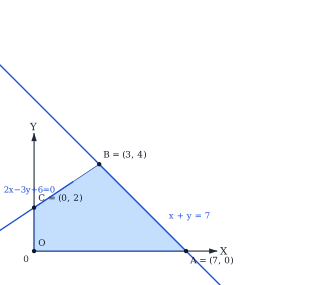 (A) x+y≥7, 2x−3y+6≤0, x≥0, y≥0
(B) x+y≥7, 2x−3y+6≥0, x≥0, y≥0
(C) x+y≤7, 2x−3y+6≤0, x≥0, y≥0
(D) x+y≤7, 2x−3y+6≥0, x≥0, y≥0
(A) x+y≥7, 2x−3y+6≤0, x≥0, y≥0
(B) x+y≥7, 2x−3y+6≥0, x≥0, y≥0
(C) x+y≤7, 2x−3y+6≤0, x≥0, y≥0
(D) x+y≤7, 2x−3y+6≥0, x≥0, y≥0›Reveal solutionSolution
Identify the two boundary lines, then use a single convenient test point inside the shaded region (the origin works) to fix the direction of each inequality.
1. Name the boundary lines
- The line of negative slope through (0,7) and (7,0) is 7x+7y=1, i.e. x+y=7.
- The line of positive slope through (−3,0) and (0,2) is −3x+2y=1⇒−2x+3y=6, i.e. 2x−3y+6=0.
Check their intersection: solving x+y=7 with 2x−3y+6=0 gives 2x−3(7−x)+6=0⇒5x=15⇒x=3, y=4 — the point B(3,4) marked on the figure. ✓ (Good — the transcription is consistent.)
2. The region is in the first quadrant
The shading lies entirely to the right of the y-axis and above the x-axis, so x≥0 and y≥0. Every option carries these, so they do not discriminate.
3. Test an interior point — the origin
The shaded quadrilateral O(0,0),C(0,2),B(3,4),A(7,0) has the origin as a vertex, so pick a point clearly inside, say (1,1) (and O itself for the boundary check):
- Against x+y=7: at (1,1), x+y=2≤7. The region is on the origin side of the line.
x+y≤7
- Against 2x−3y+6=0: at (1,1), 2(1)−3(1)+6=5>0. The region is again on the origin side. …
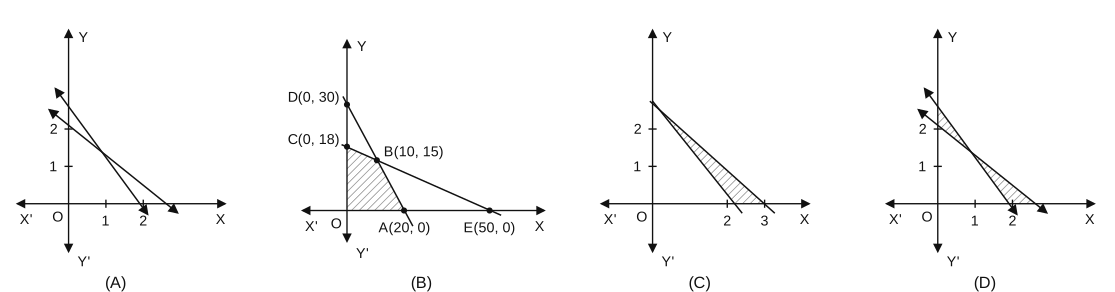
- COMEDK 2022Set 20221 markMCQQ.Shade the feasible region for the inequations 6x+4y≤120,3x+10y≤180,x,y≥0 in a rough figure. (A) (B) (C) (D)
›Reveal solutionSolution
We shade the region that satisfies all constraints: the intersection of the half-planes below each line, in the first quadrant. The feasible region is a quadrilateral with vertices at (0,0), (20,0), (10,15), and (0,18).
The problem asks you to shade the feasible region for a system of linear inequalities. This is the foundation of linear programming — you’re finding all points (x,y) that satisfy every constraint at once. Each inequality describes a half-plane; the feasible region is where all those half-planes overlap, and since x,y≥0, we only work in the first quadrant.
Let’s build it step by step.
-
Rewrite each inequality as an equation to draw the boundary lines.
For 6x+4y≤120, the boundary is 6x+4y=120. Simplify by dividing by 2: 3x+2y=60.
For 3x+10y≤180, the boundary is 3x+10y=180.
The lines x=0 and y=0 are the axes.
-
Find where each line meets the axes — these are the intercepts.
For 3x+2y=60:
- If x=0, then 2y=60⇒y=30. Point: (0,30).
- If y=0, then 3x=60⇒x=20. Point: (20,0). For 3x+10y=180:
- If x=0, then 10y=180⇒y=18. Point: (0,18).
- If y=0, then 3x=180⇒x=60. Point: (60,0).
-
Determine which side of each line is the feasible half-plane.
Test the origin (0,0) because it’s easy — but only if it’s not on the line (it isn’t here).
- For 6x+4y≤120: at (0,0), 0≤120 is true. So the region containing the origin is feasible. Shade below the line 3x+2y=60.
- For 3x+10y≤180: at (0,0), 0≤180 is true. So shade below the line 3x+10y=180 as well.
- x≥0 means the region to the right of the y-axis.
- y≥0 means the region above the x-axis.
-
Find the intersection point of the two boundary lines — this is a corner of the feasible region.
Solve:
{3x+2y=603x+10y=180
Subtract the first from the second: (3x+10y)−(3x+2y)=180−60⇒8y=120⇒y=15.
Substitute into 3x+2(15)=60⇒3x+30=60⇒3x=30⇒x=10.
So the lines intersect at (10,15).
- Identify all vertices of the feasible region.
The region is bounded by the axes and the two lines. The vertices are:
- (0,0) — origin.
- (20,0) — where 3x+2y=60 meets the x-axis.
- (10,15) — intersection of the two lines.
- (0,18) — where 3x+10y=180 meets the y-axis. …
-
- KCET 2021Set A-11 markMCQQ.The shaded region is the solution set of the inequalities (A) 5x+4y≥20,x≤6,y≥3,x≥0,y≥0 (B) 5x+4y≤20,x≤6,y≤3,x≥0,y≥0 (C) 5x+4y≥20,x≤6,y≤3,x≥0,y≥0 (D) 5x+4y≥20,x≥6,y≤3,x≥0,y≥0
›Reveal solutionSolution
The shaded region lies above the line 5x+4y=20, to the left of x=6, below y=3, and in the first quadrant — so the correct set is option (C).
The key is to read each boundary line in the graph and decide which side of it is shaded. In linear programming, a shaded region represents the intersection of several half-planes. Each inequality in the options corresponds to a line, and the direction of the inequality tells you which half-plane is included.
Let’s go through the boundaries one by one.
-
The line 5x+4y=20
This line cuts the axes at (4,0) and (0,5). Look at the shaded region: it lies above this line (the region containing the point (6,3), for example).
Above the line means 5x+4y≥20.
So the first inequality must be 5x+4y≥20. This eliminates option (B), which uses ≤.
-
The vertical line x=6
The shaded region is to the left of this line (smaller x values). That means x≤6.
This eliminates option (D), which has x≥6.
-
The horizontal line y=3
The shaded region is below this line (smaller y values). That means y≤3.
This eliminates option (A), which has y≥3.
-
The axes x=0 and y=0
The shaded region is in the first quadrant, so x≥0 and y≥0 are automatically satisfied. All remaining options include these. …
-
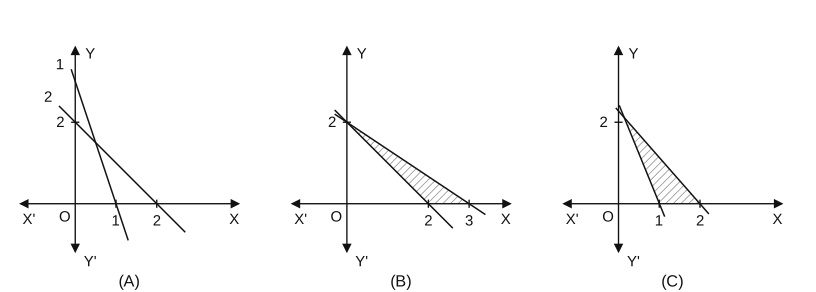
- COMEDK 2021Set 20211 markMCQQ.Shade the feasible region for the inequations x+y≥2,2x+3y≤6,x≥0,y≥0 in a rough figure. (A) (B) (C) (D) None of the above
›Reveal solutionSolution
[!TLDR]
The feasible region is the triangle with corners (0,2), (2,0), (3,0), matching option (B).
Concept
Each linear inequality defines a half-plane; the feasible region is their intersection in the first quadrant — core CBSE/NCERT Class 12 'Linear Programming' work.
Solution
Boundary lines:
- x+y=2 passes through (2,0) and (0,2).
- 2x+3y=6 passes through (3,0) and (0,2).
Both lines intersect at (0,2).
Apply the inequalities:
- x+y≥2: on/above the first line.
- 2x+3y≤6: on/below the second line.
- x≥0, y≥0: first quadrant. …
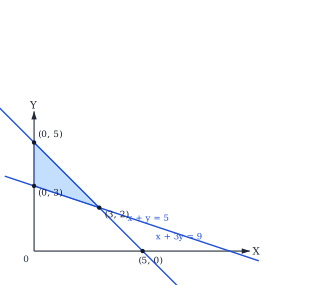
- KCET 2020Set A-11 markMCQQ.The feasible region of an LPP is shown in the figure below. If Z=11x+7y, then the maximum value of Z occurs at:
 (A) (0,5)
(B) (3,3)
(C) (5,0)
(D) (3,2)
(A) (0,5)
(B) (3,3)
(C) (5,0)
(D) (3,2)›Reveal solutionSolution
By the corner-point theorem, test Z=11x+7y at the three vertices (0,5),(0,3),(3,2) of the shaded region; the largest value, 47, occurs at (3,2).
The feasible region: a first-quadrant triangle bounded by x + y = 5, x + 3y = 9, and the Y-axis, with corner points (0, 5), (0, 3) and (3, 2) Step 1 — Read the feasible region from the figure.
The shaded region is bounded by the Y-axis on the left, by x+y=5 above and by x+3y=9 below, i.e.
x≥0,x+y≤5,x+3y≥9
Its corner points are the three points printed in the figure: (0,5), (0,3) and the intersection of the two lines.
Step 2 — Confirm the intersection point.
Solve x+y=5 and x+3y=9 simultaneously. Subtracting the first from the second:
(x+3y)−(x+y)=9−5⇒2y=4⇒y=2,x=5−2=3
So the lines meet at (3,2), exactly as the figure states.
Step 3 — Corner-point theorem.
For a linear objective function over a closed, bounded convex feasible region, the maximum (and minimum) is attained at a vertex of the region. So we need only evaluate Z at the three corners. …
- KCET 2020Set A-11 markMCQQ.Corner points of the feasible region determined by the system of linear constraints are (0,3), (1,1) and (3,0). Let z=px+qy, where p,q>0. Condition on p and q so that the minimum of z occurs at (3,0) and (1,1) is (A) p=2q (B) p=2q (C) p=3q (D) p=q
›Reveal solutionSolution
For a linear programming problem with multiple optimal minima, the objective function’s gradient must be parallel to the line joining the two optimal corner points. Here, the condition is p=2q, which corresponds to option (B).
The key idea is that in linear programming, when the minimum occurs at two distinct corner points of the feasible region, the objective function is constant along the line segment joining them. This happens because the level lines of z=px+qy are parallel to that edge of the feasible region.
Think of it this way: the feasible region is a convex polygon. The minimum of a linear function over a convex polygon occurs at a corner. If two corners give the same minimum value, then every point on the edge between them also gives that same minimum — the objective function’s contour lines are aligned with that edge.
Here, the two points are (3,0) and (1,1). The line joining them has a certain slope. For z to be constant along that line, the gradient vector (p,q) must be perpendicular to the direction vector of the line (since z changes fastest perpendicular to the contour lines). Equivalently, the slope of the contour line px+qy=constant must match the slope of the edge.
Let’s work it out step by step.
- Find the direction vector of the edge joining (3,0) and (1,1). The vector from (3,0) to (1,1) is
(1−3,1−0)=(−2,1).
So the slope of this edge is −21=−21.
- Write the condition for z to be constant along this edge. For any two points on the edge, z must be equal. In particular, at (3,0) and (1,1):
p(3)+q(0)=p(1)+q(1).
This gives:
3p=p+q.
- Solve the equation.
3p−p=q⇒2p=q⇒p=2q.
- Interpret the result. …
- KCET 2019Set A-11 markMCQQ.The shaded region in the figure is the solution set of the inequations (A) 4x+5y≥20, 3x+10y≤30, x≤6, x,y≥0 (B) 4x+5y≥20, 3x+10y≤30, x≥6, x,y≥0 (C) 4x+5y≤20, 3x+10y≤30, x≤6, x,y≥0 (D) 4x+5y≤20, 3x+10y≤30, x≥6, x,y≥0
›Reveal solutionSolution
The shaded region is bounded by three lines and lies in the first quadrant. By checking which side of each boundary line is shaded, we determine the correct inequalities: 4x+5y≥20, 3x+10y≤30, x≤6, and x,y≥0. The correct option is (A).
The key idea is that a shaded region in a linear programming problem is the intersection of half-planes. Each boundary line corresponds to an equation; the inequality sign tells us which side of that line is included. To decide the sign, pick a test point on the shaded side and see whether it satisfies the inequality.
Let’s identify the three boundary lines visible in the figure (the axes are also boundaries, since x≥0 and y≥0 are given in every option).
-
Line through (0,4) and (5,0)
Its equation: intercept form 5x+4y=1, which simplifies to 4x+5y=20.
The shaded region lies above this line (away from the origin). Test the origin (0,0): 4(0)+5(0)=0, which is not ≥20, so the origin is not in the shaded region. Hence the inequality is 4x+5y≥20.
-
Line through (0,3) and (10,0)
Equation: 10x+3y=1, i.e. 3x+10y=30.
The shaded region lies below this line (toward the origin). Test (0,0): 0≤30, so the origin satisfies 3x+10y≤30. That matches the shading.
-
Vertical line x=6
The shaded region is to the left of this line (smaller x). Test a point like (0,0): 0≤6, so the inequality is x≤6.
-
First quadrant constraints
The shading is entirely in the region where x≥0 and y≥0, so those are included.
Now check the options:
- Option (A): 4x+5y≥20, 3x+10y≤30, x≤6, x,y≥0 — matches all three signs. …
-
- KCET 2018Set A-11 markMCQQ.The feasible region of an LPP is shown in the figure. If z=3x+9y, then the minimum value of z occurs at (A) (5,5) (B) (0,10) (C) (0,20) (D) (15,15)
›Reveal solutionSolution
By the corner-point theorem, evaluate z=3x+9y at each listed vertex; the minimum, z=60, occurs at (5,5).
-
Corner-point method. For a bounded feasible region, the optimum of a linear objective occurs at a vertex. The four options are precisely the vertices of the region shown.
-
Evaluate z=3x+9y at each vertex.
z(0,10)=3(0)+9(10)=90
z(5,5)=3(5)+9(5)=15+45=60
z(15,15)=3(15)+9(15)=45+135=180
z(0,20)=3(0)+9(20)=180 …
-
- KCET 2018Set A-11 markMCQQ.For the LPP; maximise z=x+4y subject to the constraints x+2y≤2, x+2y≥8, x,y≥0 (A) zmax=4 (B) zmax=8 (C) zmax=16 (D) Has no feasible solution
›Reveal solutionSolution
The two constraints on the same expression x+2y contradict each other, so the feasible region is empty.
Step 1 — Write down the feasible region.
Maximise z=x+4y subject to
x+2y≤2,x+2y≥8,x≥0, y≥0.
Step 2 — Test the two constraints together.
Put t=x+2y. The constraints say simultaneously
t≤2andt≥8⟹8≤t≤2,
which is impossible for any real t. The half-plane x+2y≤2 lies below the line x+2y=2 and the half-plane x+2y≥8 lies above the parallel line x+2y=8; the two lines are parallel (same normal vector (1,2)) and never meet, so the half-planes are disjoint.
Step 3 — Conclusion for the LPP. …
🎓Unlock everything free for 14 days
- ✓Full step-by-step solutions
- ✓Concept-first explanations
- ✓Methods, shortcuts & mistakes
- ✓PYQ mapping + timed mock tests
Full access for 14 days. No credit card required.