Q.If i^+j^+k^, 2i^+5j^, 3i^+2j^−3k^ and i^−6j^−k^ are the position vectors of points A, B, C and D respectively, then find the angle between AB and CD. Deduce that AB and CD are collinear.
Concept understanding — Dot Product Angle
Finding the Angle Between Vectors
Suppose you have two arrows drawn from the same point. One question is unavoidable in geometry, physics, and mechanics: what is the angle between them? You could measure it with a protractor on paper, but that fails the moment the vectors live in 3D. The dot product gives you the angle by pure calculation.
The Core Idea
The scalar (dot) product of two vectors has two faces that describe the same number:
a⋅b=a1b1+a2b2+a3b3(components)
a⋅b=∣a∣∣b∣cosθ(geometry)
The first is easy to compute from coordinates; the second hides the angle θ (with 0≤θ≤π) between the vectors. Setting them equal and solving for cosθ gives the master formula.
cosθ=∣a∣∣b∣a⋅b,θ=cos−1(∣a∣∣b∣a⋅b)
Why It Works
Both vectors have a fixed length, so the only thing the dot product can "vary" with is how aligned they are. When they point the same way, cosθ=1 and the dot product is as large as possible, ∣a∣∣b∣. When they are perpendicular, cosθ=0 and the dot product vanishes. When they point opposite ways, cosθ=−1. Dividing a⋅b by the two lengths simply strips away the size information and leaves behind a pure measure of alignment — exactly cosθ.
The sign of the dot product tells you the type of angle at a glance: positive ⇒ acute, zero ⇒ right angle, negative ⇒ obtuse.
Using the Formula
For a=i^+2j^+2k^ and b=i^+0j^+0k^:
a⋅b=1,∣a∣=3,∣b∣=1
cosθ=3⋅11=31⇒θ=cos−131≈70.5∘
Never forget to divide by both magnitudes. A common slip is to compute a⋅b and call it cosθ — that is only valid if both vectors are already unit vectors.
Why You'll Use This
This single formula powers a huge range of problems: checking perpendicularity, finding the angle a line makes with an axis, computing the work done by a force at an angle, and testing whether a triangle is right-angled. Whenever the words "angle between" appear, reach for cosθ=∣a∣∣b∣a⋅b.
Finding the angle between two vectors using the dot product is one of the most exam-heavy applications in the NCERT Class 12 Vector Algebra chapter, tested in nearly every CBSE board paper and JEE Main sitting. Students searching "angle between two vectors formula and examples" should pair this with the perpendicularity and parallelism tests for a complete revision of the chapter's core toolkit.
Concept: Dot Product Angle — the angle θ between two vectors is given by cosθ=∣u∣∣v∣u⋅v.
Step 1: Find AB and CD.
AB=B−A=(2i^+5j^)−(i^+j^+k^)=i^+4j^−k^
CD=D−C=(i^−6j^−k^)−(3i^+2j^−3k^)=−2i^−8j^+2k^
Step 2: Compute dot product and magnitudes.
AB⋅CD=(1)(−2)+(4)(−8)+(−1)(2)=−2−32−2=−36
∣AB∣=12+42+(−1)2=1+16+1=18=32
∣CD∣=(−2)2+(−8)2+22=4+64+4=72=62
Step 3: Find cosθ.
cosθ=(32)(62)−36=36−36=−1
Thus θ=π (or 180∘).
Since θ=180∘, the vectors are opposite in direction, hence collinear.
The angle is 180∘ and AB and CD are collinear.
The angle between AB and CD is 180∘; since CD=−2AB, they are collinear.
With position vectors A=i^+j^+k^, B=2i^+5j^, C=3i^+2j^−3k^, D=i^−6j^−k^:
Form the vectors:
AB=B−A=i^+4j^−k^,CD=D−C=−2i^−8j^+2k^.
Angle:
AB⋅CD=(1)(−2)+(4)(−8)+(−1)(2)=−36,
∣AB∣=1+16+1=32,∣CD∣=4+64+4=62,
cosθ=(32)(62)−36=36−36=−1 ⇒ θ=180∘.
Collinearity: CD=−2(i^+4j^−k^)=−2AB, so each vector is a scalar multiple of the other. Hence AB and CD are collinear (parallel, oppositely directed).
The angle between AB and CD is 180∘, and since CD=−2AB, the two vectors are collinear.
Method: Angle between two vectors, and reading off collinearity
Use the dot-product angle formula, then interpret an angle of 0∘ or 180∘ as the vectors being parallel — hence the segments collinear.
Steps
Step 1: Form the two vectors from the position vectors
AB=B−A and CD=D−C, subtracting coordinates.
Step 2: Apply the angle formula
cosθ=∣AB∣∣CD∣AB⋅CD.
Divide by both magnitudes — the dot product alone is not cosθ unless both vectors are already unit length.
Step 3: Interpret the result
cosθ=1 means parallel and same direction (θ=0∘); cosθ=−1 means anti-parallel (θ=180∘). In either case the direction vectors are scalar multiples, so AB and CD are collinear. A cleaner confirmation is to spot the scalar multiple directly, e.g. CD=λAB.
Common Mistakes
Mistake 1: Treating the dot product itself as cosθ.
Why it's wrong: AB⋅CD equals cosθ only if both vectors are unit length; otherwise you must divide by both magnitudes. Correct approach: always compute ∣AB∣∣CD∣AB⋅CD.
Mistake 2: Reading cosθ=−1 as perpendicular or as "no relation."
Why it's wrong: cosθ=−1 is θ=180∘ (opposite direction), while perpendicular would be cosθ=0. Correct approach: −1 signals anti-parallel vectors, which are still parallel in direction.
Mistake 3: Thinking collinearity requires the same direction only.
Why it's wrong: vectors pointing exactly opposite (180∘) are also scalar multiples of each other, so the segments are still collinear. Correct approach: any CD=λAB, with λ positive or negative, proves collinearity.
- COMEDK 2022Set 20221 markMCQQ.If θ be the angle between the vectors a=2i+2j−k and b=6i−3j+2k, then (A) cosθ=214 (B) cosθ=193 (C) cosθ=192 (D) cosθ=215
›Reveal solutionSolution
cos(theta) = 4 / (3 * 7) = 4/21
Concept: cos(theta) = (a . b) / (|a| |b|)
a = 2i + 2j - k , b = 6i - 3j + 2k
Dot product:
a . b = (2)(6) + (2)(-3) + (-1)(2) = 12 - 6 - 2 = 4
Magnitudes:
|a| = sqrt(4 + 4 + 1) = sqrt(9) = 3
|b| = sqrt(36 + 9 + 4) = sqrt(49) = 7
cos(theta) = 4 / (3 * 7) = 4/21
✓Final answerThe correct option is (A) — cosθ=214
ANSWER: A
- COMEDK 2024Set 2024-A1 markMCQQ.
[!FORMULA] The angle between ^−^ & ^−k^ is
(A) 43π (B) 32π (C) 4π (D) 3π›Reveal solutionSolution
The angle between two vectors is found using the dot product formula; for a=^−^ and b=^−k^, the cosine is −21, so the angle is 32π, which corresponds to option (B).
The key idea: The angle θ between two vectors a and b satisfies cosθ=∣a∣∣b∣a⋅b. This works because the dot product measures how much the vectors point in the same direction, scaled by their lengths. Here, we just compute the dot product and magnitudes carefully.
-
Write the vectors in component form.
a=^−^ means components (1,−1,0).
b=^−k^ means components (0,1,−1).
-
Compute the dot product.
a⋅b=(1)(0)+(−1)(1)+(0)(−1)=0−1+0=−1.
-
Compute the magnitudes.
∣a∣=12+(−1)2+02=1+1=2.
∣b∣=02+12+(−1)2=0+1+1=2.
-
Find cosθ.
cosθ=2⋅2−1=2−1.
-
Determine the angle.
The angle whose cosine is −21 is 32π (since cos32π=−21). This lies between 0 and π, as required for the angle between vectors.
Watch outA common mistake is to forget the negative sign and think cosθ=21, giving 3π. But the dot product is −1, not +1, so the vectors point somewhat opposite each other.
TipNotice that both vectors have the same length 2, so the denominator simplifies nicely. This often happens with unit-vector combinations.
✓Final answerThe correct option is (B).
ANSWER: B
-
- COMEDK 2023Set 2023-M1 markMCQQ.The angle between the vectors a=i^+2j^+2k^ and b=i^+2j^−2k^ is (A) sin−1(1/9) (B) sin−1(8/9) (C) cos−1(8/9) (D) cos−1(1/9)
›Reveal solutionSolution
cosθ=∣a∣∣b∣a⋅b=91, hence θ=cos−1(1/9).
a=i^+2j^+2k^, b=i^+2j^−2k^.
a⋅b=1⋅1+2⋅2+2⋅(−2)=1+4−4=1.
∣a∣=1+4+4=3,∣b∣=1+4+4=3.
cosθ=3⋅31=91⇒θ=cos−1(91).
✓Final answerThe correct option is (D) — cos−1(1/9)
- KCET 2021Set A-11 markMCQQ.The angle between the lines whose direction cosines are (43,41,23) and (43,41,−23) is (A) π (B) 2π (C) 3π (D) 4π
›Reveal solutionSolution
The angle between two lines is found using the dot product of their direction vectors. The cosine of the angle is −21, so the angle is 32π, which is not among the given options — but the acute angle between them is 3π, option (C).
The key idea: direction cosines are the components of a unit vector along the line. So the given triples are already unit vectors. The angle between the lines is simply the angle between these two unit vectors, found via their dot product.
A common pitfall: the dot product formula gives cosθ, and θ is taken as the acute angle between lines (since lines have no direction, the angle between them is defined as the smaller angle, between 0 and 2π). If cosθ turns out negative, the acute angle is π−θ.
Let the two direction vectors be:
a=(43, 41, 23),b=(43, 41, −23)
- Verify they are unit vectors For a:
∣a∣2=(43)2+(41)2+(23)2=163+161+43=163+161+1612=1616=1
For b:
∣b∣2=163+161+43=1
Both are indeed unit vectors, so the given triples are valid direction cosines.
- Compute the dot product
a⋅b=43⋅43+41⋅41+23⋅(−23)
=163+161−43=163+161−1612=−168=−21
-
Find the angle
Since both vectors are unit, cosθ=a⋅b=−21.
So θ=cos−1(−21)=32π.
But the angle between two lines is defined as the acute angle (or the smaller angle between 0 and 2π). Since 32π>2π, the acute angle between the lines is π−32π=3π.
Watch outThe dot product gives cosθ=−21, so θ=120∘. But the angle between lines is always taken as the acute (or right) angle, i.e. 60∘ or 3π. Many students stop at 120∘ and pick the wrong option.
TipIf cosθ is negative, the lines are separated by an obtuse angle; the acute angle between them is π−θ.
✓Final answerThe angle between the lines is 3π, which corresponds to option (C).
- KCET 2018Set A-11 markMCQQ.If a and b are mutually perpendicular unit vectors, then (3a+2b)⋅(5a−6b)= (A) 5 (B) 3 (C) 6 (D) 12
›Reveal solutionSolution
Since a and b are perpendicular unit vectors, their dot products simplify to a⋅a=1, b⋅b=1, and a⋅b=0. Expanding the given expression yields 15−12=3.
The key idea here is that mutually perpendicular unit vectors give us two clean facts: each vector has length 1, and their dot product is zero. This turns what looks like a messy expansion into simple arithmetic.
When you see a dot product of two linear combinations of perpendicular unit vectors, you never need to guess coordinates — just expand using the distributive property and apply the three basic rules:
- a⋅a=∣a∣2=1
- b⋅b=∣b∣2=1
- a⋅b=0
Let’s work through it.
- Expand the dot product using the distributive law (FOIL works here):
(3a+2b)⋅(5a−6b)=(3a)⋅(5a)+(3a)⋅(−6b)+(2b)⋅(5a)+(2b)⋅(−6b)
- Pull out the scalar coefficients — dot product is bilinear, so constants factor out:
=15(a⋅a)−18(a⋅b)+10(b⋅a)−12(b⋅b)
-
Apply the unit/perpendicular facts:
- a⋅a=1
- b⋅b=1
- a⋅b=b⋅a=0
So the expression becomes:
=15(1)−18(0)+10(0)−12(1)=15−12=3
Watch outA common mistake is forgetting that a⋅b=0 only because they are perpendicular. If the problem said "unit vectors" without "mutually perpendicular", you would need the angle between them. Here, the word "perpendicular" is the crucial condition that kills the cross terms.
TipYou can also think of this as: treat a and b like the standard basis vectors i^ and j^. Then (3i^+2j^)⋅(5i^−6j^)=3⋅5+2⋅(−6)=15−12=3. The algebra is identical.
✓Final answerThe value is 3, which corresponds to option (B).
- COMEDK 2025Set 2025-E1 markMCQQ.If a and b are two vectors such that a⋅b=∣a×b∣ then the angle between a and b is (A) 4π (B) π (C) 3π (D) 2π
›Reveal solutionSolution
The condition a⋅b=∣a×b∣ forces the angle θ between the vectors to satisfy tanθ=1, so θ=π/4. The correct option is (A).
The key idea is to express both the dot product and the magnitude of the cross product in terms of the magnitudes of the vectors and the angle between them. The dot product is ∣a∣∣b∣cosθ, and the magnitude of the cross product is ∣a∣∣b∣sinθ. Setting them equal gives a simple trigonometric equation.
- Write the given condition using standard formulas. For any two vectors a and b, with angle θ between them (0≤θ≤π), we have:
a⋅b=∣a∣∣b∣cosθ
and
∣a×b∣=∣a∣∣b∣sinθ.
The problem states:
∣a∣∣b∣cosθ=∣a∣∣b∣sinθ.
- Simplify the equation. Assuming neither vector is zero (if either were zero, the angle is undefined, but the condition would hold trivially; however, the problem implies non-zero vectors), we can divide both sides by ∣a∣∣b∣ (which is positive), obtaining:
cosθ=sinθ.
- Solve the trigonometric equation. The equation cosθ=sinθ can be rewritten as tanθ=1 (provided cosθ=0; if cosθ=0, then sinθ=1 or −1, which doesn't satisfy equality). The principal solution in the range 0≤θ≤π is:
θ=4π.
(Note: θ=5π/4 is outside the range for the angle between vectors, which is taken between 0 and π.)
Watch outA common mistake is to forget that the angle between vectors is defined to be in [0,π]. The equation tanθ=1 also has the solution θ=5π/4, but that is not a valid angle between two vectors.
- Interpret the result. At θ=π/4, the dot product and the magnitude of the cross product are equal, exactly as required. No other angle in the valid range satisfies cosθ=sinθ.
TipThis problem is a neat reminder that the dot product measures alignment (cosine) and the cross product measures perpendicularity (sine). When they are equal, the vector is equally aligned and perpendicular — hence the 45∘ angle.
✓Final answerThe correct option is (A).
ANSWER: A
- KCET 2019Set A-11 markMCQQ.Acute angle between the line 2x−5=−1y+1=1z+4 and the plane 3x−4y−z+5=0 is (A) cos−1(3649) (B) sin−1(3649) (C) cos−1(2135) (D) sin−1(2135)
›Reveal solutionSolution
Use sinθ=∣b∣∣n∣∣b⋅n∣ for a line-and-plane angle, then convert the result into the cos−1 form that the options are written in.
Step 1 — Extract the vectors.
The line 2x−5=−1y+1=1z+4 has direction vector
b=2i^−j^+k^.
The plane 3x−4y−z+5=0 has normal
n=3i^−4j^−k^.
Step 2 — Use the correct formula.
The angle θ between a line and a plane is measured from the plane, so it is the complement of the angle between b and n:
sinθ=∣b∣∣n∣∣b⋅n∣.
Step 3 — Compute.
b⋅n=(2)(3)+(−1)(−4)+(1)(−1)=6+4−1=9
∣b∣=22+(−1)2+12=6,∣n∣=32+(−4)2+(−1)2=26
sinθ=6269=1569
Step 4 — Convert to the cos−1 form used in the options.
sin2θ=15681⟹cos2θ=1−15681=15675=5225
cosθ=525=2135
Hence
θ=cos−1(2135)≈46.1∘,
which is acute, as required.
Check: the distractors 3649 correspond to ∣b∣=14, which is not this line's direction; and sin−1(2135)≈43.9∘=θ.
✓Final answerThe correct option is (C) — cos−1(2135).
ANSWER: C
- COMEDK 2025Set 2025-A1 markMCQQ.The square of resultant of two equal electric field vectors is three times their product. Angle between them is (A) 5π (B) 6π (C) 8π (D) 3π
›Reveal solutionSolution
The problem reduces to solving for the angle between two equal vectors given that the square of their resultant equals three times their product. Using the law of cosines, we find the angle is π/3, so the correct option is (D).
The key here is to recall how two vectors add. When you have two vectors of equal magnitude, their resultant’s magnitude depends only on the angle between them. The phrase “square of resultant” means the square of the magnitude of the sum, and “product” means the product of the magnitudes of the two vectors. Since the vectors are equal, that product is just the square of one vector’s magnitude. This is a classic setup for using the parallelogram law of vector addition.
Let’s work through it step by step.
-
Set up the notation.
Let each electric field vector have magnitude E. So ∣E1∣=∣E2∣=E.
The resultant vector is R=E1+E2.
The square of the resultant is ∣R∣2, and the product of the two vectors’ magnitudes is E⋅E=E2.
-
Translate the given condition into an equation.
The problem says: “The square of resultant is three times their product.”
So:
∣R∣2=3⋅(E⋅E)=3E2.
- Use the formula for the magnitude of the sum of two vectors. For any two vectors with magnitudes a and b and angle θ between them:
∣a+b∣2=a2+b2+2abcosθ.
Here a=b=E, so:
∣R∣2=E2+E2+2E2cosθ=2E2(1+cosθ).
- Set this equal to the given value.
2E2(1+cosθ)=3E2.
Since E2=0, divide both sides by E2:
2(1+cosθ)=3.
- Solve for cosθ.
1+cosθ=23⇒cosθ=23−1=21.
- Find the angle. The angle whose cosine is 1/2 and lies between 0 and π (since we consider the angle between vectors) is:
θ=3π.
TipA common mistake is to forget that the “product” refers to the product of magnitudes, not the dot product. If you mistakenly set ∣R∣2=3(E1⋅E2), you’d get a different (wrong) angle. Always read carefully: “their product” means the product of their magnitudes.
Watch outAnother pitfall: using ∣R∣2=E2+E2+2E2cosθ is correct, but some students accidentally use ∣R∣2=E2+E2−2E2cosθ (the formula for the difference). The plus sign is for the sum.
✓Final answerThe correct option is (D).
ANSWER: D
-
- COMEDK 2024Set 2024-A1 markMCQQ.If α,β and γ are the angles between the vectors P,Q, and R and α=90∘ as shown in figure. the product of (Q×R)⋅Q is equal to (A) RQ2sinθcosθ (B) RQ2cosθ (C) RQ2sinθ (D) Zero
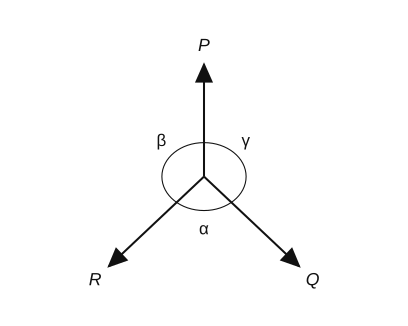
›Reveal solutionSolution
The scalar triple product (Q×R)⋅Q has a repeated vector, so it vanishes identically.
The vector Q×R is perpendicular to both Q and R. A dot product of two perpendicular vectors is zero:
(Q×R)⋅Q=0.
Equivalently, this is a scalar triple product with two identical vectors Q, which is always zero regardless of the angle θ.
✓Final answerThe correct option is (D) — Zero
🎓Unlock everything free for 14 days
- ✓Full step-by-step solutions
- ✓Concept-first explanations
- ✓Methods, shortcuts & mistakes
- ✓PYQ mapping + timed mock tests
Full access for 14 days. No credit card required.