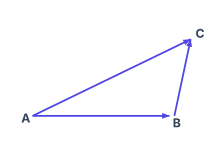
Q.In triangle (Fig 10.18), which of the following is not true: (A) (B) (C) (D)
You're viewing a preview — the full solution, concept, methods & PYQ mapping are locked.
Start your 14-day free trial to unlock the full solution →Using the triangle law of vector addition, the head-to-tail sum of vectors around a closed triangle is zero. Option (C) is the only one that does not simplify to , so it is the false statement.
The core idea here is the Triangle Law of Vector Addition: if you place vectors head to tail, the resultant vector goes from the first tail to the last head. When you go completely around a closed polygon (like a triangle) and return to the starting point, the net displacement is zero. That is, for any triangle ,
This is the fundamental relation. Every option is just a rearrangement of these three vectors. Our job is to check which one does not reduce to .
Let’s go through each option one by one.
-
Option (A):
This is exactly the closed-triangle condition. It is true by definition.
-
Option (B):
Notice that (reversing a vector flips its direction). So the expression becomes , which is exactly option (A). Hence it is true.
-
Option (C):
Here . So the expression is .
But (by the triangle law, going from A to B to C gives the same as going directly from A to C). So this sum becomes , which is not zero unless the triangle is degenerate. Therefore this statement is false. …
Unlock everything free for 14 days
- Full step-by-step solutions
- Concept-first explanations
- Methods, shortcuts & mistakes
- PYQ mapping + timed mock tests
Full access for 14 days. No credit card required.