Q.If the vertices A, B, C of a triangle ABC are (1,2,3),(−1,0,0),(0,1,2), respectively, then find ∠ABC.[∠ABC is the angle between the vectors BA and BC].
🔒You're viewing a preview — the full solution, concept, methods & PYQ mapping are locked.
🔒 Start your 14-day free trial to unlock the full solution →Concept understanding — Dot Product Angle
Finding the Angle Between Vectors
Suppose you have two arrows drawn from the same point. One question is unavoidable in geometry, physics, and mechanics: what is the angle between them? You could measure it with a protractor on paper, but that fails the moment the vectors live in 3D. The dot product gives you the angle by pure calculation.
The Core Idea
The scalar (dot) product of two vectors has two faces that describe the same number:
a⋅b=a1b1+a2b2+a3b3(components)
a⋅b=∣a∣∣b∣cosθ(geometry)
The first is easy to compute from coordinates; the second hides the angle θ (with 0≤θ≤π) between the vectors. Setting them equal and solving for cosθ gives the master formula.
cosθ=∣a∣∣b∣a⋅b,θ=cos−1(∣a∣∣b∣a⋅b)
Why It Works
Both vectors have a fixed length, so the only thing the dot product can "vary" with is how aligned they are. When they point the same way, cosθ=1 and the dot product is as large as possible, ∣a∣∣b∣. When they are perpendicular, cosθ=0 and the dot product vanishes. When they point opposite ways, cosθ=−1. Dividing a⋅b by the two lengths simply strips away the size information and leaves behind a pure measure of alignment — exactly cosθ.
The sign of the dot product tells you the type of angle at a glance: positive ⇒ acute, zero ⇒ right angle, negative ⇒ obtuse.
Using the Formula
For a=i^+2j^+2k^ and b=i^+0j^+0k^:
a⋅b=1,∣a∣=3,∣b∣=1
cosθ=3⋅11=31⇒θ=cos−131≈70.5∘ …
Concept: Dot Product Angle — the angle between two vectors is given by
cosθ=∣u∣∣v∣u⋅v.
Step 1: Find the vectors
BA=A−B=(1−(−1),2−0,3−0)=(2,2,3)
BC=C−B=(0−(−1),1−0,2−0)=(1,1,2)
Step 2: Compute dot product and magnitudes
BA⋅BC=2(1)+2(1)+3(2)=2+2+6=10
∣BA∣=22+22+32=4+4+9=17 …
The angle ∠ABC is the angle between vectors BA and BC. Using the dot product formula, we find cos(∠ABC)=17⋅610, so ∠ABC=cos−1(10210).
The problem asks for ∠ABC, which is the angle at vertex B. The key idea is that this angle is formed by the two vectors that start at B and go to the other vertices: one to A and one to C. So we need the angle between BA and BC.
Why the dot product? Because the dot product of two vectors gives us a direct link to the cosine of the angle between them: u⋅v=∣u∣∣v∣cosθ. This is the cleanest way to find an angle in 3D space without drawing anything.
Let’s work through it step by step.
-
Identify the vectors from B.
Vertex B is (−1,0,0).
- BA goes from B to A: A−B=(1−(−1),2−0,3−0)=(2,2,3).
- BC goes from B to C: C−B=(0−(−1),1−0,2−0)=(1,1,2).
-
Compute the dot product BA⋅BC.
Multiply corresponding components and add:
(2)(1)+(2)(1)+(3)(2)=2+2+6=10.
-
Find the magnitudes (lengths) of each vector.
- ∣BA∣=22+22+32=4+4+9=17.
- ∣BC∣=12+12+22=1+1+4=6.
-
Apply the dot product formula. …
Method: Finding the Angle at a Vertex Using the Dot Product
Use this for any 'angle between two vectors' or 'angle of a triangle at a vertex' problem, in 2D or 3D.
Steps
Step 1: Build the two vectors emanating FROM the vertex.
For the angle at B, use BA=A−B and BC=C−B — both must start at B. Using AB instead measures the wrong vertex's angle.
Step 2: Apply the cosine formula.
cosθ=∣BA∣∣BC∣BA⋅BC …
Common Mistakes
Mistake 1: Using AB and CB instead of vectors from B.
Why it's wrong: the angle at B is between vectors that START at B, namely BA and BC; using AB points the wrong way and can flip the sign of cosθ. Correct approach: form BA=A−B and BC=C−B.
Mistake 2: Dividing by only one magnitude. …
- COMEDK 2023Set 2023-M1 markMCQQ.The angle between the vectors a=i^+2j^+2k^ and b=i^+2j^−2k^ is (A) sin−1(1/9) (B) sin−1(8/9) (C) cos−1(8/9) (D) cos−1(1/9)
›Reveal solutionSolution
cosθ=∣a∣∣b∣a⋅b=91, hence θ=cos−1(1/9).
a=i^+2j^+2k^, b=i^+2j^−2k^.
a⋅b=1⋅1+2⋅2+2⋅(−2)=1+4−4=1.
∣a∣=1+4+4=3,∣b∣=1+4+4=3. …
- COMEDK 2024Set 2024-A1 markMCQQ.
[!FORMULA] The angle between ^−^ & ^−k^ is
(A) 43π (B) 32π (C) 4π (D) 3π›Reveal solutionSolution
The angle between two vectors is found using the dot product formula; for a=^−^ and b=^−k^, the cosine is −21, so the angle is 32π, which corresponds to option (B).
The key idea: The angle θ between two vectors a and b satisfies cosθ=∣a∣∣b∣a⋅b. This works because the dot product measures how much the vectors point in the same direction, scaled by their lengths. Here, we just compute the dot product and magnitudes carefully.
-
Write the vectors in component form.
a=^−^ means components (1,−1,0).
b=^−k^ means components (0,1,−1).
-
Compute the dot product.
a⋅b=(1)(0)+(−1)(1)+(0)(−1)=0−1+0=−1.
-
Compute the magnitudes.
∣a∣=12+(−1)2+02=1+1=2.
∣b∣=02+12+(−1)2=0+1+1=2.
-
Find cosθ.
cosθ=2⋅2−1=2−1.
-
Determine the angle. …
-
- COMEDK 2022Set 20221 markMCQQ.If θ be the angle between the vectors a=2i+2j−k and b=6i−3j+2k, then (A) cosθ=214 (B) cosθ=193 (C) cosθ=192 (D) cosθ=215
›Reveal solutionSolution
cos(theta) = 4 / (3 * 7) = 4/21
Concept: cos(theta) = (a . b) / (|a| |b|)
a = 2i + 2j - k , b = 6i - 3j + 2k
Dot product:
a . b = (2)(6) + (2)(-3) + (-1)(2) = 12 - 6 - 2 = 4
Magnitudes:
|a| = sqrt(4 + 4 + 1) = sqrt(9) = 3
|b| = sqrt(36 + 9 + 4) = sqrt(49) = 7 …
- KCET 2021Set A-11 markMCQQ.The angle between the lines whose direction cosines are (43,41,23) and (43,41,−23) is (A) π (B) 2π (C) 3π (D) 4π
›Reveal solutionSolution
The angle between two lines is found using the dot product of their direction vectors. The cosine of the angle is −21, so the angle is 32π, which is not among the given options — but the acute angle between them is 3π, option (C).
The key idea: direction cosines are the components of a unit vector along the line. So the given triples are already unit vectors. The angle between the lines is simply the angle between these two unit vectors, found via their dot product.
A common pitfall: the dot product formula gives cosθ, and θ is taken as the acute angle between lines (since lines have no direction, the angle between them is defined as the smaller angle, between 0 and 2π). If cosθ turns out negative, the acute angle is π−θ.
Let the two direction vectors be:
a=(43, 41, 23),b=(43, 41, −23)
- Verify they are unit vectors For a:
∣a∣2=(43)2+(41)2+(23)2=163+161+43=163+161+1612=1616=1
For b:
∣b∣2=163+161+43=1
Both are indeed unit vectors, so the given triples are valid direction cosines.
- Compute the dot product
a⋅b=43⋅43+41⋅41+23⋅(−23)
=163+161−43=163+161−1612=−168=−21
- Find the angle …
- COMEDK 2025Set 2025-E1 markMCQQ.If a and b are two vectors such that a⋅b=∣a×b∣ then the angle between a and b is (A) 4π (B) π (C) 3π (D) 2π
›Reveal solutionSolution
The condition a⋅b=∣a×b∣ forces the angle θ between the vectors to satisfy tanθ=1, so θ=π/4. The correct option is (A).
The key idea is to express both the dot product and the magnitude of the cross product in terms of the magnitudes of the vectors and the angle between them. The dot product is ∣a∣∣b∣cosθ, and the magnitude of the cross product is ∣a∣∣b∣sinθ. Setting them equal gives a simple trigonometric equation.
- Write the given condition using standard formulas. For any two vectors a and b, with angle θ between them (0≤θ≤π), we have:
a⋅b=∣a∣∣b∣cosθ
and
∣a×b∣=∣a∣∣b∣sinθ.
The problem states:
∣a∣∣b∣cosθ=∣a∣∣b∣sinθ.
- Simplify the equation. Assuming neither vector is zero (if either were zero, the angle is undefined, but the condition would hold trivially; however, the problem implies non-zero vectors), we can divide both sides by ∣a∣∣b∣ (which is positive), obtaining:
cosθ=sinθ.
- Solve the trigonometric equation. The equation cosθ=sinθ can be rewritten as tanθ=1 (provided cosθ=0; if cosθ=0, then sinθ=1 or −1, which doesn't satisfy equality). The principal solution in the range 0≤θ≤π is: θ=4π. …
- KCET 2019Set A-11 markMCQQ.Acute angle between the line 2x−5=−1y+1=1z+4 and the plane 3x−4y−z+5=0 is (A) cos−1(3649) (B) sin−1(3649) (C) cos−1(2135) (D) sin−1(2135)
›Reveal solutionSolution
Use sinθ=∣b∣∣n∣∣b⋅n∣ for a line-and-plane angle, then convert the result into the cos−1 form that the options are written in.
Step 1 — Extract the vectors.
The line 2x−5=−1y+1=1z+4 has direction vector
b=2i^−j^+k^.
The plane 3x−4y−z+5=0 has normal
n=3i^−4j^−k^.
Step 2 — Use the correct formula.
The angle θ between a line and a plane is measured from the plane, so it is the complement of the angle between b and n:
sinθ=∣b∣∣n∣∣b⋅n∣.
Step 3 — Compute.
b⋅n=(2)(3)+(−1)(−4)+(1)(−1)=6+4−1=9
∣b∣=22+(−1)2+12=6,∣n∣=32+(−4)2+(−1)2=26
sinθ=6269=1569
Step 4 — Convert to the cos−1 form used in the options. …
- COMEDK 2025Set 2025-A1 markMCQQ.The square of resultant of two equal electric field vectors is three times their product. Angle between them is (A) 5π (B) 6π (C) 8π (D) 3π
›Reveal solutionSolution
The problem reduces to solving for the angle between two equal vectors given that the square of their resultant equals three times their product. Using the law of cosines, we find the angle is π/3, so the correct option is (D).
The key here is to recall how two vectors add. When you have two vectors of equal magnitude, their resultant’s magnitude depends only on the angle between them. The phrase “square of resultant” means the square of the magnitude of the sum, and “product” means the product of the magnitudes of the two vectors. Since the vectors are equal, that product is just the square of one vector’s magnitude. This is a classic setup for using the parallelogram law of vector addition.
Let’s work through it step by step.
-
Set up the notation.
Let each electric field vector have magnitude E. So ∣E1∣=∣E2∣=E.
The resultant vector is R=E1+E2.
The square of the resultant is ∣R∣2, and the product of the two vectors’ magnitudes is E⋅E=E2.
-
Translate the given condition into an equation.
The problem says: “The square of resultant is three times their product.”
So:
∣R∣2=3⋅(E⋅E)=3E2.
- Use the formula for the magnitude of the sum of two vectors. For any two vectors with magnitudes a and b and angle θ between them:
∣a+b∣2=a2+b2+2abcosθ.
Here a=b=E, so:
∣R∣2=E2+E2+2E2cosθ=2E2(1+cosθ).
- Set this equal to the given value.
2E2(1+cosθ)=3E2.
Since E2=0, divide both sides by E2:
2(1+cosθ)=3.
- Solve for cosθ. …
-
- KCET 2018Set A-11 markMCQQ.If a and b are mutually perpendicular unit vectors, then (3a+2b)⋅(5a−6b)= (A) 5 (B) 3 (C) 6 (D) 12
›Reveal solutionSolution
Since a and b are perpendicular unit vectors, their dot products simplify to a⋅a=1, b⋅b=1, and a⋅b=0. Expanding the given expression yields 15−12=3.
The key idea here is that mutually perpendicular unit vectors give us two clean facts: each vector has length 1, and their dot product is zero. This turns what looks like a messy expansion into simple arithmetic.
When you see a dot product of two linear combinations of perpendicular unit vectors, you never need to guess coordinates — just expand using the distributive property and apply the three basic rules:
- a⋅a=∣a∣2=1
- b⋅b=∣b∣2=1
- a⋅b=0
Let’s work through it.
- Expand the dot product using the distributive law (FOIL works here):
(3a+2b)⋅(5a−6b)=(3a)⋅(5a)+(3a)⋅(−6b)+(2b)⋅(5a)+(2b)⋅(−6b)
- Pull out the scalar coefficients — dot product is bilinear, so constants factor out:
=15(a⋅a)−18(a⋅b)+10(b⋅a)−12(b⋅b)
-
Apply the unit/perpendicular facts:
- a⋅a=1
- b⋅b=1
- a⋅b=b⋅a=0
So the expression becomes: …
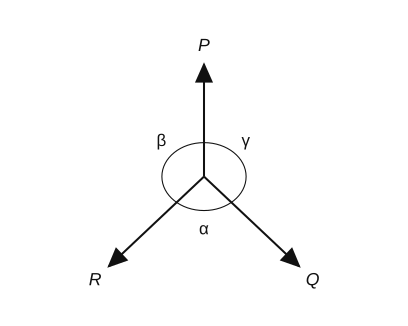
- COMEDK 2024Set 2024-A1 markMCQQ.If α,β and γ are the angles between the vectors P,Q, and R and α=90∘ as shown in figure. the product of (Q×R)⋅Q is equal to (A) RQ2sinθcosθ (B) RQ2cosθ (C) RQ2sinθ (D) Zero
›Reveal solutionSolution
The scalar triple product (Q×R)⋅Q has a repeated vector, so it vanishes identically.
The vector Q×R is perpendicular to both Q and R. A dot product of two perpendicular vectors is zero:
(Q×R)⋅Q=0. …
🎓Unlock everything free for 14 days
- ✓Full step-by-step solutions
- ✓Concept-first explanations
- ✓Methods, shortcuts & mistakes
- ✓PYQ mapping + timed mock tests
Full access for 14 days. No credit card required.