Q.If a proton had a radius R and the charge was uniformly distributed, calculate using Bohr theory, the ground state energy of a H-atom when
🔒You're viewing a preview — the full solution, concept, methods & PYQ mapping are locked.
🔒 Start your 14-day free trial to unlock the full solution →Concept understanding — Bohr Model Energy Levels
The Intuition: Why Can't an Electron Just Sit Anywhere?
Imagine you're rolling a marble on a staircase. The marble can rest on any step — step 1, step 2, step 3 — but it can never float halfway between two steps. The staircase forces the marble into specific, fixed positions.
That's the core idea of the Bohr model. Before Bohr, physicists thought electrons orbited the nucleus like planets around the sun — they could be at any distance, any energy. But experiments showed something strange: atoms only emit or absorb light at very specific colours (wavelengths), not a continuous rainbow. That meant electrons could only have certain, fixed energies — like the steps of a staircase.
Bohr's genius was to say: an electron in an atom cannot have any arbitrary energy. It can only occupy certain "allowed" energy levels. When it jumps from one level to another, it either absorbs or emits a photon of light whose energy exactly matches the difference between those levels.
The Precise Statement
In the Bohr model of the hydrogen atom (and hydrogen-like ions with one electron), the electron moves in circular orbits around the nucleus. But only those orbits are allowed where the electron's angular momentum is an integer multiple of 2πh (where h is Planck's constant).
This quantisation condition leads to a simple formula for the energy of the electron in the n-th orbit:
En=−n213.6 eV
Here:
- n is the principal quantum number — a positive integer (n=1,2,3,…)
- En is the energy of the electron in that level (in electronvolts)
- The negative sign means the electron is bound to the nucleus — you need to add energy to free it
The lowest energy state (n=1) is called the ground state. Its energy is −13.6 eV. The higher states (n=2,3,4,…) are excited states — they have less negative (higher) energies.
As n increases, the energy levels get closer together. At n=∞, the energy becomes 0 eV — the electron is completely free from the atom (ionisation).
What This Explains
When an electron jumps from a higher level (ni) to a lower level (nf), it emits a photon of energy:
ΔE=Enf−Eni=13.6(nf21−ni21) eV
This single formula predicts all the spectral lines of hydrogen — the Lyman series (jumps to n=1), Balmer series (to n=2), Paschen series (to n=3), and so on. Each series corresponds to a different "final step" on the staircase. …
Why this formula?
Why the Bohr Model Gives Those Energy Levels
The Bohr model is a beautiful piece of physics because it takes a simple, almost desperate idea — "electrons only exist in certain orbits" — and derives the entire hydrogen spectrum from it. The key is that Bohr didn't just assume the energy levels; he forced them to be consistent with classical physics in one specific way, then broke with it in another.
The Two Non-Negotiable Pieces
First, the electron moves in a circle around the proton. That's pure classical mechanics: the Coulomb attraction provides the centripetal force.
4πε01r2e2=rmv2
This gives you a relation between speed v and radius r:
v2=4πε0mre2
Second, the total energy of the electron is the sum of its kinetic and potential energies. Potential energy for a Coulomb force is −4πε01re2 (negative because the force is attractive, and we set zero at infinity).
E=21mv2−4πε01re2
Substitute v2 from above:
E=21(4πε0re2)−4πε0re2=−214πε0re2
So far, nothing is quantised. Any radius r gives a valid classical orbit, and the energy just follows from that radius. The problem is that a classical electron in a curved path radiates energy and spirals into the nucleus — atoms should collapse. Bohr needed a rule to pick out stable orbits.
The Quantisation Condition
Bohr's revolutionary step was to postulate that the angular momentum of the electron is quantised in units of ℏ=h/2π:
mvr=nℏ,n=1,2,3,…
Why this particular rule? Bohr later said it was the simplest way to get the right answer. But there's a deeper physical motivation: if you think of the electron as a wave (de Broglie's idea, which came a decade later), the condition that a standing wave fits exactly around the circumference 2πr=nλ gives mvr=nℏ directly. So the quantisation condition is really a wave condition imposed on a particle picture.
The angular momentum quantisation is the only non-classical assumption in the Bohr model. Everything else follows from classical mechanics and electromagnetism.
Deriving the Allowed Radii and Energies
From mvr=nℏ, we get v=nℏ/(mr). Substitute this into the centripetal force equation:
4πε01r2e2=rm(mrnℏ)2=mr3n2ℏ2
Solve for r:
rn=me24πε0ℏ2n2
The constant in front is the Bohr radius a0≈0.529A˚. So the radii are rn=a0n2.
Now plug rn back into the energy expression E=−214πε0re2:
En=−214πε0e2⋅a0n21=−214πε0a0e2⋅n21
Substitute a0=me24πε0ℏ2:
En=−214πε0e2⋅4πε0ℏ2me2⋅n21=−8ε02h2me4⋅n21
En=−n213.6 eV …
For a point-charge proton the electron moves in a 1/r Coulomb potential, giving the ground state −13.6eV at the Bohr radius a0=0.53A˚.
(i) R=0.1A˚. Here R≪a0, so the electron's orbit lies entirely outside the charged sphere, where the potential is the ordinary Coulomb form. The finite size changes almost nothing:
E≈−13.6eV.
(ii) R=10A˚. Here R≫a0, so the electron orbits inside the uniformly charged proton. There the field is E(r)=4πϵ0eR3r — a linear (harmonic) restoring force. Bohr's condition mvr=ℏ with the force balance rmv2=4πϵ0e2R3r gives
r4=a0R3⇒r=(0.53×10³)1/4≈4.8A˚(<R), …
If the proton is a uniformly charged sphere of radius R, then for R=0.1A˚(≪a0) the electron orbits outside it and E≈−13.6eV; for R=10A˚(≫a0) the electron orbits inside, feels a harmonic force, and E≈−1.8eV.
1. Potential of a uniformly charged sphere (total charge +e, radius R):
V(r)=⎩⎨⎧−4πϵ0e22R33R2−r2,−4πϵ0e2r1,r<Rr≥R.
Outside the sphere the field is the usual Coulomb field; inside it grows linearly with r.
2. Case (i): R=0.1A˚.
The Bohr radius is a0=0.53A˚, so R≪a0: the electron's orbit lies well outside the proton, where the potential is exactly Coulombic. The result is essentially unchanged:
E≈−13.6eV.
3. Case (ii): R=10A˚.
Now R≫a0, so the electron orbits inside the charged sphere. The inside field
E(r)=4πϵ0eR3r
produces a linear restoring force F=4πϵ0e2R3r (harmonic, like a spring).
4. Find the orbit radius from Bohr's condition.
With mvr=ℏ (ground state, n=1) and force balance
rmv2=4πϵ0e2R3r,
substitute v=ℏ/(mr):
mr3ℏ2=4πϵ0e2R3r⇒r4=me24πϵ0ℏ2R3=a0R3. …
Method: Compare R to a0 First, Then Use the Virial Theorem Inside the Sphere
Rather than blindly computing kinetic and potential energy by integration in every case, first check which regime you're in — this tells you immediately whether any calculation is even needed, and which shortcut applies if it is.
Steps
Step 1: Compare the given radius to the Bohr radius a0=0.53A˚
- If R≪a0: the electron's orbit lies entirely outside the charged sphere, where the field is ordinary 1/r2 Coulomb. No new calculation is needed — the ground-state energy is just the standard −13.6eV.
- If R≫a0: the electron orbits inside the sphere, where the field is linear in r (a Hooke's-law-type restoring force) — a genuinely different problem.
Step 2: For the inside-sphere case, recognise it as a power-law-force problem
Inside a uniformly charged sphere, F(r)∝r (like a spring). For any circular orbit under a central force F(r), the centripetal condition alone gives kinetic energy directly:
K=21mv2=21rF(r)
This is a general shortcut — you don't need to separately solve for v and square it once you know r and F(r).
Step 3: Find r from Bohr quantization, then get K in one line …
Showing the 12 most recent of 21 on this concept.
- COMEDK 2026Set 2026-A1 markMCQQ.A hydrogen atom absorbs energy and rises to n=3 state from its ground state n=1. If the potential energy of the atom at its ground state is -13.6 eV , find the wave length emitted by it when it returns to its ground state: {Planck's constant =6.6×1034 J s } (A) 12000∘A (B) 1020∘A (C) 7000∘A (D) 4000∘A
›Reveal solutionSolution
The key idea is that the energy of a hydrogen atom in state n is En=−13.6/n2 eV. The photon emitted in the transition n=3→n=1 carries the energy difference, and its wavelength is found via E=hc/λ. The computed wavelength is about 1020A˚, matching option (B).
Concept & Intuition
In hydrogen, the total energy of an electron in a given orbit is the sum of its kinetic and potential energies. For the ground state (n=1), the potential energy is given as −13.6 eV, but the total energy is half that: E1=−13.6 eV (since for Coulomb forces, total energy = potential energy/2). The energy levels scale as 1/n2. When the atom drops from a higher level to a lower one, the energy difference is released as a photon. The wavelength of that photon is inversely proportional to the energy difference.
Step-by-step solution
- Determine the total energy of the ground state The potential energy in the ground state is given as −13.6 eV. For a hydrogen atom, the total energy En is half the potential energy (virial theorem). So:
E1=21×(−13.6)=−13.6 eV
(This is the standard ground-state energy of hydrogen.)
- Find the energy of the n=3 state Energy levels scale as En=E1/n2:
E3=32−13.6=9−13.6≈−1.511 eV
- Compute the energy of the emitted photon The transition is from n=3 to n=1:
ΔE=E3−E1=(−1.511)−(−13.6)=12.089 eV
(We can keep it exact: ΔE=13.6(1−91)=13.6×98=9108.8 eV.)
- Convert energy to joules 1 eV=1.6×10⁻¹⁹ J, so:
ΔE=9108.8×1.6×10−19≈12.089×1.6×10−19=1.934×10⁻¹⁸ J
- Use the photon energy–wavelength relation
E=λhc⇒λ=Ehc
With h=6.6×10⁻³⁴ J⋅s and c=3×10⁸ m/s:
- COMEDK 2026Set 2026-M1 markMCQQ.An atom has a single electron. Its ground state energy is -30 eV and its first excited state energy is -8 eV . The atom is bombarded with a stream of photons, each of energy 15 eV . Assuming the atom being in the ground state, which of the following statements is correct? A. Atom gets excited to the first excited state and later emit photons of 22 eV B. Atom absorbs energy continuously until 22 eV is accumulated and then gets excited C. Atom will not get excited, and the transmitted light will have the same frequency as the incident light D. Atom will absorb the photon and re-emit a photon of lower energy (A) A (B) B (C) D (D) C
›Reveal solutionSolution
The atom can only absorb photons whose energy exactly matches the difference between two allowed energy levels. Since 15 eV does not match the 22 eV gap from ground to first excited state, no absorption occurs, so the light passes through unchanged. The correct option is (D).
The key concept here is quantized energy levels in an atom. An electron can only jump between discrete energy states by absorbing or emitting a photon whose energy equals the exact difference between those states. If the photon energy doesn't match any allowed transition, the atom simply cannot absorb it — it's like trying to climb a staircase with steps of uneven height using a single leap that lands between steps.
Let’s work through the reasoning:
- Identify the energy levels given Ground state: E0=−30eV First excited state: E1=−8eV The energy difference between them is:
ΔE=E1−E0=(−8)−(−30)=22eV
-
Compare the photon energy to the required transition energy
The incident photons have energy Ephoton=15eV.
For the atom to absorb a photon and jump from ground to first excited state, the photon must have exactly 22 eV. Since 15 eV ≠ 22 eV, this transition is impossible.
-
Consider other possible transitions
Could the atom absorb 15 eV and jump to some other state? The problem only gives two states, so no other bound state is available. The atom cannot absorb a fraction of a photon’s energy, nor can it "store" partial energy from multiple photons (that would violate energy quantization in a single quantum event).
-
What actually happens?
Since no allowed transition matches 15 eV, the atom remains in the ground state. The photons are not absorbed; they simply pass through the atom. Thus, the transmitted light has the same frequency (and energy) as the incident light.
-
Evaluate the options
- A: Incorrect — the atom cannot get excited to the first excited state with 15 eV. …
- COMEDK 2026Set 2026-M1 markMCQQ.An atom with one electron has ionization energy of 24 eV . An electron in this atom makes a transition from an excited energy level, where E=−15eV, to the ground state. What is the wavelength of the emitted photon from this transition? (A) 112 nm (B) 496 nm (C) 775 nm (D) 138 nm
›Reveal solutionSolution
The ionization energy gives the ground-state energy; using the given excited-state energy, the photon energy is the difference, and the wavelength is found via E=hc/λ. The result is about 138 nm, matching option (D).
The key concept here is that the ionization energy of a hydrogen-like atom is the energy required to remove the electron from the ground state to infinity (where energy is zero). So if the ionization energy is 24 eV, that means the ground-state energy E1 is −24 eV (since we define zero at infinity). The problem gives an excited state at −15 eV. When the electron drops from that excited state to the ground state, the emitted photon’s energy equals the difference in energy levels. Then we use the Planck-Einstein relation to find the wavelength.
Let’s work through it step by step.
- Determine the ground-state energy. Ionization energy = 24 eV means it takes 24 eV to remove the electron from the ground state. Therefore, the ground-state energy is
Eground=−24 eV.
- Identify the excited-state energy. The problem states the electron is in an excited level with
Eexcited=−15 eV.
- Find the energy of the emitted photon. The transition is from the excited state to the ground state, so the photon energy is the difference:
ΔE=Eexcited−Eground=(−15)−(−24)=9 eV.
- Convert photon energy to wavelength. The relation is E=λhc, …
- KCET 2026Set C21 markMCQQ.The radius of first orbit in hydrogen atom is 5.3×10⁻¹¹ m. The kinetic energy EK, potential energy EP and total energy ET of electron in first orbit are (A) EK = - 13.6 eV, EP = 27.2 eV, ET = 13.6 eV (B) EK = 13.6 eV, EP = - 27.2 eV, ET = - 13.6 eV (C) EK = - 27.2 eV, EP = - 13.6 eV, ET = 13.6 eV (D) EK = 13.6 eV, EP = - 6.8 eV, ET = - 13.6 eV
›Reveal solutionSolution
For an electron in a Coulomb (Bohr) orbit, kinetic energy is the negative of the total energy and potential energy is twice the total energy; hydrogen's first (ground) orbit has total energy −13.6 eV.
Step 1 — Recall the Bohr-model energy relations
For an electron bound in a circular Coulomb orbit:
EK=−ET,EP=2ET,ET=EK+EP
For hydrogen's first orbit (n=1): ET=−13.6 eV (this is the standard ground-state energy, consistent with the given first-orbit radius 5.3×10⁻¹¹ m).
Step 2 — Compute each energy
EK=−ET=−(−13.6)=13.6 eV …
- KCET 2026Set C21 markMCQQ.An electron transition takes place from excited state to ground state in hydrogen atom, then (A) Its kinetic energy increases but potential energy and total energy decrease (B) Its kinetic energy, potential energy and total energy decrease (C) Kinetic energy decreases, potential energy increases but total energy remains same (D) Kinetic energy and total energy decrease but potential energy increases
›Reveal solutionSolution
As an electron falls from an excited orbit to the ground state, its orbit radius shrinks and total energy becomes more negative; using EK=−ET and EP=2ET shows kinetic energy rises while potential and total energy both fall.
Step 1 — How total energy changes with orbit
For the Bohr model, ET=−n213.6 eV. As the electron transitions from an excited state (larger n) down to the ground state (n=1), n decreases, so ET becomes more negative (i.e. total energy decreases).
Step 2 — Track kinetic energy
EK=−ET
As ET becomes more negative, −ET becomes more positive — so kinetic energy increases as the electron falls to a lower orbit (it speeds up, consistent with a smaller orbital radius).
Step 3 — Track potential energy
EP=2ET …
- COMEDK 2025Set 2025-E1 markMCQQ.The minimum energy required by a hydrogen atom in ground state to emit radiation in Paschen series is nearly: (A) 13.6 eV (B) 12.75 eV (C) 10.75 eV (D) 1.5 eV
›Reveal solutionSolution
The key is that the Paschen series involves transitions to n=3, so the minimum energy to emit such radiation from the ground state requires exciting the atom to n=4 first. That energy difference is 13.6eV(121−421)=12.75eV, so the answer is (B).
The Paschen series corresponds to all transitions where an electron falls to the n=3 energy level. For a hydrogen atom initially in the ground state (n=1) to emit any Paschen-series photon, it must first be excited to a higher level from which it can then drop to n=3. The minimum energy required is the smallest excitation that allows a subsequent Paschen emission — that is, exciting the atom from n=1 to n=4. (Why n=4? Because from n=4 the electron can fall directly to n=3; from n=2 or n=3 it cannot emit a Paschen photon, since those are below or at the final level.)
- Recall the hydrogen energy levels The energy of a level with principal quantum number n is
En=−n213.6eV.
For the ground state, E1=−13.6eV.
-
Identify the target level for the smallest Paschen emission
The smallest energy photon in the Paschen series comes from the transition n=4→n=3. So the atom must first reach n=4.
-
Compute the excitation energy from n=1 to n=4
ΔE=E4−E1=(−1613.6)−(−13.6)=13.6(1−161)=13.6×1615.
ΔE=1613.6×15=16204=12.75eV.
- Interpret the result …
- COMEDK 2025Set 2025-M1 markMCQQ.Which, of the following is true of the Balmer series of the hydrogen spectrum? a. The series is in the visible region. b. The entire series falls in the ultraviolet region c. The entire series falls in the infrared region d. The series is partly in the visible region and partly in the infrared region (A) b (B) c (C) a (D) d
›Reveal solutionSolution
The Balmer series (transitions ending at n=2) is the visible-light series of hydrogen — its lines lie in the visible region. The correct statement is a, option (C).
Concept
The Balmer series is produced when an electron falls from a level n≥3 to n=2. Historically it is known as the visible series of hydrogen because its bright lines (red, blue-green, violet) fall in the visible part of the spectrum. The Rydberg formula lets us confirm the wavelengths.
Solution
- Rydberg formula with nf=2:
λ1=RH(221−n21),n=3,4,5,…
- First line (n=3→2): λ≈656nm (red).
- Further lines: 486nm (blue-green), 434nm and 410nm (violet) — all visible. …
- COMEDK 2024Set 2024-A1 markMCQQ.The shortest wavelengths of Paschen, Lymen and Balmer series are in the ratio (A) 9:1:4 (B) 4:1:9 (C) 2:1:3 (D) 3:1:2
›Reveal solutionSolution
The shortest wavelength in a spectral series corresponds to the transition from n=∞ to the lowest level n1 of that series, so λmin∝n12. For Paschen (n1=3), Lyman (n1=1) and Balmer (n1=2) the shortest wavelengths are in the ratio 9:1:4. The correct option is (A).
The key idea is that the shortest wavelength in any spectral series occurs when the electron jumps from the highest possible energy level (effectively n=∞) down to the series' ground level. The wavelength is then inversely proportional to the square of the lowest level's principal quantum number.
Why this works
For hydrogen-like atoms, the Rydberg formula gives the wavenumber (inverse wavelength) for a transition from n2 to n1:
λ1=R(n121−n221)
where R is the Rydberg constant.
The shortest wavelength corresponds to the largest energy difference, which happens when n2→∞. Then:
λmin1=R(n121−0)=n12R
So λmin∝n12.
Thus, the ratio of shortest wavelengths for different series is simply the ratio of the squares of their respective lowest principal quantum numbers.
Step-by-step
-
Identify the lowest level for each series
- Lyman series: transitions end at n1=1
- Balmer series: transitions end at n1=2
- Paschen series: transitions end at n1=3
-
Write the shortest wavelength for each
λLyman∝12=1
λBalmer∝22=4
λPaschen∝32=9
- Form the ratio (Paschen : Lyman : Balmer)
-
- COMEDK 2024Set 2024-E1 markMCQQ.If an electron in a hydrogen atom jumps from the third orbit to the second orbit, it emits a photon of wavelength λ. When it jumps from the second to the first orbit, the corresponding wavelength of the photon will be (A) 275λ (B) 207λ (C) 916λ (D) 720λ
›Reveal solutionSolution
Photon energy ∝(nf21−ni21) and λ∝1/E; the ratio of the 2→1 to 3→2 energies gives λ2→1=275λ.
Using the Rydberg relation, the emitted photon's wavenumber (and hence energy) is
λ1∝(nf21−ni21).
Transition 3→2 (wavelength λ):
λ1∝221−321=41−91=369−4=365.
Transition 2→1 (wavelength λ′):
λ′1∝121−221=1−41=43. …
- KCET 2023Set A-31 markMCQQ.Three energy levels of hydrogen atom and the corresponding wavelength of the emitted radiation due to different electron transition are as shown. Then.
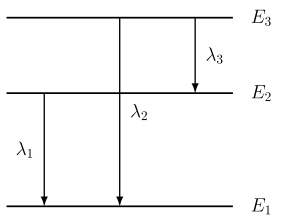 (A) λ1=λ2+λ3λ2λ3
(B) λ2=λ1+λ3
(C) λ2=λ1+λ3λ1λ3
(D) λ3=λ1+λ2λ1λ2
(A) λ1=λ2+λ3λ2λ3
(B) λ2=λ1+λ3
(C) λ2=λ1+λ3λ1λ3
(D) λ3=λ1+λ2λ1λ2›Reveal solutionSolution
Energy — not wavelength — is additive, so write E=hc/λ for each transition and add the two-step energies to get the one-step energy.
1. Read the transitions off the diagram
- λ1: E2→E1 ⇒ photon energy λ1hc=E2−E1
- λ2: E3→E1 ⇒ photon energy λ2hc=E3−E1
- λ3: E3→E2 ⇒ photon energy λ3hc=E3−E2
2. The energy identity
The level energies simply telescope:
(E3−E1)=(E3−E2)+(E2−E1)
This is the physical heart of the problem: whether the atom drops from E3 to E1 in one jump or via E2, the total energy released is the same (conservation of energy).
3. Convert to wavelengths
λ2hc=λ3hc+λ1hc
Cancel hc:
λ21=λ11+λ31=λ1λ3λ3+λ1
λ2=λ1+λ3λ1λ3
4. Why the other options fail …
- COMEDK 2023Set 2023-E1 markMCQQ.The ground state energy of hydrogen atom is −13.6 eV. If the electron jumps from the 3rd excited state to the ground state then the energy of the radiation emitted will be: (A) 1.275 MeV (B) 12.75 eV (C) 12.75 J (D) 12.75 MeV
›Reveal solutionSolution
The unit must be eV (a few eV is the atomic scale; MeV is a nuclear scale, and 12.75 J is absurdly large for one photon).
Concept: Bohr energy levels of hydrogen, E_n = -13.6/n^2 eV. The '3rd excited state' is n = 4 (ground n = 1, 1st excited n = 2, 2nd excited n = 3, 3rd excited n = 4).
E_4 = -13.6 / 16 = -0.85 eV
E_1 = -13.6 eV
Energy of the emitted photon:
E = E_4 - E_1 = -0.85 - (-13.6) = 12.75 eV. …
- COMEDK 2023Set 2023-M1 markMCQQ.The wavelength of the first line of Lyman series for H - atom is equal to that of the second line of Balmer series for a H-like ion. The atomic number Z of H-like ion is (A) 4 (B) 1 (C) 2 (D) 3
›Reveal solutionSolution
Equating the first Lyman line of H (3R/4) to the second Balmer line (n=4→2) of a hydrogen-like ion of charge Z gives 3R/4=3RZ2/16, so Z2=4, Z=2.
First line of Lyman series for H (n=2→1):
λ11=R(121−221)=43R.
Second line of Balmer series (n=4→2) for a H-like ion of atomic number Z: …
🎓Unlock everything free for 14 days
- ✓Full step-by-step solutions
- ✓Concept-first explanations
- ✓Methods, shortcuts & mistakes
- ✓PYQ mapping + timed mock tests
Full access for 14 days. No credit card required.