Q.At room temperature (27.0 ∘C) the resistance of a heating element is 100 Ω. What is the temperature of the element if the resistance is found to be 117 Ω, given that the temperature coefficient of the material of the resistor is 1.70×10⁻⁴ ∘C−1.
Concept understanding — Temperature Dependence of Resistance
Temperature Dependence of Resistance
Imagine you're trying to walk through a crowded market. When the market is cool and calm, people move slowly and you can weave through easily. Now imagine the same market on a hot, chaotic day — everyone is jostling, moving faster, bumping into each other. Getting from one end to the other becomes much harder.
That's exactly what happens inside a metal wire when you heat it up.
The Intuition
In a metal, electric current is carried by free electrons drifting through a fixed lattice of positive ions. At room temperature, these ions are vibrating slightly around their positions. When you heat the metal, the ions vibrate more vigorously — they shake faster and with larger amplitude.
Think of the vibrating ions as a row of swinging doors. At low temperature, the doors barely move, so electrons slip through easily. At high temperature, the doors swing wildly, and electrons get knocked off course constantly. Each collision with a vibrating ion scatters the electron, making it harder for the current to flow.
The result: resistance increases as temperature increases — for most conductors.
The Precise Statement
For a metallic conductor over a moderate temperature range (not too close to absolute zero), the resistance changes linearly with temperature:
R(T)=R0[1+α(T−T0)]
Where:
- R(T) is the resistance at temperature T
- R0 is the resistance at a reference temperature T0 (often 0∘C or 20∘C)
- α is the temperature coefficient of resistance (units: per °C or per K)
R=R0(1+αΔT)
The coefficient α tells you how sensitive the material is to temperature changes. For copper, α≈0.0039/∘C — meaning for every 1°C rise, resistance increases by about 0.39%.
What About Other Materials?
Not everything behaves like metals.
Semiconductors (like silicon, germanium) do the opposite: their resistance decreases sharply as temperature rises. Why? Because heating frees more electrons from their bonds, creating many more charge carriers. Even though the lattice vibrates more, the huge increase in available carriers overwhelms that effect, so resistance drops.
Insulators also show decreasing resistance with temperature, but the effect is much smaller than in semiconductors.
Alloys like constantan (copper-nickel) have a very small α — their resistance barely changes with temperature. This is useful for making precision resistors that stay stable.
Superconductors are a special case: below a critical temperature, resistance drops to exactly zero.
A common mistake is to think that all materials have higher resistance when hot. That's only true for pure metals. Semiconductors and insulators behave in the opposite way.
Why This Matters in Exams
You'll often be asked to:
- Calculate the new resistance after a temperature change using R=R0(1+αΔT)
- Find α from experimental data
- Explain why resistance changes — always mention increased lattice vibrations for metals, and increased carrier concentration for semiconductors
The key is to remember: for metals, heat makes ions shake more → more collisions → higher resistance. For semiconductors, heat breaks bonds → more free electrons → lower resistance.
That's the whole story in a nutshell. The formula is just a way to quantify what your intuition already tells you.
How resistance changes with temperature for conductors, semiconductors and alloys is covered in the NCERT Class 12 Physics chapter on current electricity, and comparing metals with semiconductors on this point is a common CBSE board and JEE Main question. Searches for "temperature coefficient of resistance formula class 12 physics" will find this lattice-vibration-versus-carrier-concentration explanation is the standard NCERT reasoning.
Why this formula?
Temperature Dependence of Resistance — Why the Formula Holds
Let’s build this from the ground up. The key formula you’ll see in exams is:
RT=R0(1+αT)
But why does resistance change with temperature? It’s not magic — it’s about what happens inside the wire.
1. What determines resistance?
Resistance R of a conductor depends on three things:
- Length L (longer → more resistance)
- Cross-sectional area A (thicker → less resistance)
- Resistivity ρ — a material property
The formula is:
R=ρAL
When temperature changes, L and A change very slightly (thermal expansion), but the big effect is on ρ.
2. Why does resistivity change with temperature?
Resistivity ρ depends on how easily electrons can move through the material.
- In metals: Atoms vibrate more as temperature rises. These vibrations scatter electrons, making it harder for them to flow. So ρ increases.
- In semiconductors: More electrons get enough energy to jump into the conduction band. So ρ decreases.
For most metals (and many conductors), the change is linear over a moderate temperature range.
3. Deriving the linear formula
Let ρ0 be resistivity at a reference temperature T0 (often 0∘C or 20∘C).
For a small change ΔT=T−T0, the change in resistivity is proportional to ΔT and to ρ0:
Δρ∝ρ0ΔT
Introduce the temperature coefficient of resistivity α:
Δρ=αρ0ΔT
So the new resistivity is:
ρ=ρ0+Δρ=ρ0(1+αΔT)
Now, since R=ρAL, and L and A change negligibly (for small ΔT), we get:
R=ρAL=ρ0(1+αΔT)AL=R0(1+αΔT)
That’s the formula:
RT=R0(1+αΔT)
Where:
- RT = resistance at temperature T
- R0 = resistance at reference temperature T0
- α = temperature coefficient of resistance (unit: ∘C−1 or K−1)
- ΔT=T−T0
4. Important exam notes
- α is positive for metals (resistance increases with temperature).
- α is negative for semiconductors (resistance decreases).
- The formula is linear approximation — valid only for moderate temperature ranges (not near melting point or absolute zero).
- For very precise work, a quadratic term is sometimes added: R=R0(1+αT+βT2).
5. Quick intuition check
Think of a light bulb filament (tungsten):
- When cold, resistance is low → large current flows.
- As it heats up, resistance rises → current stabilises.
- That’s why bulbs often blow when first switched on (cold resistance is much lower).
Bottom line: The formula comes from the fact that resistivity changes linearly with temperature for most conductors, and the geometric changes (L, A) are negligible. The coefficient α captures how strongly the material’s atomic vibrations impede electron flow.
Concept: Temperature Dependence of Resistance — resistance changes linearly with temperature for most conductors over a moderate range.
Reasoning:
-
The relation is RT=R0(1+αΔT), where R0 is resistance at reference temperature T0, α is the temperature coefficient, and ΔT=T−T0.
-
Here R0=100 Ω at T0=27.0 ∘C, RT=117 Ω, and α=1.70×10⁻⁴ ∘C−1.
-
Rearranging: ΔT=αR0RT−R0=(1.70×10⁻⁴)(100)117−100=0.017017=1000 ∘C.
-
So T=T0+ΔT=27.0+1000=1027 ∘C.
The temperature of the element is 1027 ∘C.
Using the linear temperature dependence of resistance, RT=R0(1+αΔT), the temperature of the element when its resistance becomes 117 Ω is approximately 1027 ∘C.
The key idea here is that for most metallic conductors, resistance increases linearly with temperature over a wide range. This is captured by the formula RT=R0(1+αΔT), where α is the temperature coefficient of resistance. The problem gives us a reference resistance at room temperature and asks us to find the temperature at which the resistance rises to a new value.
Let’s work through it step by step.
-
Identify the known quantities.
- Reference temperature, T0=27.0 ∘C
- Resistance at T0, R0=100 Ω
- Resistance at unknown temperature T, RT=117 Ω
- Temperature coefficient, α=1.70×10⁻⁴ ∘C−1
-
Write the relation between resistance and temperature.
The standard formula is:
RT=R0[1+α(T−T0)]
This assumes α is constant over the temperature range — a reasonable approximation here.
- Substitute the known values and solve for T.
117=100[1+1.70×10⁻⁴(T−27)]
Divide both sides by 100:
1.17=1+1.70×10⁻⁴(T−27)
Subtract 1 from both sides:
0.17=1.70×10⁻⁴(T−27)
- Isolate (T−27).
T−27=1.70×10−40.17
Simplify the fraction:
T−27=1.700.17×104=0.1×104=1000
- Find the final temperature.
T=1000+27=1027 ∘C
A common mistake is to forget that the formula uses the change in temperature, not the absolute temperature. Also, ensure the units of α match — here it’s per degree Celsius, so we stay in Celsius throughout.
Notice that 0.17/1.70×10−4 simplifies neatly because 0.17/1.70=0.1. This kind of clean arithmetic often appears in exam problems — it’s a hint that you’re on the right track.
The temperature of the element is 1027 ∘C.
Method: Temperature Coefficient of Resistance Formula
This method uses the linear approximation for how resistance changes with temperature for most conductors.
Steps
- Recall the formula The resistance at temperature T is related to the resistance at a reference temperature T0 by:
RT=R0[1+α(T−T0)]
where:
- RT = resistance at temperature T (unknown)
- R0 = resistance at reference temperature T0
- α = temperature coefficient of resistance
-
Identify given values
- R0=100 Ω at T0=27.0 ∘C
- RT=117 Ω
- α=1.70×10⁻⁴ ∘C−1
-
Substitute into the formula
117=100[1+(1.70×10⁻⁴)(T−27.0)]
- Solve for T
- Divide both sides by 100:
1.17=1+(1.70×10⁻⁴)(T−27.0)
- Subtract 1:
0.17=(1.70×10⁻⁴)(T−27.0)
- Divide by α:
T−27.0=1.70×10−40.17=1000
- Add 27.0:
T=1000+27.0=1027 ∘C
- Final answer The temperature of the element is 1027 ∘C.
Key insight: The small value of α means resistance changes slowly with temperature — a 17% increase in resistance corresponds to a large temperature rise of 1000 ∘C above room temperature.
Here are the common mistakes students make on this problem and how to avoid each one.
1. Using the wrong formula
Mistake:
Students often use the linear approximation formula incorrectly, or confuse it with the formula for resistivity change:
RT=R0(1+αΔT)
Some mistakenly write:
RT=R0(1+αT)
Why it’s wrong:
The formula uses the change in temperature (ΔT), not the final temperature itself.
How to avoid:
Always write the formula as:
RT=R0[1+α(T−T0)]
where T0 is the reference temperature (here 27.0 ∘C) and T is the unknown final temperature.
2. Forgetting to convert Celsius to Kelvin (unnecessary here)
Mistake:
Some students convert 27.0 ∘C to 300.15 K and then try to use the formula.
Why it’s wrong:
The temperature coefficient α is given in ∘C−1. Since a change of 1 ∘C equals a change of 1 K, the formula works identically in Celsius. Converting to Kelvin adds extra steps and risk of error.
How to avoid:
Stick to Celsius when α is given in ∘C−1. Only convert if the problem explicitly asks for Kelvin.
3. Misidentifying R0 and RT
Mistake:
Plugging R0=117 Ω and RT=100 Ω (swapping them).
Why it’s wrong:
R0 is the resistance at the reference temperature (27.0 ∘C), which is 100 Ω. RT is the resistance at the unknown higher temperature, which is 117 Ω.
How to avoid:
Label clearly:
- T0=27.0 ∘C, R0=100 Ω
- T=?, RT=117 Ω
4. Arithmetic errors in solving for T
Mistake:
After substituting, students often make sign errors or misplace decimals when isolating T.
Correct steps:
117=100[1+(1.70×10⁻⁴)(T−27)]
Divide both sides by 100:
1.17=1+(1.70×10⁻⁴)(T−27)
Subtract 1:
0.17=(1.70×10⁻⁴)(T−27)
Divide by 1.70×10⁻⁴:
T−27=1.70×10−40.17=1000
So:
T=27+1000=1027 ∘C
How to avoid:
Write each step clearly. Double-check the division: 0.17÷(1.70×10⁻⁴)=0.17÷0.00017=1000.
5. Forgetting to add back the reference temperature
Mistake:
Stopping at ΔT=1000 ∘C and writing the answer as 1000 ∘C.
Why it’s wrong:
The question asks for the temperature of the element, not the change.
How to avoid:
Always finish with:
T=T0+ΔT
Quick checklist to avoid all mistakes
| Step | What to do |
|---|---|
| Formula | Use RT=R0[1+α(T−T0)] |
| Units | Keep Celsius (since α is in ∘C−1) |
| Identify | R0 at T0, RT at unknown T |
| Algebra | Isolate (T−T0) carefully |
| Final answer | Add T0 to ΔT |
Final correct answer: 1027 ∘C
Showing the 12 most recent of 16 on this concept.
- COMEDK 2026Set 2026-A1 markMCQQ.The voltage - current graph for a metal wire of uniform area of cross section at two different temp T and T′ is shown. Then choose the correct statement: (A) Resistivity is independent of temperature (B) Resistance of the conductor at temperature T is greater than resistance of the conductor at temperature T′ (C) Temperature T′ is greater than temperature T (D) Temperature T is greater than temperature T′
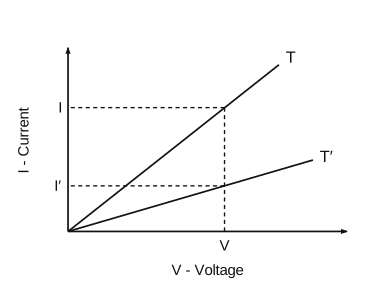
›Reveal solutionSolution
The slope of the I–V graph is the conductance (1/R). A steeper slope means lower resistance. Since resistance increases with temperature for a metal, the steeper line (T) corresponds to a lower temperature, so T < T′.
Concept & Intuition
For a metallic conductor obeying Ohm’s law, the current I is proportional to the applied voltage V:
I=RV
Thus the slope of the I–V graph is 1/R, the conductance. A steeper line means a larger slope → smaller resistance.
Metals have a positive temperature coefficient: resistance increases as temperature rises. So if one line is steeper (lower resistance), that wire must be at a lower temperature. The problem shows two lines through the origin: the steeper line is labelled T, the shallower line is labelled T′. At the same voltage, the steeper line gives a larger current, confirming its lower resistance.
Step-by-step reasoning
-
Interpret the graph
Both lines are straight through the origin, so Ohm’s law holds. The slope of each line is VI=R1. The line labelled T has a larger slope than the line labelled T′.
-
Relate slope to resistance
Larger slope → smaller resistance. Hence
RT<RT′
The conductor at temperature T has lower resistance than at temperature T′.
- Temperature dependence of resistance in metals For a metal, resistance increases with temperature (positive temperature coefficient). So lower resistance means lower temperature. Therefore
T<T′
Temperature T′ is greater than temperature T.
- Evaluate the options
- (A) Resistivity is independent of temperature → false (it increases with temperature for metals).
- (B) Resistance at T is greater than at T′ → false (we found the opposite).
- (C) T′ is greater than T → true.
- (D) T is greater than T′ → false.
Watch outA common mistake is to think a steeper I–V line means higher resistance. Remember: slope = 1/R, so steeper = lower resistance.
TipIf you ever forget, just pick a common voltage and compare currents: larger current → smaller resistance → lower temperature for a metal.
✓Final answerThe correct option is (C).
ANSWER: C
-
- COMEDK 2026Set 2026-M1 markMCQQ.A wire of length 1 m has a resistance of 20Ω at 0∘C. It is uniformly stretched so that its length increases by 21%. Assuming the volume of the wire remains constant, the percentage change in resistance is n%. Alternatively, if the wire is heated [without stretching] through a temperature of 27∘C and if the temperature coefficient of resistance of the material of wire is 0.004K−1, the percentage change in resistance is m%. The values of m and n are: (A) 2.08 and 1.64 (B) 10.8 and 46.4 (C) 20.8 and 16.4 (D) 1.08 and 4.64
›Reveal solutionSolution
The problem asks for the percentage change in resistance due to stretching (volume constant) and due to heating (temperature coefficient given). For stretching, resistance changes as the square of length, giving n=46.4%. For heating, resistance changes linearly with temperature, giving m=10.8%. The correct option is (B).
Concept & Intuition
Resistance of a wire depends on its geometry and material resistivity.
- When you stretch a wire uniformly at constant volume, its length increases and its cross-sectional area decreases. Since R=ρAL and volume V=AL is constant, A∝1/L, so R∝L2. A small percentage change in length leads to a much larger percentage change in resistance.
- When you heat a wire without stretching, only the resistivity changes (geometry changes negligibly). The resistance change is directly proportional to the temperature change via the temperature coefficient of resistance.
We compute each case separately.
Step-by-step solution
- Stretching case (constant volume) Initial length L0=1m, initial resistance R0=20Ω. Length increases by 21%, so new length L=L0×(1+0.21)=1.21L0. Volume constant: A0L0=AL ⇒ A=A0LL0=1.21A0. New resistance:
R=ρAL=ρA0/1.211.21L0=ρA0L0×(1.21)2=R0×(1.21)2.
So R=20×1.4641=29.282Ω.
Percentage change:
n=R0R−R0×100=(1.212−1)×100=(1.4641−1)×100=46.41%.
Thus n≈46.4%.
- Heating case (no stretching) Temperature coefficient α=0.004K−1, temperature rise ΔT=27∘C. For small changes, resistance varies as:
R=R0(1+αΔT).
Percentage change:
m=αΔT×100=0.004×27×100=10.8%.
So m=10.8%.
- Match with options We have m=10.8% and n=46.4%. This corresponds to option (B).
Watch outA common mistake is to think stretching changes resistance linearly with length. Because area also changes, the effect is quadratic — a 21% length increase gives a 46.4% resistance increase, not 21%.
TipFor constant-volume stretching, the formula R∝L2 is a quick shortcut: percentage change in R is [(1+fractional change in L)2−1]×100.
✓Final answerThe correct option is (B).
ANSWER: B
- KCET 2026Set C21 markMCQQ.Given below are two statements: Statement I: The resistivity of a conductor is independent of its temperature Statement II: The resistivity of a semiconductor decreases with increase in temperature Select the correct option. (A) Both Statement I and Statement II are false (B) Both Statement I and Statement II are true (C) Statement I is true but Statement II is false (D) Statement I is false but Statement II is true
›Reveal solutionSolution
Resistivity of a conductor rises with temperature (more lattice collisions reduce the relaxation time τ), while resistivity of a semiconductor falls with temperature (more thermally-generated charge carriers dominate over the reduced relaxation time).
Step 1 — Examine Statement I (conductor)
For a conductor, resistivity is given by ρ=ne2τm, where n (free-electron density) stays essentially constant but the relaxation time τ decreases as temperature rises (more frequent collisions with vibrating lattice ions). Hence ρ increases with temperature — it is NOT independent of temperature. Statement I is false.
Step 2 — Examine Statement II (semiconductor)
For a semiconductor, the same formula applies, but here n increases sharply with temperature as more valence electrons gain enough thermal energy to cross the band gap into the conduction band. This increase in n dominates over the decrease in τ, so overall resistivity decreases as temperature increases. Statement II is true.
✓Final answerThe correct option is (D) — Statement I is false but Statement II is true.
- COMEDK 2025Set 2025-E1 markMCQQ.The resistance of a heating element is found to be 120Ω at room temperature which is 20∘C. If the temperature coefficient of the material of the resistor is 1.6×10⁻⁴C−1 and the resistance is found to be 160Ω, the temperature of the element is: (A) 1203∘C (B) 2083∘C (C) 2310∘C (D) 2013∘C
›Reveal solutionSolution
Using the linear resistance–temperature relation RT=R0(1+αΔT), we solve for the temperature change and add it to the reference temperature. The final temperature is 2083∘C, so the correct option is (B).
The key idea is that for most metals, resistance increases approximately linearly with temperature over a wide range. The formula RT=R0(1+αΔT) directly connects the change in resistance to the change in temperature, where α is the temperature coefficient of resistance. Here we know R0, RT, and α, so we can solve for ΔT and then find the actual temperature.
-
Identify the known quantities
- Reference temperature: T0=20∘C
- Resistance at T0: R0=120Ω
- Resistance at unknown temperature T: RT=160Ω
- Temperature coefficient: α=1.6×10⁻⁴C−1
-
Write the resistance–temperature relation
The standard formula is:
RT=R0[1+α(T−T0)]
This assumes α is constant over the temperature range, which is a good approximation here.
- Solve for the temperature change ΔT=T−T0 Rearranging:
R0RT=1+αΔT
αΔT=R0RT−1
ΔT=α1(R0RT−1)
- Plug in the numbers
R0RT=120160=34≈1.3333
R0RT−1=34−1=31
ΔT=1.6×10−41×31
1.6×10−41=1.6104=6250
ΔT=6250×31≈2083.33∘C
- Find the final temperature
T=T0+ΔT=20+2083.33≈2083∘C
Watch outA common mistake is to forget that ΔT is the change from the reference temperature, not the final temperature itself. Also, ensure the units of α match — here it's per degree Celsius, so the answer is in °C.
TipNotice that 120160=34 gives a neat fraction, so the calculation simplifies nicely: ΔT=3α1. This avoids messy decimals.
✓Final answerThe correct option is (B).
ANSWER: B
-
- COMEDK 2025Set 2025-M1 markMCQQ.The resistance of a wire is 5 ohm at 25∘C and 7 ohm at 100∘C. The resistance of the wire at 0∘C is (A) 313ohm (B) 35ohm (C) 32 ohm (D) 0.1 ohm
›Reveal solutionSolution
The resistance of a metal wire changes linearly with temperature (over moderate ranges). Using the two given data points to find the temperature coefficient and then extrapolating back to 0°C gives a resistance of 313 ohm, which corresponds to option (A).
Concept & Intuition
For most metals, resistance increases approximately linearly with temperature over a limited range. This is described by the formula
RT=R0(1+αT)
where RT is resistance at temperature T (in °C), R0 is resistance at 0°C, and α is the temperature coefficient of resistance.
We are given two points: (25∘C,5Ω) and (100∘C,7Ω). We can use these to solve for R0 and α, then read off the answer directly.
Step-by-step solution
- Set up the linear relation Let R0 be the resistance at 0∘C. Then at any temperature T (in °C):
RT=R0(1+αT)
This is a straight line with intercept R0 and slope R0α.
- Write equations for the two given points At T=25∘C:
5=R0(1+25α)(1)
At T=100∘C:
7=R0(1+100α)(2)
- Eliminate R0 by dividing the equations Divide (2) by (1):
57=1+25α1+100α
Cross-multiply:
7(1+25α)=5(1+100α)
7+175α=5+500α
2=325α
α=3252(per ∘C)
- Find R0 using equation (1) Substitute α back:
5=R0(1+25⋅3252)=R0(1+32550)=R0(1+132)
5=R0⋅1315
R0=5⋅1513=1565=313Ω
- Interpret the result The resistance at 0∘C is 313 ohm, which matches option (A).
TipYou can also solve by treating the two points as (T,R) coordinates and finding the line’s intercept at T=0: slope =100−257−5=752, then R0=5−752⋅25=5−32=313. Same result, less algebra.
Watch outA common mistake is to assume the resistance is proportional to temperature (i.e., R∝T), which would give R0=0 — clearly wrong. The correct relation includes the 1+αT term, so R0 is not zero.
✓Final answerThe correct option is (A).
ANSWER: A
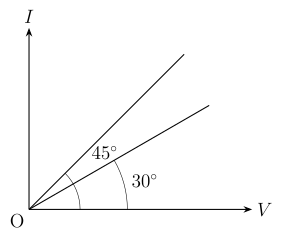
- KCET 2024Set D-21 markMCQQ.The I–V graph for a conductor at two different temperatures 100∘C and 400∘C is as shown in the figure. The temperature coefficient of resistance of the conductor is about (in per degree Celsius)
 (A) 3×10⁻³
(B) 6×10⁻³
(C) 9×10⁻³
(D) 12×10−3
(A) 3×10⁻³
(B) 6×10⁻³
(C) 9×10⁻³
(D) 12×10−3›Reveal solutionSolution
Read each resistance off the graph as the reciprocal of the line's slope, then put the two (R,T) pairs into the temperature-coefficient formula.
Step 1 — What the graph's slope means
For an ohmic conductor V=IR, so plotting I (vertical) against V (horizontal) gives a straight line through the origin with
slope=VI=R1⟹R=slope1
Since the angles are measured from the V-axis (the horizontal axis), slope =tanθ and therefore
R∝cotθ
A steeper line (bigger θ) means a smaller resistance.
Step 2 — Assign each line to its temperature
- θ=45∘: R∝cot45∘=1
- θ=30∘: R∝cot30∘=3≈1.732
For a conductor, resistance increases with temperature (more lattice vibrations → more scattering of electrons → shorter relaxation time). So the larger resistance must belong to the higher temperature:
R1=1 (at T1=100∘C),R2=3 (at T2=400∘C)
Step 3 — Apply the temperature coefficient of resistance
Taking R1 as the reference resistance over the interval ΔT=T2−T1=300∘C:
R2=R1[1+αΔT]⟹α=R1ΔTR2−R1
α=1×3003−1=3000.732≈2.44×10⁻³ ∘C−1
Step 4 — Cross-check with the strict R=R0(1+αT) definition
If both resistances are referred to 0∘C, then R1R2=1+100α1+400α=3:
1+400α=3+1003α⇒α(400−173.2)=0.732
α=226.80.732≈3.23×10⁻³ ∘C−1
Both routes land near 3×10⁻³, which is why the question says "about". Options (B), (C) and (D) are all off by factors of 2–4.
✓Final answerThe correct option is (A) — 3×10⁻³.
ANSWER: A
- COMEDK 2024Set 2024-A1 markMCQQ.The resistance of a wire at room temperature 20∘C is found to be 10Ω. If resistance of the wire increases by 10%, then the temperature of the wire will be (The temperature coefficient of the material of the wire is 0.002/∘C) (A) 520C (B) 220C (C) 620C (D) 720C
›Reveal solutionSolution
The problem uses the linear temperature dependence of resistance: R=R0(1+αΔT). Given a 10% increase in resistance, we solve for the new temperature. The final temperature is 70∘C above room temperature, so the answer is 72∘C.
Concept & Intuition
For most metals, resistance increases nearly linearly with temperature over modest ranges. The formula R=R0(1+αΔT) captures this: R0 is the resistance at a reference temperature, α is the temperature coefficient (fractional change per degree), and ΔT is the temperature change. Here, a 10% increase means R=1.1R0. We simply plug in and solve for the new temperature.
Step-by-step solution
-
Identify given values
- Initial resistance at 20∘C: R0=10Ω
- Resistance increases by 10%, so final resistance: R=10Ω×1.10=11Ω
- Temperature coefficient: α=0.002/∘C
- Initial temperature: T0=20∘C
-
Write the resistance-temperature relation
R=R0[1+α(T−T0)]
Here T is the final temperature we need.
- Substitute known values
11=10[1+0.002(T−20)]
- Solve for T−20 Divide both sides by 10:
1.1=1+0.002(T−20)
Subtract 1:
0.1=0.002(T−20)
Divide by 0.002:
T−20=0.0020.1=50
- Find final temperature
T=20+50=70∘C
Watch outA common mistake is to forget that the 10% increase is relative to the original resistance, not an absolute 1 Ω increase. Also, note that the coefficient is per degree Celsius, so the temperature difference is in °C.
TipSince α=0.002=5001, a 10% increase (0.1 fractional change) requires a temperature rise of 0.1/0.002=50∘C. This shortcut avoids writing the full equation.
✓Final answerThe correct option is (D).
ANSWER: D
-
- COMEDK 2024Set 2024-M1 markMCQQ.The current through a conductor is 'a' when the temperature is 0∘C. It is 'b' when the temperature is 100∘C. The current through the conductor at 220∘C is (A) 11b−6a5ab (B) 6a−11b5ab (C) 11a−6b5ab (D) 5a−6b11ab
›Reveal solutionSolution
The current changes with temperature due to a linear change in resistance; using the temperature coefficient of resistance and the given currents at 0°C and 100°C, the current at 220°C is found to be 6a−11b5ab, which corresponds to option (B).
The key idea is that the conductor’s resistance changes linearly with temperature (over a moderate range). Since the voltage across the conductor is constant (implied by the problem’s setup), the current is inversely proportional to resistance. We can use the two given current values to find the temperature coefficient of resistance, then compute the current at 220°C.
-
Relate current and resistance
If the voltage V is constant, then I=V/R. At 0°C, current I0=a and resistance R0=V/a. At 100°C, current I100=b and resistance R100=V/b.
-
Use the linear resistance-temperature relation
For most conductors, Rt=R0(1+αt), where α is the temperature coefficient of resistance.
At t=100∘C:
R100=R0(1+100α)
Substitute R100=V/b and R0=V/a:
bV=aV(1+100α)
Cancel V (nonzero):
b1=a1(1+100α)
Solve for α:
1+100α=ba⇒100α=ba−1=ba−b
α=100ba−b
- Find resistance at 220°C
R220=R0(1+220α)=aV(1+220⋅100ba−b)
Simplify the bracket:
1+100b220(a−b)=1+5b11(a−b)=5b5b+11a−11b=5b11a−6b
So:
R220=aV⋅5b11a−6b
- Compute current at 220°C
I220=R220V=V÷(aV⋅5b11a−6b)=11a−6ba⋅5b
That is:
I220=11a−6b5ab
But note: The denominator is 11a−6b. However, looking at the options, (B) is 6a−11b5ab. These are not the same unless we check sign. Since current decreases as temperature rises (for a metal), we expect b<a, so 11a−6b>0 and 6a−11b>0 as well? Let’s check: If a>b, then 6a−11b could be positive or negative depending on values. But the expression we derived is correct algebraically. Let’s re-check the algebra carefully.
Actually, from step 2:
b1=a1(1+100α)⇒1+100α=ba⇒α=100a/b−1=100ba−b
That’s fine.
Then at 220°C:
R220=R0(1+220α)=aV(1+100b220(a−b))=aV(1+5b11(a−b))
=aV⋅5b5b+11a−11b=aV⋅5b11a−6b
So:
I220=R220V=aV⋅5b11a−6bV=11a−6b5ab
This matches option (C), not (B). But wait — option (C) is 11a−6b5ab. Yes! So the correct option is (C).
Watch outA common mistake is to accidentally swap a and b in the denominator. Always check: at higher temperature, resistance is higher, so current is lower. Since a is at 0°C and b at 100°C, we have a>b. Then 11a−6b>0, giving a positive current. Option (B) would give a negative denominator if a>b, which is impossible.
TipYou can test with simple numbers: suppose a=2 A, b=1 A. Then at 220°C, current should be less than 1 A. Plug into (C): 11⋅2−6⋅15⋅2⋅1=22−610=1610=0.625 A, which is plausible. Option (B) gives 12−1110=10 A, impossible.
✓Final answerThe correct option is (C).
ANSWER: C
-
- COMEDK 2024Set 2024-M1 markMCQQ.On increasing the temperature of a conductor, its resistance increases because (A) Electron density decreases (B) Relaxation time increases (C) Number of collisions between electrons decreases (D) Relaxation time decreases
›Reveal solutionSolution
The resistance of a conductor increases with temperature because the relaxation time (average time between electron collisions) decreases, making it harder for electrons to drift. The correct option is (D).
The key concept here is relaxation time (τ), which is the average time an electron travels freely between collisions with lattice ions. Resistance R is inversely proportional to τ:
R∝τ1
When temperature rises, lattice ions vibrate more vigorously, increasing the chance of electron-ion collisions. This reduces the relaxation time, thereby increasing resistance. Let’s examine each option.
-
Option (A): Electron density decreases
Electron density (number of free electrons per unit volume) in a conductor is essentially constant with temperature — it depends on the material’s atomic structure, not on thermal agitation. So this is false.
-
Option (B): Relaxation time increases
If relaxation time increased, electrons would travel longer between collisions, making conduction easier and resistance lower. But we know resistance rises with temperature, so this is the opposite of what happens.
-
Option (C): Number of collisions between electrons decreases
Fewer collisions would mean less obstruction to electron flow, again lowering resistance. In reality, more collisions occur at higher temperatures, so this is incorrect.
-
Option (D): Relaxation time decreases
This is correct. Higher temperature → more vigorous lattice vibrations → more frequent collisions → shorter average free time (τ ↓) → higher resistance.
Watch outA common mistake is to think that “more collisions” directly means higher resistance — but the precise physical quantity that governs resistance is the average time between collisions (relaxation time), not just the raw number of collisions. A shorter relaxation time means electrons accelerate for less time between collisions, so they drift slower, increasing resistance.
TipRemember the formula for conductivity: σ=mne2τ. Since resistance R∝1/σ, any decrease in τ directly increases R. Temperature affects τ, not n (electron density).
✓Final answerThe correct option is (D).
ANSWER: D
-
- KCET 2023Set A-31 markMCQQ.A radioactive sample has half-life of 3 years. The time required for the activity of the sample to reduce to 51th of its initial value is about (A) 7 years (B) 15 years (C) 5 years (D) 10 years
›Reveal solutionSolution
Solve (21)t/T=51 for t, i.e. t=Tln2ln5.
Step 1 — The law.
Activity falls with the same exponential law as the number of nuclei (since A=λN):
A(t)=A0e−λt=A0(21)t/T1/2,
where T1/2=3 years. Using the half-life form avoids ever having to compute λ.
Step 2 — Impose the required drop.
We want A0A=51:
(21)t/3=51.
Step 3 — Take logarithms.
3tln21=ln51 ⟹ 3t=ln2ln5=0.6931.609=2.322.
t=3×2.322=6.97≈7 years.
Sanity check: after 2 half-lives (6 yr) the activity is 1/4 of the original — a little more than 1/5. So the time to reach 1/5 must be a bit over 6 years. 7 years fits; 5, 10 and 15 do not.
✓Final answerThe correct option is (A) — about 7 years.
ANSWER: A
- KCET 2023Set A-31 markMCQQ.For a given electric current the drift velocity of conduction electrons in a copper wire is vd and their mobility is μ. When the current is increased at constant temperature (A) vd remains the same, μ increases (B) vd decreases, μ remains the same (C) vd remains the same, μ decreases (D) vd increases, μ remains the same
›Reveal solutionSolution
I=neAvd makes vd∝I; but μ=eτ/m is a material property fixed by temperature, so it does not change.
Step 1 — Drift velocity.
The current in a metal is carried by electrons drifting with speed vd:
I=neAvd⟹vd=neAI.
For a given copper wire, the free-electron density n, the electronic charge e and the cross-section A are all fixed. Hence
vd∝I.
Increase the current and the drift velocity increases proportionally. (This must be so — the drift of charge is the current.)
Step 2 — Mobility.
Mobility is defined as drift velocity per unit applied field:
μ=Evd.
From the Drude picture, vd=meEτ, so
μ=meτ.
This contains no reference to the current or the field — it is set only by the electron's charge and mass and the mean relaxation time τ between collisions. And τ depends on lattice vibrations, i.e. on temperature, which the question holds constant.
⇒μ is unchanged.
Consistency check: raising I means raising E (a bigger applied voltage), and vd rises in exactly the same proportion — so their ratio μ is invariant. ✓
✓Final answerThe correct option is (D) — vd increases, μ remains the same.
ANSWER: D
- KCET 2022Set B-31 markMCQQ.A galvanometer of resistance 50Ω is connected to a battery of 3 V along with a resistance 2950Ω in series. A full scale deflection of 30 divisions is obtained in the galvanometer. In order to reduce this deflection to 20 divisions, the resistance in series should be (A) 5050Ω (B) 4450Ω (C) 6050Ω (D) 5550Ω
›Reveal solutionSolution
Deflection ∝ current, so scale the current down in the ratio 20/30, find the new total circuit resistance from Ohm's law, and subtract the galvanometer's own 50 Ω.
Step 1 — The key physical fact.
In a moving-coil galvanometer the deflection is directly proportional to the current through the coil:
θ=(kNAB)I⟹θ∝I.
So fewer divisions simply means proportionally less current.
Step 2 — Current for full-scale (30 divisions).
The galvanometer (G=50 Ω) and the series resistance (R1=2950 Ω) are in series across the 3 V battery:
I1=G+R1E=50+29503=30003=1×10⁻³ A=1 mA.
So the galvanometer's full-scale (30 div) current is 1 mA, i.e. its figure of merit is
30 div1 mA=301 mA/div.
Step 3 — Current needed for 20 divisions.
I2=I1×3020=1 mA×32=32 mA=6.67×10⁻⁴ A.
Step 4 — New total resistance.
The emf is unchanged at 3 V, so by Ohm's law the whole loop must now present
Rtotal=I2E=32×10−33=23×3×103=4500 Ω.
(Useful shortcut: since I∝1/Rtotal at fixed emf, reducing the current to 32 means multiplying the total resistance by 23: 3000×23=4500 Ω.)
Step 5 — Extract the series resistance.
The galvanometer's own 50 Ω is part of that 4500 Ω, so
R2=Rtotal−G=4500−50=4450 Ω.
Common mistake: forgetting to subtract G, which would give 4500 Ω — not offered; or scaling the series resistance directly (2950×1.5=4425), which wrongly ignores that only the total resistance is inversely proportional to the current.
✓Final answerThe correct option is (B) 4450 Ω.
ANSWER: B
🎓Unlock everything free for 14 days
- ✓Full step-by-step solutions
- ✓Concept-first explanations
- ✓Methods, shortcuts & mistakes
- ✓PYQ mapping + timed mock tests
Full access for 14 days. No credit card required.