Q.Figure 8.5 shows a capacitor made of two circular plates each of radius , and separated by . The capacitor is being charged by an external source (not shown in the figure). The charging current is constant and equal to .
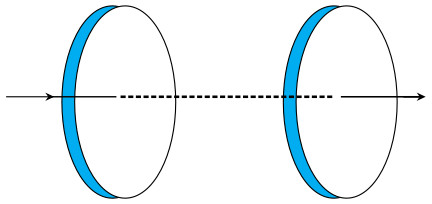
The key idea is that a charging capacitor has a displacement current between its plates, which equals the conduction current in the wires. For part (a), we use and . For part (b), . For part (c), Kirchhoff's junction rule holds because displacement current completes the circuit.
Let's understand what's happening physically before we touch a single formula. A capacitor being charged doesn't have charges flowing through the gap — that would be a short circuit. Instead, the electric field between the plates builds up as charge accumulates. Maxwell realised that a changing electric field itself acts like a current — he called it displacement current — and it's this that "completes" the circuit across the capacitor gap. This is the central insight of electromagnetic waves.
(a) Capacitance and rate of change of potential difference
1. Find the capacitance.
The plates are circular, radius , so area
Separation . For a parallel-plate capacitor with vacuum (or air) between plates,
Using :
2. Relate charging current to voltage change.
The charging current is constant. For a capacitor,
This is just the definition of capacitance: , and . So
That's volts per second — an enormous rate. This is fine mathematically, but in practice such a capacitor would break down almost instantly. The problem is idealised to illustrate the concept.
(b) Displacement current across the plates
3. Define displacement current.
Between the plates, there's no conduction current (no moving charges), but the electric flux through any surface between the plates changes as the field builds up. Maxwell defined
4. Compute the electric flux and its rate of change.
For a parallel-plate capacitor, the electric field between the plates is uniform (ignoring fringing):
The flux through a surface of area parallel to the plates is
Therefore,
Substituting into the displacement current formula:
The displacement current exactly equals the conduction current in the wire. This is not a coincidence — it's required by the conservation of charge. The displacement current is the "bridge" that makes the total current continuous across the capacitor.
(c) Validity of Kirchhoff's first rule
5. What Kirchhoff's junction rule says.
The rule states that the sum of currents entering a junction equals the sum leaving it. At a capacitor plate, conduction current arrives via the wire, but no conduction current leaves through the dielectric.
6. The resolution.
If we consider only conduction current, the rule appears to fail — current goes in but doesn't come out. However, if we include displacement current as part of the total current, then at the left plate: conduction current enters, and displacement current leaves (into the gap). At the right plate: displacement current enters from the gap, and conduction current leaves. In both cases, the sum is zero.
Kirchhoff's junction rule is valid if and only if we treat displacement current as a real current for the purpose of current continuity. This is exactly what Maxwell's correction to Ampère's law achieves.
So the answer is yes — the rule holds, but only when displacement current is accounted for.
- , ;
- ;
- Yes, Kirchhoff's junction rule is valid at each plate because the displacement current across the gap completes the circuit, making the total current continuous.
Unlock everything free for 14 days
- Full step-by-step solutions
- Concept-first explanations
- Methods, shortcuts & mistakes
- PYQ mapping + timed mock tests
Full access for 14 days. No credit card required.