Botany · Ch 6 — Cell Cycle and Cell Division
Metaphase
Metaphase
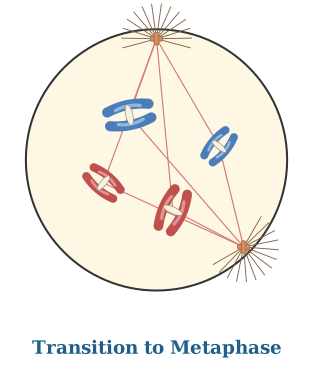
Metaphase is the second phase of mitosis, and its onset is marked by the complete disintegration of the nuclear envelope. Once the nuclear envelope breaks down, the chromosomes are freed and become spread out through the cytoplasm of the cell.
By this stage the condensation of the chromosomes is complete, so they can be seen very clearly under the microscope. For this reason, metaphase is the stage at which the morphology of chromosomes is most easily studied — their shape and structure are at their most distinct.
At metaphase, each chromosome is made up of two sister chromatids held together by the centromere. On the surface of the centromeres are small disc-shaped structures called kinetochores. These kinetochores act as the points of attachment where the spindle fibres bind to the chromosomes, allowing the chromosomes to be moved into position at the centre of the cell.
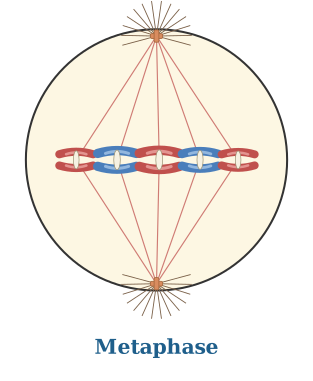
As a result, metaphase is characterised by all the chromosomes coming to lie at the equator of the cell. One chromatid of each chromosome is linked, through its kinetochore, to spindle fibres coming from one pole, while its sister chromatid is linked, through its own kinetochore, to spindle fibres from the opposite pole. The plane along which the chromosomes line up at this stage is called the metaphase plate. …
Drawn by us to help you understand the concept clearly, and verified to make sure it's accurate. For exams, practice from your textbook's own diagram.
Once the nuclear envelope has completely disintegrated, the chromosomes are freed into the cytoplasm. In this transition to metaphase the fully condensed chromosomes (each a pair of sister chromatids joined at the centromere, marked by the white oval) are still scattered, while spindle fibres (red) growing from the two poles reach out and attach to their c …
Drawn by us to help you understand the concept clearly, and verified to make sure it's accurate. For exams, practice from your textbook's own diagram.
At metaphase all the chromosomes have been moved to lie at the equator of the cell, forming the metaphase plate. Each chromosome's two sister chromatids are connected, through their centromeres (kinetochores), to spindle fibres from opposite poles — so one chromatid of each chromosome faces each pole. This is the sta …