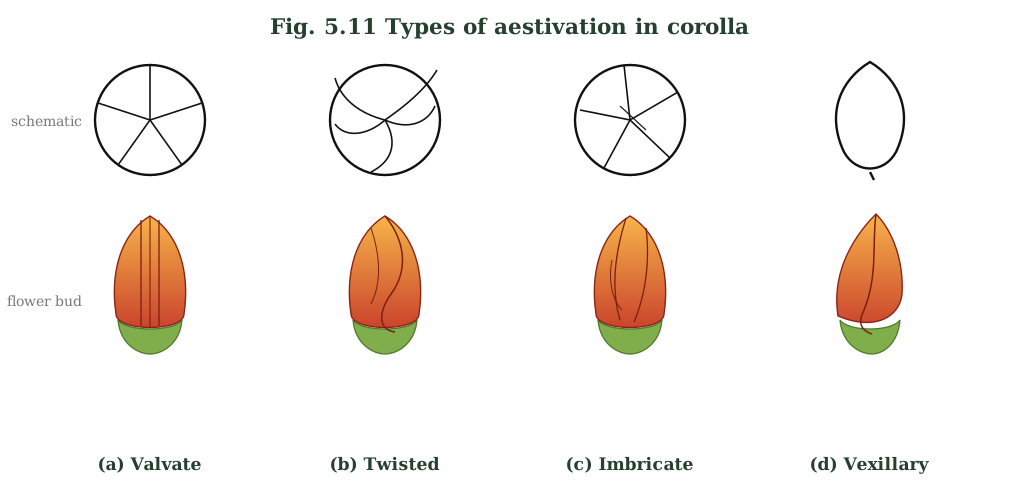
Aestivation: The Sleeping Arrangement of a Flower Bud
Think of a flower bud as a tightly packed suitcase. Before the flower opens, all its parts — sepals and petals — are folded together in a specific, repeatable pattern. That pattern is aestivation. It's simply the way the sepals or petals are arranged in the bud, relative to each other.
Why does this matter? Because the pattern is often constant within a plant family. If you can identify the aestivation, you've taken a big step toward naming the plant. It's a classification tool, not just a curiosity.
The Four Main Types
There are exactly four types you need to know for exams. Each describes how the edges of the sepals or petals meet (or don't meet) in the bud.
Aestivation types: Valvate, Twisted, Imbricate, Vexillary
1. Valvate — Just Touching
Imagine placing your palms together, fingers pointing up, with the edges of your hands just touching — no overlap. That's valvate aestivation. The sepals or petals meet edge-to-edge without one overlapping another.
This is the simplest arrangement. You'll see it in calyx (sepals) of many plants, like in the mustard family (Brassicaceae). The sepals are separate and simply touch at their margins.
Valvate is the "no overlap" type. If you see petals or sepals that just meet at the edges, it's valvate.
2. Twisted — One Edge Overlaps the Next
Now interlock your fingers loosely, so that each finger lies on top of the next one in a continuous spiral. That's twisted aestivation. Each petal or sepal has one edge overlapping the next petal, and the other edge is overlapped by the previous one.
It's a regular, one-directional spiral. You'll find this in China rose (Hibiscus rosa-sinensis) and cotton (Malvaceae family). Look at a hibiscus bud — the petals are twisted like a screw.
To remember: Twisted = one edge overlaps, the other is overlapped. Every petal is both "on top" and "underneath" its neighbours.
3. Imbricate — Irregular Overlap
This is the "messy" one — but it has a rule. In imbricate aestivation, the petals overlap irregularly. One petal is completely outside (overlaps both neighbours), one is completely inside (is overlapped by both neighbours), and the remaining petals have one edge out and one edge in.
Think of a hand of playing cards where one card is fully on top, one is fully at the bottom, and the rest are shuffled in between. You'll see this in Cassia (a common ornamental tree) and many members of the Fabaceae family.
Don't confuse imbricate with twisted. In twisted, every petal has the same relationship (one edge out, one in). In imbricate, the relationships are unequal — one petal is fully outside, one fully inside.
4. Vexillary — The Butterfly's Flag
This is a special case of imbricate, found only in the subfamily Papilionoideae of the Fabaceae (pea family). It has a very specific arrangement of five petals:
- The largest petal (the standard or vexillum) is outermost, covering the others.
- Two wing petals are next, each overlapping the innermost pair.
- Two keel petals are innermost, joined together, and are overlapped by the wings.
Imagine a butterfly with its wings spread — the large top petal is the "flag," the side petals are the "wings," and the bottom joined petals are the "keel" (the boat-shaped part). This is the classic flower of pea, gram, and bean.
Vexillary is always descending imbricate — the largest petal (standard) is outermost, and the smallest (keel) is innermost. This is the defining aestivation of the pea family.
Quick Comparison Table
| Type | Overlap Pattern | Example |
|---|
| Valvate | No overlap, edges just touch | Mustard (sepals) |