Q.Given below is the schematic representation of tricarboxylic acid cycle in respiration.
🔒You're viewing a preview — the full solution, concept, methods & PYQ mapping are locked.
🔒 Start your 14-day free trial to unlock the full solution →Concept understanding — Krebs Cycle
You are about to meet one of the most elegant cycles in biochemistry. The Krebs cycle (also called the citric acid cycle or TCA cycle) is the central hub of cellular respiration — the place where the final breakdown of carbohydrates, fats, and proteins converges.
The intuition: Why a cycle?
Imagine you are running a factory that needs to burn fuel completely. The fuel arrives in small, manageable packets called acetyl-CoA (each packet is a 2-carbon molecule). But you cannot just set fire to a 2-carbon molecule in one step — that would be inefficient and dangerous. Instead, you need a molecular assembly line that systematically strips away carbon atoms, one at a time, and captures the energy released.
The cycle is a closed loop of chemical reactions. Think of it as a circular conveyor belt. A 4-carbon molecule (oxaloacetate) sits at the start of the belt. The 2-carbon acetyl-CoA joins it, making a 6-carbon molecule (citrate). Then, through a series of steps, the belt rotates, and two carbons are removed as CO₂. At the end of one full rotation, the original 4-carbon molecule is regenerated, ready to accept another acetyl-CoA. The belt never stops — it just keeps turning.
Why a cycle? Because the starting molecule is reused. You do not need to build a new one each time. This makes the process continuous and efficient.
The precise statement
The Krebs cycle is a sequence of eight enzyme-catalysed reactions that occur in the mitochondrial matrix. Its overall job is to completely oxidise the acetyl group (2 carbons) of acetyl-CoA to two molecules of CO₂, while capturing the released energy in the form of reduced coenzymes (NADH and FADH₂) and one molecule of GTP (which is easily converted to ATP).
Here is the net equation for one turn of the cycle:
Acetyl-CoA+3NAD++FAD+GDP+Pi+2H2O→2CO2+3NADH+FADH2+GTP+CoA+3H+
The eight steps in plain language
- Condensation: Acetyl-CoA (2C) joins oxaloacetate (4C) to form citrate (6C). The CoA is released.
- Isomerisation: Citrate is rearranged into isocitrate (still 6C).
- First oxidation & decarboxylation: Isocitrate loses one CO₂ and gives one NADH, forming α-ketoglutarate (5C).
- Second oxidation & decarboxylation: α-ketoglutarate loses another CO₂ and gives one NADH, forming succinyl-CoA (4C).
- Substrate-level phosphorylation: Succinyl-CoA is converted to succinate (4C), producing GTP (or ATP in some organisms).
- Third oxidation: Succinate is oxidised to fumarate (4C), producing FADH₂.
- Hydration: Fumarate adds water to become malate (4C).
- Fourth oxidation: Malate is oxidised to oxaloacetate (4C), producing another NADH. The cycle is now ready to start again.
A mnemonic to remember the order: Can I Keep Selling Sex For Money, Officer? — Citrate, Isocitrate, α-Ketoglutarate, Succinyl-CoA, Succinate, Fumarate, Malate, Oxaloacetate.
What is the point of all this? …
In this simplified TCA-cycle diagram, Acetyl CoA first condenses with oxaloacetic acid to give a six-carbon acid, which loses two CO2 molecules over the following steps to reach a four-carbon acid — so identifying A and B depends on where each sits in that sequence. …
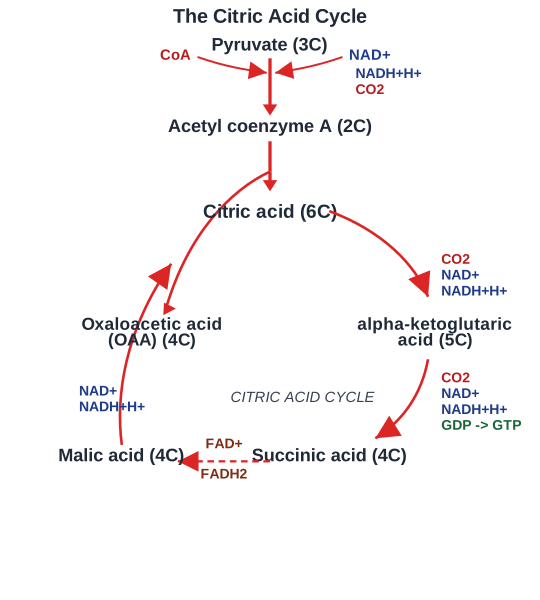
In this simplified TCA-cycle diagram, A (formed from Acetyl CoA + Oxaloacetic acid, releasing CO2/NADH on the way to α-ketoglutaric acid) is Citric acid, and B (formed from α-ketoglutaric acid after CO2 release and GTP formation, interconverting with FADH2/FAD+ on the way to Malic acid) is Succinic acid; the cycle was elucidated by Hans Krebs and occurs in the mitochondrial matrix.
The tricarboxylic acid (TCA) cycle, also called the Krebs cycle or citric acid cycle, begins when pyruvic acid (formed by glycolysis in the cytoplasm) enters the mitochondrion and is oxidatively decarboxylated to a 2-carbon acetyl group, which combines with coenzyme A to form acetyl coenzyme A, releasing CO2 and NADH.
…
- CBSE 2026Set ANNUAL1 markMCQQ.During the conversion of succinyl-CoA to succinic acid(a) NAD+ is regenerated from NADH(b) NAD+ is reduced to NADH + H+(c) a molecule of GTP is synthesized(d) FAD+ is reduced to FADH2
›Reveal solutionSolution
The succinyl-CoA -> succinic acid step of the Krebs cycle is the only step that directly generates a high-energy phosphate bond (GTP), via substrate-level phosphorylation.
In the Krebs (citric acid) cycle, succinyl-CoA is converted to succinic acid (succinate) by the enzyme succinyl-CoA synthetase (succinate thiokinase). This reaction couples cleavage of the high-energy thioester bond in succinyl-CoA to the phosphorylation of GDP to GTP (readily interconvertible with ATP) — a substrate-level phosphorylation, distinct from the oxidative phosphorylation carried out later by the electron transport chain. This is the only ATP/GTP-yielding step generated directly within one turn of the Krebs cycle itself.
…
- CBSE 2026Set ANNUAL1 markMCQQ.How many ATPs are produced in Krebs cycle?(a) 8 ATP(b) 16 ATP(c) 24 ATP(d) 38 ATP
›Reveal solutionSolution
One glucose molecule yields two turns of the Krebs cycle, together producing 24 ATP by the standard textbook tally.
Each turn of the Krebs cycle (per acetyl-CoA entering) produces, directly and indirectly: 1 ATP/GTP (substrate-level phosphorylation at the succinyl-CoA step), 3 NADH, and 1 FADH2. Using the conventional respiratory energy accounting (1 NADH = 3 ATP, 1 FADH2 = 2 ATP via the electron transport chain), one turn yields 1 + (3×3) + (1×2) = 1 + 9 + 2 = 12 ATP. Since glycolysis of one glucose molecule produces two pyruvate molecules, each converted to acetyl-CoA and each entering the Krebs cycle separately, the cycle effectively runs TWICE per glucose, giving a total of 2 × 12 = 24 ATP from the Krebs cycle stage for one glucose molecule.
…
- CBSE 2025Set zoology-hz21 markQ.Expand the term 'CAC'.
›Reveal solutionSolution
CAC = Citric Acid Cycle, also known as the Krebs cycle or TCA (Tricarboxylic Acid) cycle — the second major stage of aerobic cellular respiration.
After glycolysis produces pyruvate in the cytoplasm, pyruvate enters the mitochondrion and is converted to Acetyl-CoA. This Acetyl-CoA then enters the Citric Acid Cycle in the mitochondrial matrix, where it combines with oxaloacetate (OAA) to form citrate (citric acid) — hence the name. Through a series of enzyme-catalysed steps, the cycle:
- Completely oxidises the two carbons brought in by Acetyl-CoA, releasing 2 molecules of CO2 per turn.
- Generates reduced coenzymes NADH and FADH2, which carry electrons to the electron transport chain. …
- CBSE 2024Set ANNUAL1 markMCQQ.In citric acid cycle, which of the following step is not catalysed by dehydrogenase enzyme ?(a) Oxaloacetic acid to citric acid(b) Citric acid to α-ketoglutaric acid(c) Succinic acid to fumaric acid(d) Malic acid to oxaloacetic acid
›Reveal solutionSolution
Citrate synthase (a condensing enzyme), not a dehydrogenase, catalyses the oxaloacetate-to-citrate step of the citric acid cycle.
Going through the options:
- (a) Oxaloacetic acid + Acetyl-CoA → Citric acid: catalysed by citrate synthase, a condensation reaction, not a dehydrogenation.
- (b) Citric acid → α-ketoglutaric acid (via isocitrate): the isocitrate-to-α-ketoglutarate step is catalysed by isocitrate dehydrogenase, releasing CO₂ and NADH. …
- CBSE 2023Set ANNUAL1 markMCQQ.Which of the following reaction is not involved in Kreb's cycle ?(a) Splitting of Fructose 1, 6 bisphosphate into two molecules of 3C compounds(b) Dephosphorylation from the substrates(c) Shifting of phosphate from 3C to 2C(d) All of the above
›Reveal solutionSolution
Splitting of fructose 1,6-bisphosphate into two 3-carbon sugars is a glycolysis step, not a Krebs cycle reaction, so it is the odd one out.
The Krebs cycle takes place in the mitochondrial matrix and processes the 2-carbon acetyl group (from acetyl-CoA) through a series of oxidative decarboxylations and phosphate transfers. Its reactions include:
- Dephosphorylation from substrates such as succinyl-CoA (substrate-level phosphorylation, forming GTP/ATP) - this IS a Krebs cycle step.
- Shifting of phosphate from a 3-carbon compound to a 2-carbon compound during substrate-level phosphorylation in the cycle - this IS a Krebs cycle step. …
- CBSE 2023Set ANNUAL1 markMCQQ.End product of Kreb's cycle is :(a) ATP(b) CO2(c) CO2 + H2O(d) pyruvate
›Reveal solutionSolution
Krebs cycle releases CO2.
In the Krebs cycle, acetyl-CoA is oxidised and its carbon is released as CO2 (two molecules per turn), along with NADH, FADH2 and ATP/GTP. Water is formed later in the electron transport chain, and pyruvate is the input from glycolysis. So CO2 is the end p …
- CBSE 2020Set ANN1 markQ.Fill in the blank. The number of carbon atoms in acetyl co-enzyme A, which take part in Kreb's cycle is ________.
›Reveal solutionSolution
Acetyl coenzyme A (acetyl-CoA) that enters the Krebs cycle contains 2 carbon atoms (the acetyl group, CH3-CO-).
During aerobic respiration, pyruvic acid (a 3-carbon molecule produced by glycolysis) is oxidised inside the mitochondrial matrix. In this step, one carbon is removed as CO2 (oxidative decarboxylation), and the remaining 2-carbon acetyl group combines with coenzyme A to form acetyl-CoA.
…
- CBSE 2020Set ANNUAL1 markMCQQ.Kreb's cycle is also known as :(a) TCA cycle(b) BCA cycle(c) ABA cycle(d) PGA cycle
›Reveal solutionSolution
Krebs cycle = TCA (Tricarboxylic Acid) cycle, named for citric acid, the three-carboxyl-group compound formed when acetyl-CoA condenses with oxaloacetic acid at the start of the cycle.
The cycle, discovered by Hans Krebs, takes place in the mitochondrial matrix. It begins when the 2-carbon acetyl group (from pyruvate oxidation) combines with 4-carbon oxaloacetic acid to form 6-carbon citric acid -- a tricarboxylic acid -- which then undergoes a series of oxidative decarbo …
- CBSE 2019Set ANNUAL1 markQ.Fill in the blank: Kreb's cycle is completed in ______.
›Reveal solutionSolution
The Krebs cycle runs in the mitochondrial matrix, following glycolysis (which occurs in the cytoplasm) and preceding the electron transport chain (on the inner mitochondrial membrane).
Aerobic cellular respiration proceeds through glycolysis in the cytoplasm, producing pyruvate, which is then transported into the mitochondrion. Inside the mitochondrion, pyruvate is oxidatively decarboxylated to acetyl-CoA, which enters the Krebs cycle (also called the citric acid cycle or TCA cycle). This entire cycle of reactions takes place in the mitochondrial matrix, the fluid-filled interior space of the mitochondrion enclosed by the …
🎓Unlock everything free for 14 days
- ✓Full step-by-step solutions
- ✓Concept-first explanations
- ✓Methods, shortcuts & mistakes
- ✓PYQ mapping + timed mock tests
Full access for 14 days. No credit card required.