Question of 52
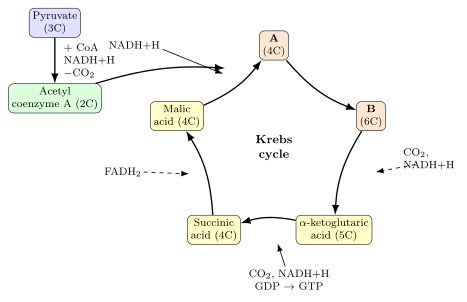
Q.Observe the figure given below and answer the following questions.
(i) Write the name of this cycle.
(ii) Identify A & B in the cycle.
Kerala DhseKerala DHSE Plus One Board 2023Subjective· 3mImportance★★★★★
0% · 0/52 Questions
You're viewing a preview — the full solution, concept, methods & PYQ mapping are locked.
Start your 14-day free trial to unlock the full solution →The cyclic pathway shown, which begins with Acetyl CoA combining with a 4-carbon acceptor and proceeds through 6-carbon and 5-carbon intermediates back to a 4-carbon acid, is the Krebs cycle (citric acid/TCA cycle). A = Oxaloacetic acid, the entry-point acceptor; B = Citric acid, formed immediately after Acetyl CoA joins.
- Name of the cycle: This is the Krebs cycle (also called the Citric Acid Cycle or Tricarboxylic Acid/TCA cycle), the second major stage of aerobic respiration, occurring in the mitochondrial matrix.
- Identifying A and B: The cycle begins when pyruvate (3C), produced by glycolysis, is oxidatively decarboxylated (releasing CO2 and NADH+H+, using NAD+ and CoA) to form Acetyl CoA (2C). Acetyl CoA then condenses with the 4-carbon acceptor already circulating in the cycle:
- A (4C) = Oxaloacetic acid (OAA). This is the compound that accepts the incoming Acetyl CoA. When Acetyl CoA (2C) combines with Oxaloacetic acid (4C), it forms a 6-carbon compound.
- B (6C) = Citric acid. This 6-carbon compound formed right after Acetyl CoA joins OAA is citric acid, which gives the cycle its name. …
Unlock everything free for 14 days
- Full step-by-step solutions
- Concept-first explanations
- Methods, shortcuts & mistakes
- PYQ mapping + timed mock tests
Full access for 14 days. No credit card required.