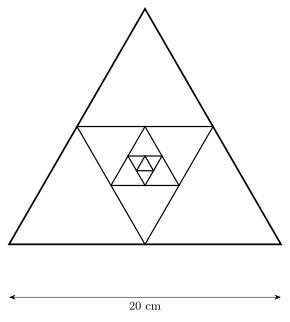
Q.A side of an equilateral triangle is 20 cm long. A second equilateral triangle is inscribed in it by joining the mid points of the sides of the first triangle. The process is continued as shown in the accompanying diagram. Find the perimeter of the sixth inscribed equilateral triangle.
Geometric Progression: The Idea of Repeated Multiplication
Imagine you're folding a piece of paper in half. Start with thickness 1 unit. After one fold, thickness becomes 2. After two folds, thickness becomes 4. After three folds, thickness becomes 8. The sequence of thicknesses is:
1, 2, 4, 8, 16, ...
Notice the pattern: each term is obtained by multiplying the previous term by the same number (here, 2). That's the core intuition behind a geometric progression — you keep multiplying by a fixed number, step after step.
This is different from an arithmetic progression, where you keep adding a fixed number. Here, the growth is multiplicative, not additive. That's why geometric progressions grow (or shrink) much faster.
Precise Definition
A Geometric Progression (GP) is a sequence of numbers where the ratio of any term to its preceding term is constant. This constant is called the common ratio, denoted by r.
If the first term is a, then the sequence looks like:
a,ar,ar2,ar3,ar4,…
Note
The common ratio r can be any real number — positive, negative, or even a fraction. If r is negative, the terms alternate in sign. If 0<r<1, the terms get smaller and smaller.
The n-th Term
To find any term directly without listing all previous ones, use the formula:
Tn=a⋅rn−1
where Tn is the n-th term, a is the first term, r is the common ratio, and n is the term number (starting from 1).
Example: For the paper-folding sequence, a=1, r=2. The 5th term is 1⋅25−1=24=16, which matches our list.
Sum of n Terms
There are two cases, depending on whether r=1 or not.
Sum of first n terms of a GP:
Sn=⎩⎨⎧a⋅r−1rn−1,n⋅a,r=1r=1
When r=1, every term is just a, so the sum is simply n×a.
Why the formula works (intuition):
Let S=a+ar+ar2+⋯+arn−1. Multiply both sides by r: rS=ar+ar2+⋯+arn. Subtract the first from the second: rS−S=arn−a, so S(r−1)=a(rn−1), giving the formula above.
Sum of an Infinite GP
If the common ratio r lies strictly between −1 and 1 (i.e., ∣r∣<1), the terms get smaller and smaller, and the sum of all terms approaches a finite value:
S∞=1−ra,for ∣r∣<1
Watch out
If ∣r∣≥1, the infinite sum does not exist (it diverges to infinity or oscillates without settling). Never apply the infinite sum formula when ∣r∣≥1.
Example:1+21+41+81+… has a=1, r=21, so S∞=1−1/21=2. This matches the intuition that repeatedly halving a unit length eventually fills exactly 2 units.
Concept: Similar triangles form a geometric progression.
Joining the midpoints of an equilateral triangle gives a new equilateral triangle with side exactly half the original (midpoint theorem). Starting from s1=20 cm, the side of the nth triangle overall is
sn=20⋅(21)n−1
The original triangle is not itself "inscribed," so the 6th inscribed triangle is the 7th triangle overall (n=7): …
Each inscribed triangle has a side exactly half its predecessor's; the sixth inscribed triangle has perimeter 1615 cm.
Why this works: the geometry of midpoint triangles
Joining the midpoints of an equilateral triangle's three sides creates a new, smaller equilateral triangle inside it. By the midpoint theorem, the segment joining the midpoints of two sides is parallel to the third side and exactly half its length. So every time we repeat this construction, the new triangle's side is half the previous triangle's side — this is a geometric progression with common ratio 21.
Step-by-step
Original triangle (given): side s1=20 cm.
1st inscribed triangle: side s2=2s1=10 cm.
2nd inscribed triangle: side s3=2s2=5 cm.
3rd inscribed triangle: side s4=2s3=2.5 cm.
4th inscribed triangle: side s5=2s4=1.25 cm.
5th inscribed triangle: side s6=2s5=0.625 cm.
6th inscribed triangle: side s7=2s6=0.3125=165 cm.
In general, the side of the nth triangle overall (counting the original as n=1) is
Same / Similar Concept — real previous-year questions on the same or a closely similar concept, not this exact question.
Showing the 12 most recent of 43 on this concept.
KEAM 2026Set eng-2026-04174 marksMCQ
Q.The sum of the first two terms of a geometric series is 12 and the third term is 16. Then the common ratio r>0 of the geometric progression is
(A) 21
(B) 32
(C) 2
(D) 3
(E) 23
›Reveal solutionSolution
From a+ar=12 and ar2=16 derive 3r2−4r−4=0; the positive root is r=2.
Q.The sum of four consecutive terms in a geometric progression is 960. If the fourth term is 8 times as large as the first term, then the smallest number in the geometric progression is
(A) 40
(B) 64
(C) 128
(D) 160
(E) 240
›Reveal solutionSolution
The ratio is r=2 (since term 4 =8× term 1), and 15a=960 gives smallest term a=64.
Let the four consecutive terms be a,ar,ar2,ar3. The condition ar3=8a gives r3=8, so r=2.
Q.If k, 6 and k+5 are the first three terms of a geometric series, then the possible values of the common ratio are
(A) 21,2
(B) 2,−2
(C) 31,3
(D) 23,3−2
(E) 32,2−3
›Reveal solutionSolution
Solve k2+5k−36=0 (k=4,−9), then r=6/k=23 or −32.
For a GP, the middle term squared equals the product of neighbours:
Q.Let t1,t2,t3,…,t2n−2,t2n−1,t2n be in G.P. with common ratio r. Then
(A) t1,t3,t5,…,t2n−5,t2n−3,t2n−1 are in G.P. with common ratio r
(B) t1,t4,t7,…,t2n−7,t2n−4,t2n−1 are in G.P. with common ratio r2
(C) t1,t3,t5,…,t2n−5,t2n−3,t2n−1 are in G.P. with common ratio r2
(D) t2,t4,t6,…,t2n−4,t2n−2,t2n are in G.P. with common ratio r3
(E) t2,t4,t6,…,t2n−4,t2n−2,t2n are in G.P. with common ratio r5
›Reveal solutionSolution
Every-other term of a GP forms a GP with ratio r2.
In a GP tk=t1rk−1. The odd-indexed subsequence t1,t3,t5,… has
Q.The sum of the first n terms in a G.P. is sn=100−1001−n. The common ratio r is
(A) 1003
(B) 5001
(C) 201
(D) 501
(E) 1001
›Reveal solutionSolution
A G.P. sum has the form Sn=1−ra(1−rn)=1−ra−1−rarn. Writing the given Sn=100−1001−n=100−100⋅(1/100)n shows the geometric factor is rn=(1/100)n, so r=1/100.