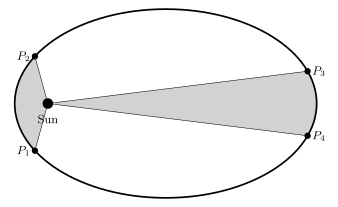
Q.(a) Consider a planet moving in an elliptical orbit around the sun as shown in fig. If t1 and t2 be the time taken by the planet to go from P1 to P2 and from P3 to P4 respectively. The two shaded parts have equal area, then
You're viewing a preview — the full solution, concept, methods & PYQ mapping are locked.
Start your 14-day free trial to unlock the full solution →Since the two shaded areas swept out by the planet's radius vector are equal, Kepler's law of areas tells us the corresponding time intervals must also be equal, i.e., t1 = t2.
(a) Kepler's second law (the law of areas) states that the radius vector from the Sun to a planet sweeps out equal areas in equal intervals of time — this is a consequence of the conservation of angular momentum of the planet about the Sun (since the gravitational force on the planet is always directed along the radius vector towards the Sun, it exerts no torque about the Sun, so the planet's angular momentum about the Sun stays constant).
In the given figure, the area swept while going from P1 to P2 (in time t1) equals the area swept while going from P3 to P4 (in time t2). Since areal velocity (area swept per unit time) is constant for a given orbit,
Area(P1→P2)/t1 = Area(P3→P4)/t2
…
Unlock everything free for 14 days
- Full step-by-step solutions
- Concept-first explanations
- Methods, shortcuts & mistakes
- PYQ mapping + timed mock tests
Full access for 14 days. No credit card required.