Q.State Pascal's law. Explain the working of a hydraulic lift by drawing figure.
You're viewing a preview — the full solution, concept, methods & PYQ mapping are locked.
Start your 14-day free trial to unlock the full solution →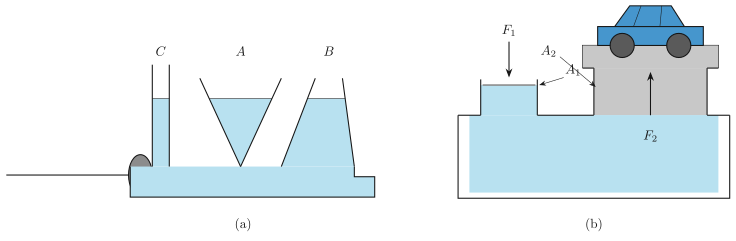
State Pascal's law, then apply it to a hydraulic lift: a small force F1 on a narrow piston (area A1) creates pressure P = F1/A1, which is transmitted undiminished to a wide piston (area A2), producing a much larger output force F2 = P·A2 = F1(A2/A1).
Pascal's Law
"Whenever pressure is applied at any point of a fluid enclosed in a container, it is transmitted undiminished and equally in all directions throughout the fluid, and acts perpendicular (normal) to the walls of the container at every point."
Working of a hydraulic lift
[Figure: Two vertical cylinders of very different cross-sectional areas, connected at their base by a tube, all filled with an incompressible liquid (e.g. oil). The narrow cylinder has a small piston of area A1, on which a small force F1 is applied. The wide cylinder has a large piston of area A2, on which a heavy load (e.g. a car) rests and which rises when F1 is applied.]
A hydraulic lift consists of two vertical cylinders of different cross-sectional areas — a narrow cylinder with piston area A1 and a wide cylinder with piston area A2 — connected at the bottom and filled with an incompressible liquid. Both pistons touch the liquid and are free to move.
When a small downward force F1 is applied on the narrow piston, it creates a pressure in the liquid at that point:
P = F1/A1
…
Unlock everything free for 14 days
- Full step-by-step solutions
- Concept-first explanations
- Methods, shortcuts & mistakes
- PYQ mapping + timed mock tests
Full access for 14 days. No credit card required.