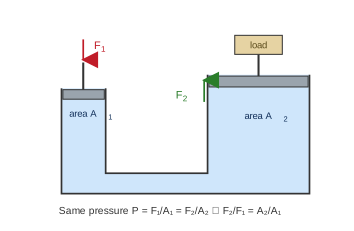
Pascal's Principle: The Intuition
Imagine you have a sealed plastic bottle completely filled with water, with no air inside. If you squeeze the bottle at one spot, what happens? The water doesn't just compress at that spot — the entire bottle bulges outward everywhere. The pressure you applied at one point travels instantly through the entire liquid.
That's the core idea: in a confined fluid, pressure applied anywhere is transmitted undiminished to every part of the fluid and to the walls of the container.
Now, why does this happen? Fluids (liquids and gases) are made of particles that can slide past each other. When you push on one part of a confined fluid, those particles bump into their neighbours, which bump into their neighbours, and so on — like a chain of dominoes. Because the fluid is nearly incompressible (especially liquids), the push doesn't get absorbed by squishing the fluid itself. It gets passed along perfectly.
This principle works only for confined fluids — fluids trapped inside a container with no way to escape. An open bucket of water doesn't behave this way because the water can just spill out.
The Precise Statement
Pascal's Principle (Pascal's Law):
Papplied=AF
A change in pressure applied to an enclosed incompressible fluid is transmitted undiminished to every portion of the fluid and to the walls of its container.
In simpler words: if you increase the pressure at one point by ΔP, every other point in the fluid experiences exactly the same increase ΔP.
The Key Equation
The pressure P is defined as force per unit area:
So if you apply a force F1 over a small area A1, you create a pressure P=F1/A1. That same pressure pushes on a larger area A2 elsewhere, producing a larger force:
F2=P×A2=A1F1×A2
This is the force multiplication that makes hydraulic systems work.
Think of it like this: pressure is the "currency" that gets transferred. Force is what you get when you "cash in" that pressure over a bigger area.
The Classic Example: Hydraulic Lift
A car repair shop uses a hydraulic jack. Here's how it works:
- You push down on a small piston (area A1=10 cm2) with a force of 100 N.
- This creates a pressure P=100 N/0.001 m2=100,000 Pa.
- That same pressure pushes up on a large piston (area A2=1000 cm2=0.1 m2).
- The upward force is F2=P×A2=100,000×0.1=10,000 N.
You applied 100 N and got 10,000 N — a 100× force multiplication. But notice: the small piston moves down 100 cm while the large piston moves up only 1 cm. Work done (F×d) is the same on both sides — you don't get energy for free.
Pascal's Principle does not violate energy conservation. Force is multiplied, but distance is divided by the same factor. The product F×d (work) remains equal.
Where It Applies (and Where It Doesn't)
| Applies | Does Not Apply |
|---|
| Hydraulic brakes in cars | Open containers (water in a glass) |
| Hydraulic jacks and lifts | Gases that are not confined |
| Dental chairs | Fluids under very high compression (rare) |