Q.Schematic diagram of a heat engine is shown below. a) Modify the given diagram for a refrigerator.
You're viewing a preview — the full solution, concept, methods & PYQ mapping are locked.
Start your 14-day free trial to unlock the full solution →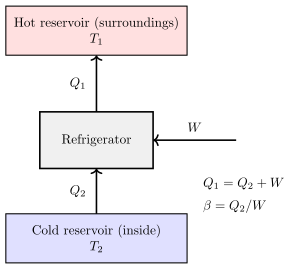
A refrigerator is a heat engine run in reverse (work is put IN to pump heat from cold to hot); for the ideal (Carnot) case here, Q2/Q1 = T2/T1, which gives Q2 directly from the given data.
a) Modifying the heat engine diagram for a refrigerator:
A refrigerator works exactly opposite to a heat engine — external work is done ON the system (rather than extracted from it) to force heat to flow from a cold body to a hot body (which does not happen spontaneously). To modify the given heat-engine diagram:
- Reverse the direction of the Q2 arrow: heat Q2 is now ABSORBED FROM the Cold Reservoir (T2) INTO the central engine/refrigerator (previously it flowed OUT to the cold reservoir).
- Reverse the direction of the W arrow: work W is now done ON the system (input, arrow pointing INTO the central oval), supplied by an external agent (the compressor motor) — previously W was extracted as useful output.
- Reverse the direction of the Q1 arrow: heat Q1 = W + Q2 is now REJECTED FROM the central engine TO the Hot Reservoir (T1) (previously it flowed IN from the hot reservoir).
So all three arrows in the original heat-engine diagram are reversed for a refrigerator: Q2 flows in from the cold side, W flows in from outside, and Q1 flows out to the hot side.
b) Coefficient of performance (COP) of a refrigerator:
…
Unlock everything free for 14 days
- Full step-by-step solutions
- Concept-first explanations
- Methods, shortcuts & mistakes
- PYQ mapping + timed mock tests
Full access for 14 days. No credit card required.