Q.The fundamental mode of vibration of a stretched string is shown below.
You're viewing a preview — the full solution, concept, methods & PYQ mapping are locked.
Start your 14-day free trial to unlock the full solution →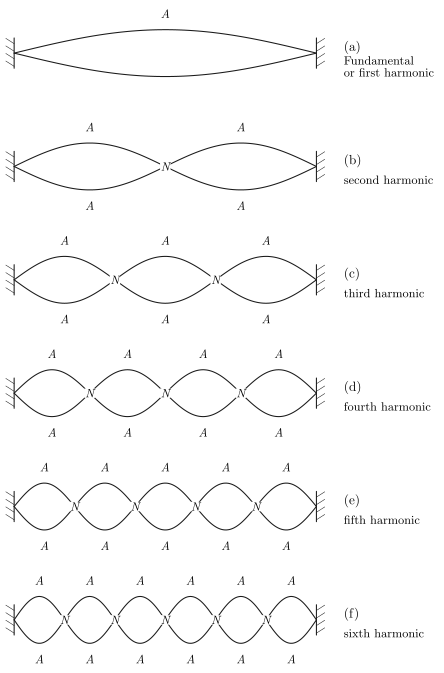
A string fixed at both ends can only support standing waves with nodes at the two fixed ends, which forces the wavelengths (and hence frequencies) into the ratio — this is why plucking a string produces a fundamental plus a full harmonic series. Using with the given numbers, the tension works out to about 248.1 N.
Setup — the fundamental mode shown in the figure
This is the first harmonic (fundamental): one loop, node–antinode–node, wavelength .
a) The second and third harmonics
A drawn diagram cannot be rendered in this text answer, but the exact shape each one takes is fully specified below (this is the standard way these are drawn in the NCERT figure, and is sufficient to reproduce them by hand):
- Second harmonic (): the string vibrates in two equal loops of opposite phase, side by side. There are nodes at both fixed ends and one additional node exactly at the midpoint of the string; antinodes sit at the centre of each loop (at and from one end). Wavelength (one full wavelength fits the string).
- Third harmonic (): the string vibrates in three equal loops. There are nodes at the two fixed ends plus two additional internal nodes (at and from one end), with antinodes at the centre of each of the three loops. Wavelength .
In general, the th harmonic has loops, nodes total (including the two ends), and antinodes.
b) Proof that the frequencies are in the ratio 1 : 2 : 3
A string of length fixed rigidly at both ends must have a node at each end — the string cannot move at a rigid support. A standing wave pattern with loops fits exactly half-wavelengths into the length :
The speed of a transverse wave on the string is set purely by the string's own physical properties — the tension and the mass per unit length (linear density) — and does not depend on which mode is excited:
Since for every mode, and is the same constant for all of them: …
Unlock everything free for 14 days
- Full step-by-step solutions
- Concept-first explanations
- Methods, shortcuts & mistakes
- PYQ mapping + timed mock tests
Full access for 14 days. No credit card required.